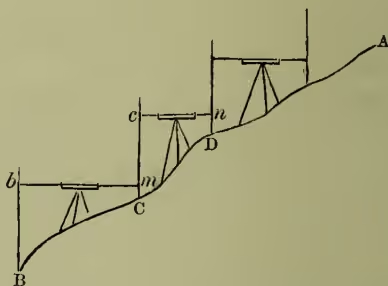
Levelling. Level is a term applied to surfaces that are parallel to that of still water, or perpendicular to the direction of the plumb-line; it is also applied to the instrument employed in determining the amount of variation from perfect levelness. The instrument is a cylindrical glass tube very slightly convex on one side, and so nearly filled with water, or, what is better, with alcohol, that only a small bubble of air remains inside. The level is then mounted on a three or four legged stand, with its convex side upwards, and by means of a pivot and elevating screws is made capable of assuming any required position. If the level be properly constructed the bubble should lie exactly in the middle of the tube when the instrument is properly adjusted, and at the same time the line of sight of the telescope attached to the level should be accurately parallel to the surface of still water. In ordinary levels this first condition is seldom seen, and, instead, two notches are made on the glass to mark the position of the two extremities of the bubble when the instrument is level. The tube and bubble should be of considerable length to ensure accuracy. The leveller requires two assistants, each furnished with a pole from 10 to 14 feet high, and graduated to feet and inches, or feet and tenths of feet. If he wishes to measure the height of A above B, he may do this by beginning either at A or B. Let the latter be the case: then one assistant is placed at B, holding his pole upright; the other is sent forward to C (which must be below the level of the top of the pole at B); the surveyor, who places himself between them, reads off the height Bb, which he puts down in the back-sight column of his book, and then turns the level to C, reading off Cm, which is entered in the front-sight column. The surveyor and his assistant at B then take up new positions, the latter at D; the back-sight Cc and the front-sight Dn are read off, and the process is repeated till one of the assistants reaches A. The excess of the sum of the back-sights over that of the front-sights gives the height of A above B. A little consideration shows that this method only holds true when practised on a small scale, and consequently in extensive surveys the level (as found by the above method) must be reduced by an allowance for the earth's curvature. See works by F. W. Simms (1884) and T. Holloway (1887).