Lightning (Fr. éclair, Ger. Blitz), the name given to the visible discharge of electricity between one group of clouds and another, or between the clouds and the ground. Thunder-clouds, well known by their dark and heavy look, belong usually to the cumulus type (see CLOUDS), and are found at all heights from close to or almost touching the ground up to about 6000 feet. But most of the summer thunder-clouds in Great Britain float at an altitude of from 1000 to 3000 feet. On elevated mountain-tops, 12,000 feet high or more, lightning and hail showers accompany the passage of cirrus clouds over them. Lightning occurs in three distinct forms, commonly called forked-lightning, sheet-lightning, and ball-lightning, the last class serving also as a convenient term for unexplained phenomena.
Forked-lightning appears as long flashes passing from cloud to cloud or between clouds and the ground. It gets its name from the apparently sharp bends it makes, but most photographs of lightning show it in a wavy or ribbon-like form. Occasionally it splits into several branches at one or both ends.
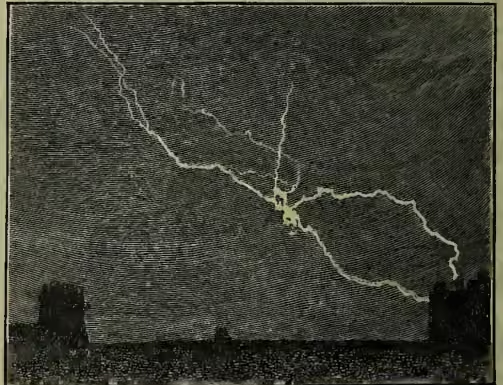
These flashes frequently pass between clouds several miles apart, lengths of 6, 8, and even 10 miles having been observed. The thunder which accompanies this form of lightning is due to the intense and sudden heat developed in the path of the discharge expanding the air with explosive rapidity. As sound travels slowly compared with electricity and light, the noise from different parts of the flash reaches the ear in succession, and aided by echoes from the clouds, produces the prolonged rolling of the thunder-peal. The distance away of the flash can be estimated by the time between the flash and the beginning of the thunder, every 5 seconds being equivalent to 1 mile; 50 seconds or 10 miles is the greatest observed interval at which thunder has been heard.
Sheet-lightning, sometimes called summer-lightning, is a frequent accompaniment of warm weather in temperate climates and an almost daily phenomenon in most tropical regions. It appears as a diffuse glare lighting up a whole cloud, is often of a reddish colour, and is believed to be due to discharges of feeble intensity than those causing forked-lightning. It may occasionally be merely the reflection on the cloud of a distant thunderstorm invisible to the spectator.
Ball-lightning is an as yet unexplained phenomenon; forked and sheet lightning are the gigantic analogues of the spark and glow from an electric machine, but nothing resembling the slow-moving, luminous globe described by those who have seen ball-lightning has ever been produced artificially. The ball has been estimated at from a few inches to over a yard in diameter; and, while not affecting anything that it does not directly touch, acts like an explosive shell on any solid body in its track, throwing down walls, making holes several feet deep in the ground, or ploughing long trenches; sometimes disappearing with a loud report, at others gradually getting smaller till it vanishes. This destructive and dangerous form of lightning is happily very rare. Allied to lightning is St Elmo's Fire (q.v.). See Arthur Parnell, The Action of Lightning (1882).
Death by Lightning is always instantaneous, and is probably always caused by the shock to the brain and nervous system. The post-mortem appearances are extremely variable. Sometimes no marks of injury are found; but more often lacerations, bruises, burns, and occasionally even fractures of bones are present. The clothes may be burnt or torn, even when the surface of the body is not injured; metallic substances on the person may be fused, and steel magnetised. When the accident is not immediately fatal, the consequences are still more variable: insensibility, paralysis, burns, wounds, loss of hair, eruptions on the skin, hemorrhages, loss of speech or of one or more of the special senses, may all occur. The treatment must be directed to the special symptoms, which are liable to great variations. Sir B. Brodie's advice is as follows: 'Expose the body to a moderate warmth, so as to prevent the loss of animal heat, to which it is always liable when the functions of the brain are suspended or impaired, and inflate the lungs, so as to imitate natural respiration as nearly as possible.' These means should be fully tried, as respiratory action has been restored after more than an hour's suspension.
LIGHTNING-CONDUCTOR (Fr. paratonnerre, Ger. Blitzableiter). The object of a lightning-conductor is twofold: first, and most important, to drain away the electricity from passing clouds and thus prevent the occurrence of lightning in its neighbourhood; and secondly, when unable to do this, to receive and convey to earth the lightning-flash without damage to the building to which it is attached. The first object is best secured by the lightning-conductor being a sharp-pointed metallic rod standing clear above all surrounding buildings, trees, &c.; while the second necessitates its having considerable diameter to carry the short-lived but intense current produced by the flash: both require that it should be in thorough metallic connection with the earth. The action of the lightning-conductor may be illustrated by an electric machine. When the machine is in action the prime conductor, which corresponds to the thunder-cloud, discharges a rapid succession of flashes or sparks; but if a pointed metallic rod is held near it all sparking ceases, the electricity is drawn off silently as fast as it is generated by the machine, while if a ball or blunt rod is placed near the conductor in thorough connection with the ground the sparks will pass to it as the easiest passage to earth. Good copper is almost six times better a conductor of electricity than iron, and therefore lightning-conductors are usually made of copper; but they may be equally well constructed of iron if made times the diameter, so as to equalise their conducting power. For ordinary buildings the diameter of the rod should be at least inch for copper or inch for iron; lighthouses and similar exposed buildings are usually fitted with copper conductors 1 inch in diameter. Instead of a solid rod, wire-robe of equivalent size is frequently used for convenience of adjustment to the buildings. The top of the conductor, always a solid rod, ends in a blunt point surrounded a few inches down by three or four sharp points projecting obliquely upwards, but not rising as high as the top; these points ought to be platined or gilded to prevent oxidation. The rod must project higher than any other part of the building. It has been found that, roughly speaking, a lightning-conductor protects from direct flashes a conical space equal to its height with a radius at the base of double its height. Thus, a rod standing 6 feet above the gable end of an ordinary house will protect the roof ridge for 12 feet along, but if the house is more than 12 feet broad will not protect the other gable. All large masses of metal in a building, more especially the roof-gutters, should be connected with the lightning-conductor, as they may otherwise form a broken connection to earth and conduct the lightning with dangerous sparking at the breaks. Sharp bends must be avoided in the conductor, and any joins in it should be braced, or embedded in a large mass of solder, so as to avoid any risk of heating at the junction by imperfect contact. Perhaps the most important part of the lightning-conductor, and certainly the part in which it is most difficult to ensure satisfactory arrangement and workmanship, is the connection to earth. Dry earth is practically a non-conductor of electricity; damp earth is a moderately good conductor, and, being of infinite area compared with any lightning-conductor, can safely receive any discharge. The problem therefore is to make a satisfactory junction with a sufficiently large area of damp soil. This is usually done by attaching to the lower end of the lightning-conductor a brass plate about a yard square, and burying it in a damp spot surrounded by gas-coke. Sometimes the lightning-conductor is connected to an iron water or drain pipe, but not a gas-pipe, as the risk of setting fire to the gas from a spark at a break must not be incurred. A faulty earth connection makes a lightning-conductor worse than useless. Every large building requires more than one conductor, and perfect safety can only be ensured by a town or district having a sufficient number of conductors to drain passing thunder-clouds of their electricity and prevent flashes from ever occurring. The first lightning-conductor was erected by Benjamin Franklin on his own house in Philadelphia in 1752. See Edinburgh Review for July 1884; and O. J. Lodge, Lightning Conductors (1892).
LIGHTNING-PRINTS are appearances sometimes found on the skin or clothing of men or animals that either have been struck by lightning or have been in the vicinity of the stroke, and are currently believed to be pictorial representations of surrounding objects or scenery. The existence of such prints appears, from a theoretical point of view, highly improbable, as the essential conditions of forming a photographic image are wanting; still, several apparently well-authenticated instances have been recorded, one or two of which may serve to give a general idea of what are meant by lightning-prints. On the 14th of November 1830 lightning struck the Château of Benattonnière, in La Vendée; at the time a lady happened to be seated on a chair in the salon, and on the back of her dress were printed minutely the ornaments on the back of the chair. In September 1857 a peasant-girl, while herding a cow in the department of Seine-et-Marne, was overtaken by a thunderstorm. She took refuge under a tree; and the tree, the cow, and herself were struck with lightning. The cow was killed, but she recovered, and, on loosening her dress for the sake of respiring freely, she saw a picture of the cow upon her breast. These anecdotes are typical of a great mass of others. They tell of metallic objects printed on the skin, of clothes while being worn receiving impressions of neighbouring objects, or of the skin being pictured with surrounding scenery or objects during thunderstorms. One object very generally spoken of as being printed is a neighbouring tree. This may be accounted for by supposing that the lightning-discharge has taken place on the skin in the form of the electric brush (see ELECTRICITY), which has the strongest possible resemblance to a tree, and that this being imprinted on the skin by a slight charring of the tissues in its track has led observers to confound it with a neighbouring tree. Of other prints it would be difficult to give a satisfactory account, though observers have done something in imitation of them. When a coin is placed on glass and a stream of sparks poured on it from a powerful electrical machine, on the glass being breathed upon after its removal a distinct image of the coin is traced out by the dew of the breath. The parts of the glass surface in contact with the metal having received a different charge from the rest, a selective action by the glass on the dew of the breath takes place; but this is very different from the permanent image of the anecdote. With all due allowance for the possible printing-power of lightning, the accounts given of it in most cases bear the stamp of exaggeration.