Lighthouse, a building erected on some conspicuous part of the coast from which a light is shown at night to guide mariners, and which serves as a landmark by day. Aids to navigation comprise lighthouses, lightships, beacons, buoys, fog-signals, and landmarks. Lighthouses are generally placed on salient points of the coast-line, islands, isolated or sunken rocks, low promontories, and sandbanks, each requiring structures specially designed to meet the exigencies of such varied sites. When placed on headlands or large islands lighthouses are very much alike in general features, the differences being mainly in the height of the towers, depending on the distance at which the light requires to be seen, and the lighting apparatus. Towers erected on isolated wave-swept rocks in the open sea, such as Smeaton's Eddystone (now superseded by Sir James Douglass's tower), Stevenson's Bell Rock, Walker's Bishop and Wolff Rocks, Alan Stevenson's Skerryvore, David Stevenson's North Unst, and Messrs Stevenson's Dhuheartach and Chickens Rock lighthouses, Alexander's Minot's Ledge and Spectacle Reef in America, and Bréhat in France, are triumphs of engineering.
The history of lighthouse construction and illumination may be said to extend over a period of more than two thousand years; but the regularly-organised life-preserving system of modern lighthouse engineering goes back very little further than the beginning of the 19th century. None of the early lighthouse buildings now exist. The Pharos of Alexandria (331 B.C.) gave its name to its successors. The Romans built lighthouses at Ostia, Ravenna, Puteoli, and other ports. The Phœnician Pharos at Coruña was repaired during the reign of the Emperor Trajan, was re-established as a lighthouse about 1634, and in 1847 had a dioptic apparatus placed in it. On the cliff at Boulogne there are the remains of a lighthouse ascribed to Caligula (40 A.D.), and at Dover there are remains of another Roman pharos. Corduan, at the mouth of the Garonne, has seen all the improvements, from the open chauffer, in which billets of wood were burned, to the dioptic light combined with a four-wick lamp. Until the end of the 18th century the lighthouses of Britain and America were few in number, and of an inferior description in the great essential of a lighthouse—viz. sending the greatest number of rays of light towards the horizon. Many of the public lights in England were private property, as was also the case with the Isle of May in Scotland, the patent for which was ratified in 1641. There were only twenty-five lighthouse stations and six floating lights in England at the beginning of the 19th century. In 1786 the Northern Lighthouse Board was constituted by act of parliament, but such was the then state of commerce that the act provided for only four lighthouses; now there are no fewer than sixty-seven lighthouses under the Board's jurisdiction. The Irish Lighthouse Board was constituted about the same period. The coast and harbour lights in Great Britain and Ireland are now upwards of 880 in number. In the United States of America the first act of congress relating to lighthouses was passed in 1789, and there are now in American waters 2375 lights and light-ships and 246 fog-signals.
The early lighthouse towers had on their summits grates or chauffers, in which billets of wood or coal were burned, but though expensive to maintain—some of them using 400 tons of coal yearly—were uncertain in their appearance, varying with the ever-changing character of the atmosphere. Such coal-lights survived in Scotland till 1816, in England till 1822, and on the Baltic till 1846. As an example of a modern lighthouse tower we may take Skerryvore, which is 139 feet in height and 42 feet in diameter at the base, containing a mass of 58,580 cubic feet of granite. The foundations of all the towers exposed to the sea are quarried out of the solid rock, and all the courses are dovetailed or joggled together into each other by various devices, and they are made solid for about 20 or 30 feet above the foundation, where they become divided off into rooms, one above another, access to which is obtained by means of ladders. The difficulties of building are very great, as may be judged from the following facts: Winstanley's Eddystone took four seasons to erect, and was finally swept away, Rudyerd's and also Smeaton's Eddystones took each three years, the Bell Rock took four years, the Skerryvore five, and Dhuheartach three and a half, the great difficulty being to effect a landing of men and materials. At Minot's Ledge, off the Massachusetts coast, General Alexander got only 30 hours of work in the first year and 157 in the second, and the histories of the Bell Rock, Skerryvore, Dhuheartach, Chickens, Eddystone, and some others tell the same tale. The cost of lighthouses may vary much; for instance, the Bell Rock cost £61,000, Skerryvore £86,000, Spectacle Reef, on Lake Huron, £60,000, Bishop £35,000, Dhuheartach £80,000, and North Unst £32,000; and it will be easily seen that an ordinary land station, fully equipped, will cost much less—as a matter of fact, about £5000 to £10,000. Light-vessels cost about £9000.
Oil-lamps were used in lighthouses at the end of the 16th century; but liquid fuel often gave way to candles of tallow or wax. Smeaton's famous Eddystone was lighted with twenty-four candles, five of which weighed 2 lb. The use of lamps led to reflectors. The early ones were about 18 inches in diameter, and made of small squares of mirror glass, set in plaster of Paris, the lamps having torch-like wicks, the fuel ordinary whale-oil. These lamps did not give good results, and the flat wick, though an improvement, was still unsatisfactory. It was reserved for Argand (q.v.) to devise the cylindrical wick-burner. The height of the flame in the argand lamp varied with the level of the oil in the fountain, and Carcel devised the arrangements for supplying a superabundance of oil to keep the burner cool. Argand's invention is said to have been also discovered by Teulère, who combined his lamp with the use of reflectors.
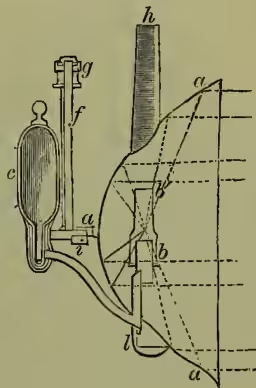
By placing a parabolic mirror behind a flame (fig. 1) all the rays of light proceeding from the focus and falling upon its surface are reflected parallel to the axis, and emerge in a beam of light. Such reflectors are generally 21 inches in diameter for fixed and 25 inches for revolving lights, their power being equal to 350 to 450 times the unassisted flame. By arranging a number of reflectors on a frame there can be sent, all round the horizon, a number of beams of light of practically equal intensity, thus producing a fixed light; and by assembling them on a frame having three or more faces, and making this frame revolve, a revolving light results, the rotation of the frame thus producing a succession of light and dark intervals. These reflectors are used in some of the most characteristic lighthouses in Britain. By arranging reflectors in a certain manner on a frame, and causing it to revolve, a group-flashing light can be produced—i.e. one giving two or three flashes in quick succession, followed by a long interval of darkness.
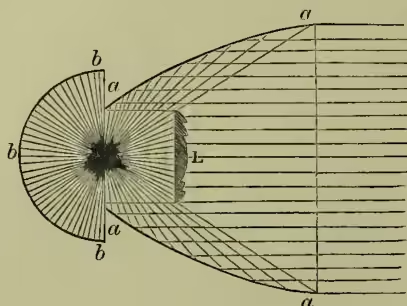
The ordinary parabolic reflector allows about one-third of the rays to escape past the lips by natural divergence. To prevent this waste Mr Thomas Stevenson, in 1849, devised the holophotal reflector (fig. 2), which consists of a lens, , with a parabolic mirror, , and a hemispherical mirror, , which returns all the rays falling upon it back to the flame.
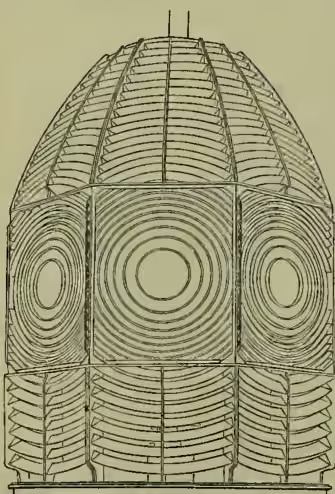
To Augustin Fresnel (q.v.) belongs the honour of inventing and first employing, in 1822, the dioptric system for lighthouse purposes in combination with a central lamp having four concentric wicks. He was apparently ignorant of what had been done by Buffon and Condorcet in proposing, for burning purposes, to build up lenses in separate pieces with the view of reducing the thickness of glass and correcting to a large extent spherical aberration. So he devised the lighthouse lens, which is plano-convex, 3 feet 3 inches in height by 2 feet 6 inches in breadth, composed of a central disc, surrounded by annular rings gradually decreasing in breadth as they recede from the centre. If these lenses be assembled on a frame with eight or more sides, having a lamp in their common focus, and be made to revolve, a dioptric revolving light is produced. The lens implied a central lamp and a flame of great intensity, which this defect. When designing the revolving apparatus for Skerryvore, Mr Alan Stevenson substituted prisms for the mirrors below the lenses, and also introduced totally reflecting prisms for first order lights, and, in 1849, Mr
Fresnel and Arago devised, and in which they adhered to Argand's principle of the double air-current; and they also took advantage of Rumford's idea of a lamp with concentric wicks. The lenses, however, not intercepting the rays of light proceeding from the flame above and below them, Fresnel designed an arrangement of inclined lenses, and mirrors above the lenses, and silvered mirrors below them, which, to some extent, obviates
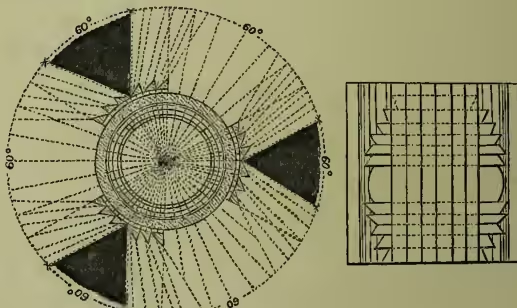
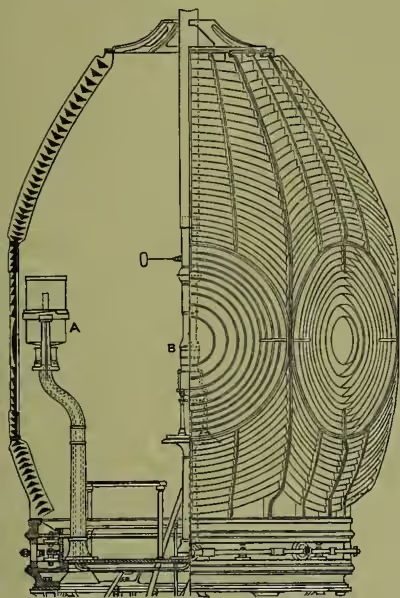
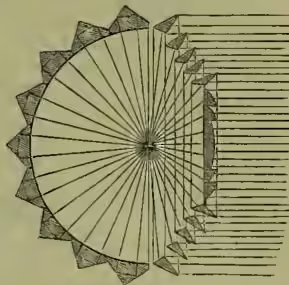
T. Stevenson dispensed with the double agents above and below the lens, and substituted holophotal prisms which parallelise the rays in every plane (fig. 3). The holophotal apparatus is now universally adopted for revolving lights. Fresnel devised the fixed light varied by flashes by placing straight refracting prisms on a revolving frame outside a fixed apparatus. An extension of this is the condensing revolving apparatus which has been carried to such perfection in Scotland, whereby straight refracting or reflecting prisms revolve, and intercept the rays from a central fixed apparatus, so as to produce darkness over the sections they subtend, while they spread the rays which they intercept uniformly over, and thus strengthen, the intermediate sections (fig. 4). The power is increased in proportion to the duration of the intervening periods of darkness. There have been devised by Dr Hopkinson group-flashing lights by splitting up the lens into two or three portions so as to give two or more flashes (fig. 5).
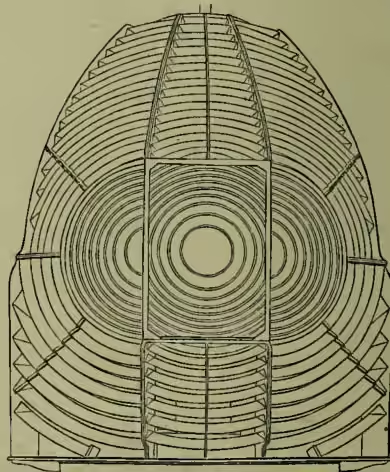
The most notable improvement of recent times in revolving apparatus is what Messrs Stevenson suggested in 1869, and to which they have given the name hyper-radiant. The radius which they adopted was 1330 mm., that of Fresnel being 920 mm. The first lens of this size was made to Messrs Stevenson's design by Messrs Barbier and Fenestre, Paris. When combined with the large flames developed by the increased size of burners now used, this apparatus, when completed with the enlarged prisms above and below the lenses (fig 6), leaves little to be desired, as all the rays of light are acted on, excessive heat is avoided, and biformal and triformal arrangements are rendered unnecessary, as one central flame is alone required. It is optically the most efficient apparatus yet made.
Fresnel not only gave us the dioptic revolving light, but also the fixed dioptic apparatus, showing all round the horizon a vertical strip of light, depending on the diameter of the central flame.
Dioptic Spherical Mirror.
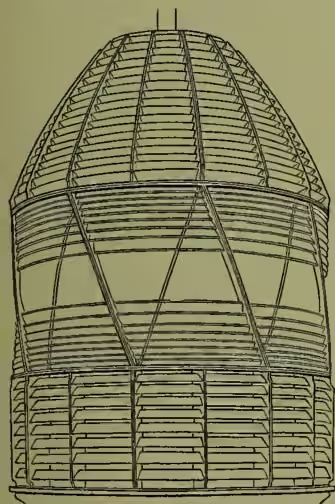
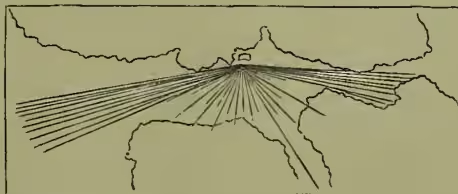
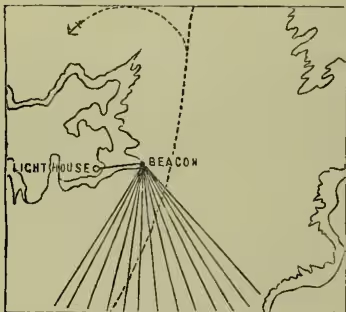
It is said that owing to difficulties of construction Fresnel adopted a polygonal form of thirty-two narrow lenses for the refracting hoop; but Mr Alan Stevenson, when introducing the dioptic light into Britain, designed a truly cylindrical belt, to the different sections of which he gave a rhomboidal form with oblique joints (fig. 7). He also had executed on the large scale totally reflecting prismatic rings. Fig. 8 is a dioptic spherical mirror, which shows a dioptic holo- phot, and fig. 9 the dioptic mirror as improved by Mr J. T. Chance, which is largely used in lighthouses, as is also the azimuthal condensing light, introduced by Messrs Stevenson in 1857, to suit the requirements of narrow sounds on the west coast of Scotland, where the light did not require to be of equal power in all directions. As shown by the chart (fig. 10), it is obvious that on the side next the shore no light is required, across the sound a feeble light is all that is necessary, while up and down the sound the sea to be illuminated is of greater or less extent, requiring corresponding intensity. Various applications of Stevenson's condensing principle are now extensively used in lighthouses. The apparent light is another of Mr T. Stevenson's devices for indicating, by means of a beam of parallel rays thrown from the shore, the position of a rock lying at some distance off. By means of apparatus placed on a beacon on the rock, the rays of light from the shore are reflected seawards so
| Internal Diameter. | Height of Glass-work. | |
|---|---|---|
| Hyper-radiant...8 feet | 8'72 inches. | 11 feet 10'28 inches. |
| 1st Order.....6 " | 0'44 " | 8 " 8'5 " |
| 2d ".....4 " | 7'12 " | 7 " 0 " |
| 3d ".....3 " | 3'37 " | 5 " 1'5 " |
| 4th ".....1 " | 7'68 " | 2 " 8'06 " |
| 5th ".....1 " | 2'77 " | 1 " 10 " |
| 6th ".....0 " | 11'81 " | 1 " 5'5 " |
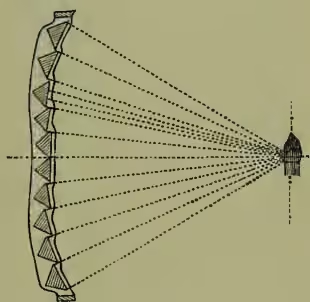
Chance's Improvement on Fig. 8.
Lanterns.—The lantern, or framework of glass and metal which contains the lighting apparatus, is an important part of lighthouse economy. The early lanterns had vertical and horizontal sash-bars, but in 1835 Mr Alan Stevenson, when he introduced diagonal framework for the dioptic light, extended it to the lantern. The diagonal astragals do not intercept light in any azimuth throughout their whole height, and this trigonal arrangement secures a structure of great rigidity and strength. The astragals are of gun-metal, 1 inch section, glazed with plate-glass inch in thickness, unless in peculiarly exposed situations, where it is used inch thick. The first order lantern is 12 feet in diameter, and 10 feet in height of daylight, with an outer and inner dome of copper. Mr Alan Stevenson designed a helical lantern in 1846, but it was not executed. Sir James Douglass, however, recently designed a lantern with helical astragals 14 feet in diameter, glazed with glass inch in thickness, bent to the proper curve. In the Scottish lighthouses 'storm-panes,' which are glazed copper frames, are always in readiness in case of breakage of a pane. They are fixed to the astragals by screws. There is no instance in the Northern Lighthouse service of a lantern-pane being broken by the force of the wind, but they are occasionally broken by birds or by stones being driven against them during strong gales.
Lamps.—The earliest lighthouses had lamps with two or more spouts each with a skein of cotton, until Argand and Teulère gave us the cylindrical burner, Carcel the arrangement for causing a flow of oil over the burner, Rumford the idea of concentric wicks, and Arago and Fresnel the four-wick lamp. Mr Alan Stevenson added a fifth wick, and other lighthouse engineers have increased the number. These burners were suitable for consuming animal or vegetable oils. The extensive use of paraffin led to its adoption in lighthouses, but success was only attained with the one-wick burner until Captain Doty, in 1868, devised burners which develop a flame of great purity and intensity in concentric wick lamps. Single-wick burners draw their supply by the capillary action of the wick, but with multiple-wick burners the oil is supplied by cisterns placed above the level of the burner, or from below by pumps worked by clockwork, or by pressure exerted by a weighted piston. When vegetable or animal oils are employed with multiple-wick lamps the burner requires to be kept cool and the wicks prevented from charring by causing a superabundant supply of oil—nearly three times greater than is consumed—to flow over the wicks, the overflow running back to the cistern. When paraffin is used, however, the fluid is not allowed to rise beyond a certain height in the wick-chambers, the overflow being returned by a tube to the fountain. The satisfactory results in increased photogenic power and economy arising from the use of paraffin have led to the diameters of the burners being much increased. Sir James Douglass has devised burners having seven, eight, and nine concentric wicks, which, of course, greatly increase the candle-power. Messrs Stevenson pointed out, in 1869, that much of the light from burners of greatly increased diameter, when used with revolving apparatus, was not condensed by the lenses, and not properly utilised, and that special apparatus was necessary, and hence their proposal of the hyper-radiant apparatus already referred to.
Illuminants.—Almost every kind of oil, animal and vegetable, has been used in lighthouses—whale, sperm, seal, lard, olive, cocoa-nut, hempseed, colza—but these have been superseded by paraffin, not only on financial but on photogenic grounds. Sperm-oil was long the illuminant used in British lights, but it gave way, in 1845, to colza at a saving of one-half the cost, while it has been succeeded by paraffin, which has raised the power of the lamps from 10 per cent. in the four-wick burner to over 100 per cent. in the one-wick lamp. Messrs Stevenson, in 1870, set at rest the comparative merits of colza and paraffin, and, when the isolated rock station of Dhuheartach came to be lighted in 1872, they introduced paraffin as the illuminant. It may be stated that in the Scottish lighthouses alone a sum of between £4000 and £5000 is annually saved by the use of paraffin, while the power of the lights has been exalted; and most lighthouse authorities have followed their example. Paraffin can be readily obtained with a specific gravity of 0.82, and a flashing-point, close test, of 125° to 150° F., and even as high as 250° F. The following is the consumption in gallons per hour of the Doty paraffin burners: 1 wick, .015; 2 wicks, .055; 3 wicks, .126; 4 wicks, .205; 5 wicks, .373; 6 wicks, .499. The use of gas was suggested when gas-lighting was in its infancy, and the experiments did not succeed. Wherever gas can be had, and proper precautions are taken, there can be no doubt of its utility for lighthouse purposes; but when it requires to be specially made at a lighthouse station, either from coal or paraffin, it is expensive. For harbour-lights, where the supply can be readily had, it has long been used with satisfactory results. In 1827 Mr Wilson erected a very simple piece of machinery at Troon for producing an intermittent light from gas, whereby the alternations of light and darkness were got by shutting off the gas so as to extinguish the light, and again as suddenly letting on the full supply, the gas being re-ignited by a separate small burner supplied by a 'by-pass valve.' Mr T. Stevenson proposed to make intermittent gas-lights by causing the flow of gas to produce intermittent action by means of a dry meter. The meter is so made as to pass gas sufficient to keep a small jet constantly burning. The full flame of the large jet continues to burn until the action of the meter cuts off the supply, and the small jet is again kept burning alone until the full supply flows to the larger jet. Mr Wigham of Dublin has devised a system of gas-burners, having five rings of 28, 48, 68, 88, and 108 jets, the diameter of the rings varying from 4 to 11 inches, the power being 250, 680, 990, 1400, and 2300 standard candles respectively. These burners require no glass-chimney, and all or any of the rings can be used to suit the state of the atmosphere. He has also strongly advocated, and has introduced at some lighthouses in Ireland, a system of superposed lenses, which have been styled biform, triform, and quadriform lights, each tier of lenses having an independent burner. Sir James Douglass has devised six and ten ring gas-burners, the gas issuing from surface-holes, as in the ordinary argand, the power being 850 and 2500 candles respectively. These burners require a glass-chimney. The result of the South Foreland experiments is that, for ordinary lighthouse purposes, paraffin is the most suitable and economical illuminant, and this agrees with the conclusions arrived at by Messrs Stevenson in 1870.
Electric Light.—The electric light was first shown to the mariner in 1858 from the Foreland lighthouse, the generating machine being that of Professor Holmes; but since that date more powerful machines have been devised. The alternate current machines of Barou de Meritens have been used with good results at the Isle of May and other lighthouses. The Isle of May machines are of the L type, of the largest size hitherto constructed, and weigh about 4 tons each. The induction arrangement of each of the two machines consists of 5 sets of 12 permanent magnets, each magnet being made up of 8 plates. The armature, which makes 600 revolutions per minute, is driven by a belt from the engine—16 horse-power—is two feet six inches in diameter, and is composed of 5 rings with 24 bobbins on each, arranged in groups of 4 in tension and 6 in quantity. With the circuit open each machine develops an electromotive force of 80 volts, measured at the distributor; and with the circuit closed through an arc, 40 volts. An average current of 220 ampères is developed, thus yielding an electrical energy of 8800 watts, or 11.8 horse-power in the external circuit. The five rings are so arranged that , , , , or the whole of the current of a machine can, at pleasure, be sent to the distributor for transmission to the lantern, and the two machines can be coupled and the full current from both be employed during hazy weather. The current is conveyed to the lighthouse—a distance of 880 feet—by solid copper conductors 1 inch in diameter, with scarphed joints bolted and soldered together. The lamps are of the Serrin-Berjot type, with some modifications—notably the shunt or by-pass, whereby a large percentage of the current goes direct to the lower carbon. The carbons, which are 1.6 inch in diameter, have a core of pure graphite, and burn with great steadiness at the rate of 2 inches per hour.
The dioptic apparatus, originally used with the electric arc, was too small, and Messrs Stevenson in 1865 suggested that it should be third order, and this was generally adopted; but at the Isle of May it was made second order condensing, so as to give a group of four flashes in quick succession, with intervals of darkness of thirty seconds, the whole light being condensed into three degrees, the resulting beams being equal to three million candles with single power, and six million with double power. It is seen thirty per cent. oftener than a first-class revolving dioptic light. At Souter Point, the Forelands, Lizard, the apparatus is third order. At St Catherine's and Tino it is second order, while at Macquarie it is first order.
Characteristics.—The following are the main distinctions in use: (1) fixed lights; (2) the revolving light, which at equal periods comes into view and gradually attains its full power and then gradually disappears; (3) revolving red and white, showing alternately flashes of red and white light; (4) flashing, showing flashes at short intervals; (5) intermittent, which bursts instantaneously into full power, and, after remaining as a fixed light for a certain period, is suddenly eclipsed; and (6) group flashing, consisting of two or more flashes separated by short eclipses, the groups being separated by a longer eclipse. The use of colour is resorted to for danger arcs, or when another characteristic is not available. The two colours employed are red and green, generally produced by coloured chimneys over the lamps. Experiments made at Edinburgh show that light, in passing through red glass, should be times stronger than for a light of the natural colour—a loss slightly redeemed in thick weather owing to the red rays not being so much absorbed.
Machines.—If the apparatus revolves, motion is generally produced by clockwork and by the fall of a weight. In the case of small apparatus, Messrs Stevenson produced motion by means of the heat from the burner causing a fan to revolve, which has since been adopted in the Trotter-Linberg system.
Distribution.—The coasts of all countries have three lines of defence. There are first great sea lights which indicate important 'landfalls,' and require the most powerful apparatus; secondary lights which, though not requiring to be so powerful as those of the first order, are of great importance, as indicating turning-points in the navigation; and, lastly, harbour lights to guide ships into havens of safety. It has been laid down as an axiom by lighthouse engineers that over-sea lights of similar character should not be placed nearer each other than 100 miles, and that if possible lights near coast-lines much frequented by shipping should be designed to overlap each other.
Lightships.—Light-vessels are moored in situations where it would be impossible to erect a lighthouse. They are generally wooden ships, 103 feet in length between perpendiculars, and feet beam, strongly built, copper fastened, and sheathed with muntz metal. The North Carr Lightship, at the entrance of the Forth, is moored by a 1-inch studded chain cable and 3-ton anchor, as it is in a very exposed situation, and the engines for the fog-signal are driven by steam. The lantern is 8 feet in diameter, of steel, carried on a steel mast. The apparatus consists of eight fixed dioptic apparatus, each of 180°, fitted with spherical mirrors and argand lamps. Each apparatus, with its fountain and lamp, is hung on gimbals, so balanced as to hang vertically in any position of the mast within 30 degrees of the vertical.
Early light-vessels had small lanterns suspended from the yard-arms. Mr R. Stevenson, in 1807, introduced a lantern which surrounded the mast, and all subsequent lightship lanterns have been made on his plan. All floating lights had catoptric apparatus until Messrs Stevenson, when designing the Hooghly lightships, employed dioptic apparatus. Sir James Douglass has done much to improve the lanterns of light-vessels, and introduced two-wick lamps instead of single argands.
Fog-signals.—The average duration of fog on the whole coast of England is only slightly over 400 hours yearly, though in some parts it reaches 1080 hours. In Scotland the average is under 400 hours yearly, while at some parts of the coast of the United States the average is 2226 hours yearly, the highest being 2454 hours. There are few coast lighthouse stations where a phonic signal would not be a useful auxiliary, as there are times when the most powerful lights, even the electric, are obscured by dense fog, when the sailor must be guided by signals addressed to the ear. Various instruments have been used, such as bells, gongs, steam-whistles, guns, sound-rockets, tonite charges, reed trumpets, and sirens sounded by compressed air or steam. The Daboll fog-horn and siren are of American origin, the siren being the most powerful in use; but, though it has been heard at distances of upwards of 20 nautical miles, there are certain conditions of the atmosphere when its effective range is limited to 2 or 3 miles. Though bells are not effective signals, no fewer than 55 of them are used in British and 158 in American waters; and since 1811, when Stevenson introduced fog-bells at the Bell Rock Tower, all subsequent rock lighthouses, owing to the want of space for other signals, have been supplied with them. Such rock tower bells vary from 3 cwt. to 2 tons. It has been found that when struck by a hammer outside, instead of by a clapper, the sound is heard at a greater distance, and when the blows are struck in rapid succession for a short time the sound is more penetrative. For the sake of distinction two bells of different tone, struck after each other, are sometimes used. Gongs, struck by hand, are still employed on board some lightships; but though the sound is distinctive it is not heard at any great distance. Steam-whistles are largely used in the United States, and guns are still employed at a few stations. Sound-rockets are charged with the ordinary composition to carry the rocket up to a height of 600 feet, when a charge of cotton powder is exploded with a report like the discharge of a piece of ordnance. The charges of cotton powder are generally 4 ounces, but 12-ounce charges are sometimes used when there is wind along with the fog. Tonite signals are used at eleven stations in Britain. The charges consist of small cylindrical discs of dry cotton powder (tonite), 4 ounces in weight, each having a hole up the centre for receiving the detonator, which is a copper tube containing fulminate composition. The charge is fired by connecting it with an electric cable attached to a small electro-magnetic machine standing in the light-room. A light framework or jib is fixed outside the lantern, counterbalanced and raised by means of wheel-work to about 12 feet above the lantern. When the charge and detonator are attached to the ends of an electric cable, the jib is hoisted, the firing handle of the electric machine is raised and smartly pushed down, when the fuse and detonator fires the charge, which gives a loud report. An arrangement is made so that the circuit cannot be closed until the jib and charge are raised to the full height above the lantern. The Daboll horn is a metal trumpet in which a metallic reed or tongue 18 inches long, inches broad, and varying from to inch in thickness at the free end, is made to vibrate by compressed air or steam being blown through it. This signal is effective, though not so powerful as that of the siren. The siren consists of a trumpet having two discs, 12-inch diameter, one of which is fixed, and one rotating with radial slits cut in them. The rotation is from 1500 to 2000 times a minute, with air at 20 lb. pressure per square inch. Holmes' siren is automatic, consisting of two cylinders having angular slots, one being fixed and the other free to rotate within the fixed cylinder; the compressed air impinging against the inclined sides of the slots causes the inner cylinder to revolve, the rapid passage of one row of slots over the other produces a series of vibrations which give the note desired, and notes of different pitch can also be produced. Sirens are used at 41 stations in British waters. At Ailsa Craig, Messrs Stevenson adopted a central station, the compressed air, at 75 lb. per square inch, being conveyed to distances of and mile respectively. The south signal gives 3 blasts in quick succession every 3 minutes, the first a high note, the second a low note, the third a high note; while the north gives one blast of 5 seconds duration every 3 minutes. These signals are so arranged as to begin to sound about minute before each other, and never together. The motive power is five gas-engines, one being spare, the gas being made from the paraffin used in the lighthouse lamps. As regards the distance to which the compressed air is carried, this was a new departure in fog-signalling. These signals are actuated by compressed air, the motive-power being hot air, steam or gas engines, or, as at Corsewall in Scotland, by Priestman's oil-engines, with ordinary lighthouse paraffin oil as the explosive.
Administration.—British lighthouses are managed by three boards—the Trinity House for England, the Commissioners of Northern Lights for Scotland and the Isle of Man, and the Ballast Board, Dublin, for Ireland; the Board of Trade, by the Mercantile Marine Act of 1854, having control over the three boards in finance and other matters. Some colonial lights are also under the control of the Board of Trade. For the United States of America a Lighthouse Board was constituted in 1852, the Treasury defraying the cost of erecting and maintaining lighthouses and other aids to navigation. In France the lighthouse service is under the minister of Public Works and a special 'Commission des Phares.' In Sweden, Norway, Holland, Denmark, Russia, and Austria the lighthouse administration is under the Admiralty or minister of Marine. In Spain the system of administration is similar to that of France.
Lightkeepers.—At lighthouse stations on shore there are two keepers, while at rock stations there are generally four, one being always on shore by rotation. Where there is a fog-signal at any station there are generally three keepers, and at electric light stations there are five, one of them being a mechanical engineer. The crews of light-ships are eleven in number, three of the crew and the master or mate getting on shore by rotation.
See J. Smeaton, Eddystone Lighthouse (1791); R. Stevenson, Bell Rock Lighthouse (1824); Alan Stevenson, Skerryvore Lighthouse, with Notes on Lighthouse Illumination (1848), and Treatise on the History, Construction, and Illumination of Lighthouses (1850); David Stevenson, Lighthouses (1864); M. L. Reynaud, Mémoire sur l'Éclairage et le Balisage des Côtes de France (1864); L. Renard, Les Phares (1867); G. H. Elliott, European Lighthouse Systems (1875); M. E. Allard, Mémoire sur l'Intensité et la Portée des Phares (1876); Thomas Stevenson, Lighthouse Construction and Illumination (1881); M. L. Reynaud, Phares et Balises (1883); Sir James Douglass's Opening Address to the British Association (1886); E. P. Edwards, Our Seamarks (1886); D. P. Heap, Ancient and Modern Lighthouses (1889); and Minutes of Proceedings of the Institution of Civil Engineers.