Lizards (Lacertilia), an order of reptiles occupying a somewhat central position in that class. The body is usually well covered with scales, reaching a climax in the tubercles and spines covering the Australian moloch, but very much reduced in the geckos and amphisbænas. There are generally fore and hind limbs, but either pair may be lost, or both in such serpent-like forms as the slow-worm (Anquis fragilis) and the amphisbænas. Shoulder and hip girdles are always present, in rudiment at least. Unlike snakes, lizards have non-expansible mouths, and almost always movable eyelids and external ear-openings. The teeth are fused to the jaws, not planted in sockets; the protrusible tongue, broad and short in geckos, agamas, and iguanas, long and terminally clubbed in chameleons, is in most lizards a narrow, worm-like, bifid organ of touch. There is a transverse cloacal aperture, a urinary bladder, and a double copulatory organ.
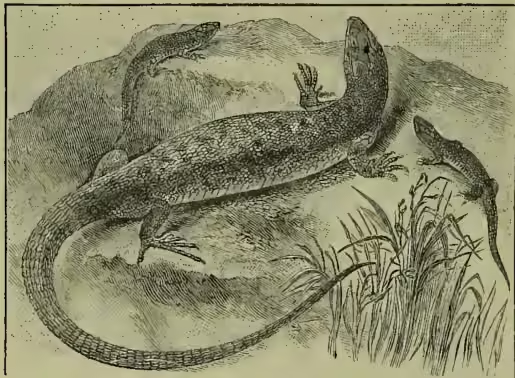
Most are oviparous, but a few—e.g. the slow-worm and our British Lacerta (Zootoca) vivipara—bring forth their young living. Lizards, though most abundant in the tropics, and absent from very cold countries, are virtually world-wide in distribution. There is one marine form, Oreocephalus (Amblyrhynchus) cristatus, from the Galapagos; most of the rest are terrestrial. Yet the geckos climb on rocks and trees, the giant Varanidae are semi-aquatic, the amphisbænas are subterranean, and the arboreal dragons (Draco) take long swoops through the air from branch to branch. The food generally consists of insects, worms, and similar small animals, but some prey upon larger animals, and others are vegetarian. Lizards are usually active, agile animals, beautifully and often protectively coloured. They are noteworthy for brittleness in the caudal region, and for their power of reproducing lost tails or even legs. Among the most remarkable forms may be noted the Geckos (q.v.); the large monitors (Varanus), which attain a length of six feet, and prey upon small mammals, birds, frogs, fishes, and eggs; the poisonous Mexican lizard, Heloderma horridum, with large poison-gland and fang-like teeth; the worm-like Amphisbænas; the Slow-worm, which illustrates so well the tendency lizards have to break in the spasms of capture; the large Iguanas, which frequent tropical American forests, and feed on leaves and fruit; the sluggish spiny 'Horned Toads' (Phrynosoma); the Agamas, taking the place of the Iguanas in the Old World; the Flying Dragon (q.v.); the Australian frilled lizards (Chlamydosaurus), with a peculiar collar of skin; the repulsive moloch; and the divergent Chamaeleons (q.v.). The unique New Zealand lizard, Sphenodon or Hatteria, with its remarkable persistent pineal eye, is to be regarded as the sole survivor of a distinct order—Rhynocephalia (see SPHENODON). There are four British lizards, the commonest being Lacerta vivipara and the Slow-worm. Two other species of Lacerta—L. agilis and the green L. viridis—have a local distribution in the south of England and the Channel Islands. The modern forms are classified in twenty-one families, including over 1600 species. Though Lacertilia probably began about the Permian times, their remains are not numerous before Tertiary strata. See G. A. Boulenger, Catalogue of the Lizards in the British Museum (3 vols. 1885-87).