Malta, an island and British possession in the Mediterranean, 17½ miles long by 8½ broad, with an area of 95 sq. m. It stands on the submarine plateau which, stretching across from Sicily to Africa, divides the Mediterranean into two basins, and is of late Eocene or perhaps Miocene formation, the prevailing rocks being limestones. From its central position in the Mediterranean Sea, 58 miles S. of the Sicilian coast and about 180 S.E. by
E. of Cape Bon in Algeria, and from the enormous strength of its fortifications—Disraeli called it 'the little military hothouse'—Malta is one of the most important of the British dependencies. It is the headquarters of the British Mediterranean fleet, the principal coaling station for merchant-vessels as well as the navy in the Mediterranean—between 500,000 and 600,000 tons of coal are imported for use and re-exportation annually—a powerful stronghold (Valetta), a valuable sanatorium for troops employed in the Orient, and an interesting island historically, architecturally, and from the antiquarian standpoint. The dependencies include the island of Gozo (20 sq. m.), lying NW. of Malta, and separated from it by a channel 3 miles wide, in which are the little islands of
The annual mean is F., and the annual rainfall 24.23 inches. But when the hot sirocco wind blows—not dry as in Africa, but laden with moisture—the climate is enervating. Otherwise Malta is fairly healthy, though cholera pays occasional visits, as in 1853 and 1887; since about 1880 the government have been providing the island with a comprehensive system of water-works, which has greatly contributed to its healthfulness. Earthquakes are relatively frequent.
In 1881 Malta (132,129) and Gozo (17,653) contained 149,782 inhabitants; in 1891, 177,225 (including 2300 British residents and 1200 foreigners, but excluding the 6000 to 7000 imperial troops). The local militia, including the Royal Malta Fencible Artillery, number about 1200. The language of the people is a corrupt dialect of Arabic, with a strong admixture of Italian and other words; some authorities, however, connect it with the ancient Phœnician. The native population believe themselves to be of Phœnician descent. From the time of the settlement of the Knights of St John down to quite recently Italian was the official language; but it has been superseded by English. Most of the educated Maltese speak Italian, and some speak English; the peasantry as a rule know neither the one nor the other. The Maltese are a sober, industrious race of people, though often quick-tempered and ignorant. Their thrifty habits are proved by the fact that 5197 depositors had £402,969 standing to their credit in the savings-bank in 1888. They are fond and proud of their island home—they love to call it 'the flower of the world'—and are devout Roman Catholics, the power of the Church being very great over the people. There are two bishops (Malta, Gozo) and 1200 clergy. Canon law is recognised as the civil law of Malta. Owing to the rapid growth of the population and their density to the sq. m. (1471 in Malta and 931 in Gozo; Belgium has 514 to the sq. m.), large numbers are compelled to emigrate; they are found to the number of 50,000 in all parts of North Africa and the Levant. Education is provided for in a university, a lyceum (400 pupils), and nearly fifty government schools, attended by 10,000 pupils. The university, founded in 1769, has four faculties and (1888) 105 students. The educational condition of the island had long been a subject of discontent; but reforms were introduced in the end of 1887, after which the number of students at the university more than doubled, and a thousand more pupils attended the primary schools. Yet other causes of discontent existed in the ecclesiastical jealousy of the predominant church, and social jealousy between the impoverished native nobility (for the most part counts and marquises created by the Knights of St John, and fully recognised since 1878) and the upper classes of the British. Within the last few years the sovereign power has shown more consideration for the political susceptibilities, and also for the social welfare, of the people. The fortified towns that constitute Valetta have been re-drained, water has been carried throughout Malta, and in 1890 was to be carried over Gozo likewise, and the old Maltese coinage of the knights was superseded (1887) by the British currency (silver being legal tender up to £5). Moreover, a constitution based on popular representation was conferred in 1887. Legislation is carried on by six official and fourteen elected members, the governor, with the power of veto, being president. There is also an executive council, consisting of the governor as president, seven official members, and three nominated by the governor from among the elected members of the legislative chamber; the crown retains the right to legislate also through orders in council. There is no direct taxation in Malta.
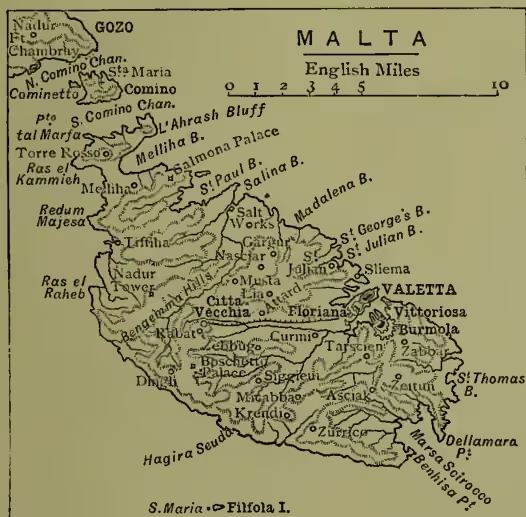
Comino and Cominotto, and several islets round the coasts of the larger islands. On one of these islets, General's Rock, near the west side of Gozo, the famous Maltese fungus Cynomorium (q.v.) grows. The area of the entire governorship of Malta extends to 117 sq. m. The island of Malta is oval in shape, the north-eastern and eastern shores being broken into several good harbours (Valetta, Marsa Scirocco, St Paul's Bay, Mellieha Bay, &c.); the southern coast rises in picturesque cliffs 400 feet high. The culminating point of the island is 758 feet. The sea has hollowed out among its cliffs grottoes and caverns in almost every direction, some of considerable extent, especially one in Comino. Malta has a bare, stony appearance, owing to the absence of trees and the fact that the fields and gardens are enclosed in high walls, to shelter the crops against the violent winds. There are no rivers or lakes; but water is easily obtained from springs. The soil is thin, but remarkably fertile; and its fertility is increased by the skilful cultivation and the diligent toil of the inhabitants. Large crops of wheat and potatoes are raised, early varieties of the latter being largely exported to England; maize, barley, cotton, clover, oranges, figs, grapes, carob beans, and peaches and other fruits are also grown. Fine honey is produced; in spring the island is gay with flowers. Those of the Maltese who do not cultivate the soil are chiefly engaged in the docks and harbours. Filigree ornaments and a little cotton are manufactured. Sheep and goats are kept, with smaller numbers of cattle, mules, asses, and horses. The Maltese Dog (q.v.) is virtually extinct. During the summer months the thermometer ranges from to F., during the coldest from to .
The government own two-sevenths of the land (the rest is divided about equally between the ecclesiastical establishments and private owners); from the rents of this and other crown property, and from customs, licenses, &c., the annual revenue of £260,000 to £300,000 is derived. The public debt is £80,000 (1895). There is a railway, 8½ miles long, connecting Valetta (q.v.), the present capital, with the old capital Citta Vecchia, known to Cicero as Melita, to the Saracens as Medina, and to the modern Maltese as Notabile, a place founded so long ago as 700 B.C. Here is the cathedral of St Paul (1697), traditionally occupying the site of a palace of Publius, who erected there a church, and of a former cathedral built by the Normans in the 12th century and destroyed by earthquake in 1693. The cathedral is adorned with mosaics, pictures, statues, and other works of art. Near by are the extensive catacombs and the Grotto of St Paul, where he is popularly believed to have lived during his three months' stay on the island. Two miles distant is the Verdala Palace, built by the grand-master Verdala in 1586, and now a summer residence of the governor of the island. At Mnaidra and Hagia Kim, in the south of the island, there are megalithic Phœnician temples, the ground-plans, not only of the general structures, but also of the detailed compartments, being all elliptical in shape. The traditional scene of St Paul's shipwreck is on the north side of the Bay of St Paul. The church of Musta (1833-64) is designed on the model of the Pantheon at Rome, and has the largest dome in Europe next after those of St Peter's and the Pantheon. Some 8000 vessels of 6,000,000 tons enter and clear the island ports every year, with cargoes varying in value from £25,000,000 to £70,000,000. But of the total imports (worth nearly £36,000,000 in 1891, in 1894 hardly £14,000,000) only a fraction—say £800,000—is actually retained in the island; the rest is re-exported.
The Hyperion or Ogygia of Homer is sometimes identified with Malta. The Phœaicians colonised the island at a very early date, more than 1000 years before the birth of Christ. Before they were disturbed in their possession by the Greeks, about 700 B.C., they had developed considerable commerce. The Greeks, who called the island Melita, were driven out by the Carthaginians about 480 B.C. As early as the first Punic war Malta was plundered by the Romans, but did not come definitively into their hands until 216 B.C. In those early times Malta was renowned for its manufactured cotton, its roses, and its honey; and its Roman temples and villas boasted excellent works of art and other indications of great luxury. On the division of the Roman world (395) Malta followed the fortunes of the eastern empire. During the 5th century it fell successively under the Vandals and the Goths; and though in 533 Belisarius recovered it for the Byzantine empire, its prosperity departed, and its civilisation almost vanished amid constant local feuds. In 870 the Arabs destroyed the Greek power in Malta, and fortified the harbour. Count Roger of Sicily drove out the Arabs in 1090. As a fief of Sicily, Malta passed, under a marriage-contract, to the Emperor Henry VI. (1194). In 1282 the island was conquered by Pedro of Aragon, and, so coming eventually into the hands of Charles V., was given by him, along with Gozo and Tripoli, in perpetual sovereignty to the Knights of the Order of St John of Jerusalem (1530). The Knights raised the stupendous fortifications which rendered Malta so powerful, and spent much wealth in beautifying the island. To revenge their attacks on the Barbary pirates, Sultan Solyman sent in 1565 a very powerful fleet, strengthened by the galleys of Dragut of Tripoli, against the forts. Valetta was founded in the following year, after the Turkish attack, which lasted three months, had been beaten off (see VALETTA). In 1571 the Maltese followers of the Knights of St John behaved courageously at the battle of Lepanto. The Hospitalers continued in possession of Malta until 1798, when they surrendered their fortresses to the French. The Maltese, however, rose in a few months against their new masters, who treated them ill, and after a siege of two years, during which they were assisted by Neapolitan and British forces, they forced the French to capitulate to the English general Pigot. The treaty of Amiens stipulated that Malta should be restored to the Knights of St John; but the Maltese protested against such an arrangement, and preferred the government of Great Britain. The British government consequently refused to give up the island, and Napoleon made the refusal one of his grounds for the resumption of hostilities. The Congress of Vienna (1814) finally recognised Malta as a British dependency.
See historical works on Malta by Miège (1840), Eton (1802), Avaes (1830), Tullack (1861), Winterberg (1879); Caruana's Reports on Phœnician and Roman Antiquities in Malta (1881-82); James Smith, Voyage and Shipwreck of St Paul (1866); Sir R. L. Playfair, Mediterranean (1890), in Murray's Guidebook series; and John Murray's valuable paper in Scot. Geog. Mag. (1890).