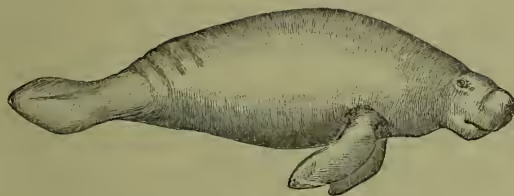
Manatee (Manatus), one of the 'sea-cows' or Sirenia, allied to the Dugong (q.v.) and to the extinct Rhytina. Two species, very like one another in structure and habit, are distinguished, M. australis, in the rivers and estuaries of the Atlantic side of tropical South America, and M. senegalensis, in the Senegal and other rivers of West Africa. They are gregarious, inoffensive, sluggish mammals, browsing on algæ, fresh-water weeds, and even shore-plants. In regard to their breeding and parturition information is still required, but we know that the mothers show much affection for the young, and protect them in danger. In length the manatee measures from 10 to 12 feet; the colour of the thick, wrinkled, hairless hide is dark bluish gray, lighter as usual on the ventral surface. The upper lip bears a rounded knob, and there are yellow bristles about the mouth; the eyes are small and deeply sunk, and the nostrils are valved slits at the end of the snout. From the dugongs they differ in having a thicker body and a straighter head, with the jaws but slightly curved, in the rounded or shovel-like shape of the tail, and in the presence of rudimentary nails on the fore-limbs, to the hand-like form of which the word Manatee refers. They differ also in more technical characters—e.g. in the very exceptional occurrence of six instead of seven neck vertæbræ, and in the Dentition (q.v.), which in the adult manatee is represented by horny pads replacing the front teeth lost in early life, and by ridged molars, of which, however, only are in use at a time. The manatee, though becoming scarcer, is still harpooned or otherwise caught, being valued on account of its palatable flesh, its abundant fat, and its strong skin. Gentle and affectionate, it readily admits of being tamed, and living specimens have been successfully transported to the Zoo in London.
See DUGONG; and also the memoirs by Murie and Garrod in the Trans. Zool. Soc., vols. viii. x. xi.