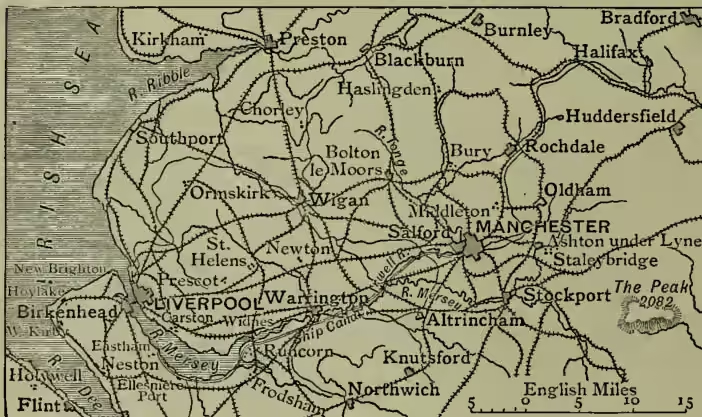
Manchester (Sax. Mancestre), a corporate and parliamentary borough of Lancashire, was elevated to the dignity of a city in 1847, by being made the see of a bishop, and confirmed by royal charter in 1853. It is situated in the hundred of Salford, on the east bank of the Irwell. Salford is on the opposite bank; and the two boroughs, connected by sixteen bridges (besides railway viaducts), may be considered one city. Manchester is the acknowledged centre of the most extensive manufacturing district in the world, and is remarkable from being surrounded by a ring of populous suburban townships formed from the overflow of its population. Within a few miles there is a second circle of towns, with populations ranging from 10,000 to 50,000. At a radius of 30 miles is another cluster of towns, nearly all of them manufacturing, and to all of which there is easy and frequent access by tramways, canals, and railways. Manchester is 187 miles NNW. of London, 31 E. of Liverpool, 51 SE. of Lancaster, 84 N. of Birmingham, 68 NW. of York, 48 SW. of Leeds, 41 NW. of Sheffield, and 40 NE. of Chester. The following table shows the growth of the population of the two boroughs:
| Manchester. | Salford. | Total. | |
|---|---|---|---|
| 1801..... | 75,275 | 14,477 | 89,752 |
| 1851..... | 303,382 | 102,449 | 405,831 |
| 1871..... | 351,189 | 124,801 | 475,990 |
| 1881..... | 462,303 | 176,235 | 638,538 |
| 1891..... | 505,343 | 198,136 | 703,479 |
By the City Extension Act of 1885 the parliamentary boundaries were greatly extended, and later an agitation was begun in various suburban townships for incorporation. Five of these were already incorporated with Manchester in 1890, and others were expected to become incorporated. The city was made a county borough under the Act of 1888. The area of the parliamentary borough (comprising eleven townships and parts of two others) is 20 sq. m., and that of Salford 8 sq. m. Both boroughs were enfranchised by the Reform Bill of 1832, Manchester returning two members and Salford one member to parliament. The Reform Bill of 1867 gave Manchester three and Salford two members. Since 1885 Manchester returns six and Salford three members to parliament.
At present Manchester and Salford, and a large portion of the suburban population, are supplied with water collected on the slopes of Blackstone Edge, distant about 20 miles. The water-works possess a total capacity of 3,828,000,000 gallons, and the average daily supply is about 25,000,000 gallons. In view of the rapid increase of the population the city council purchased Thirlmere (q.v.), in Cumberland, giving a further supply of 50,000,000 gallons daily. The water is conveyed by aqueduct and tunnels (completed in 1894; see AQUEDUCT) to Bolton, and most of the remaining 60 miles in large iron pipes laid along the main roads. The first contract of 6 miles' tunneling and mile of open cutting was let in 1885. The water-works, along with the gas-works, are the property of the corporation, and Manchester claims to have been the first local authority to obtain powers to supply public light. The profits average £105,480, out of which £25,000 is paid over for city improvements. The market rents amount to £44,000 per annum, and until so late as 1845, being governed by the antiquated machinery of manor courts, borough reeve, constables, and unpaid magistrates, tax and toll were paid on all articles brought into the markets. During that year (1845) these manorial privileges were bought for £200,000. In 1845-46 a public subscription founded three parks of about 30 acres each, and shortly after a fourth of 60 acres was added. There are now in Manchester and Salford eleven parks, giving seven for the former and four for the latter, with eight recreation grounds, covering altogether 300 acres. Manchester was also the first borough to take advantage in 1852 of the churches, a Greek church, and an Armenian (q.v.) church.
The principal buildings for secular purposes are, first, the town-hall (1868-77), by Waterhouse, completed in 1883. The original estimate for the building was £750,000; it has, however, cost £1,053,000, and occupies an area of 8648 square yards. It is a Gothic structure and triangular in form, built of brick, faced with freestone, and at some parts with granite; and is, it is claimed, the finest building in the world devoted to purely municipal purposes. The great hall is decorated with remarkable pictures illustrating the history of Manchester, by Madox Brown (q.v.). The clock-tower, 286 feet high, contains a fine peal of twenty-one bells. In the Royal Infirmary, first used in 1755, as many as 32,000 patients are treated annually, and there is an average of 25 accident cases admitted daily. The Royal Institution is a noble Doric edifice by Barry, built at a cost of £30,000, and contains a gallery of paintings, a school of design, and a lecture theatre. It was erected in 1825-30, its object being to diffuse a taste for the fine arts by exhibiting works of art of the highest class, and to encourage literary and scientific pursuits by means of popular courses of lectures. The walls of the entrance-hall are decorated with casts of the Elgin Marbles, presented by George IV. A fine statue of Dalton by Chantrey is placed in the hall. The Royal Exchange (1864-74), an imposing building in the Italian style, has a meeting-hall said to be the largest in the United Kingdom—area, 5170 square yards. It is 120 feet wide without intermediate supports. Tuesdays and Fridays are the chief days for business, and on these days its immense area is densely covered. The Free-trade Hall (1856) holds 5000 people,
Free Libraries Act. Perhaps none of the great towns in Britain is better furnished with good libraries and reading-rooms than Manchester, all provided within a few years. There are six branch libraries with reading-rooms, and also additional rooms for boys. The Free Reference Library in King Street has 198,000 volumes. Salford has four branch libraries, with reading-rooms and a museum; while Manchester in 1890 received a park, library, and museum from the Whitworth legates, to be incorporated with the Technical School and School of Art. There are besides eighteen private libraries, some connected with other institutions. The Chetham Library, founded by Humphrey Chetham (q.v.) in 1653, contains 30,000 volumes, with many rare books and manuscripts, and was the first free library in England. The John Ryland's Library comprises the famous Althorp collection, presented to the town in 1892 by the widow of a Manchester millionaire. Mention may be made also of the Athenæum, Royal Exchange, Portico, and Law and Foreign Libraries, &c. The two boroughs have about 162 churches belonging to the Establishment. The Cathedral, formerly known as the Collegiate Church, but now called the 'Old Church' (built in 1422), is a fine Gothic structure, and between 1845 and 1868 underwent complete restoration in its original style. It comprises a perfect stalled choir of exquisite beauty, a retrochoir, lady chapel, lateral chapels, chapter-house, and a tower 139 feet high, with ten bells. There are 23 Roman Catholic and 398 dissenting chapels, some of which are very fine specimens of modern Gothic architecture. There are 5 Jewish synagogues, 5 German and is a memorial of the agitation which resulted in the repeal of the corn laws. The 'Peterloo Massacre' took place on its site. The Assize Courts (1864), by Waterhouse, are a splendid specimen of Gothic architecture, and cost £100,000. The great hall is a magnificent apartment, being 100 feet long, 48½ broad, and 75 feet high. All the arrangements of the court are considered as nearly perfect as possible.
The Literary and Philosophical Society (1789), in George Street, has a valuable scientific library and a chemical laboratory, and publishes memoirs. On its roll are many distinguished names, including Drs Henry and Percival, Benjamin Franklin, Thomas de Quincey, John Dalton, Eaton Hodgkinson, Sir W. Fairbairn, Sir James Whitworth, James Nasmyth, and Dr Joule. There are about seventy other societies and institutions of various kinds in Manchester, many of them of very high standing.
The statues and monuments in Manchester are numerous, and vary considerably in order of merit. On the Infirmary Esplanade are four statues—the Duke of Wellington, Sir R. Peel, Watt, and Dalton. The Albert Memorial stands in Albert Square, where are also statues of Bishop Fraser, of Dr Joule (1891), and of John Bright (also in 1891). In front of the town-hall is one of Oliver Heywood (1894); there is one of Cobden in St Anne's Square, of Humphrey Chetham in the Cathedral, and of Cromwell near the entrance of Victoria Street.
The facilities for education in Manchester have been greatly extended and improved within recent years. The Grammar-school is the most ancient, and was founded by Hugh Oldham, Bishop of Exeter, in 1515. Its original endowment was £29 per annum, but the possession of certain mills on the Irk—a tributary of the Irwell—soon gave the school a substantial revenue. In 1825 the report of the Charity Commissioners showed that the total income of the Grammar-school Trust had reached a sum exceeding £4000 per annum. In 1868 the original plan of the founder was altered, and the new scheme, as sanctioned by the Court of Chancery, is the admission of 100 boys at twelve guineas a year each, the remainder being on the foundation, and the school is enlarged to accommodate 350 boys. In Brasenose College, Oxford, there are four scholarships belonging to this school, and eighteen others of which it has every third turn. In St John's College, Cambridge, it has, in turn with two other schools, a right to twenty-two scholarships. There is also a hospital school, founded in 1651 by Humphrey Chetham, 'for maintaining, educating, bringing up, and apprenticing forty healthy and poor boys.' By 1845 the revenue had increased sufficiently to justify the feoffers in increasing the number of boys to 100. In 1851 was opened Owens College (q.v.). It is due to the liberality of John Owens, who died in 1846, leaving by will £100,000 to be expended in founding an educational institution of the highest class. In 1870 a further sum of £90,000 was expended on new buildings, &c. In 1880 a royal charter was granted for the founding of Victoria University, of which Owens is one of the colleges, and by an additional charter the university was entitled to confer degrees in surgery and medicine. As an educational institution it has already earned a very high character, and has grown steadily in usefulness and resources. The university contains an excellent library and museum of natural history. The Technical School, with which in 1883 was incorporated the Mechanics' Institute, and in 1890 the Manchester Whitworth Institute, has proved very completely how a school can be organised to give thorough technical training in the principles and processes of great and complicated industries. The course of studies is generally confined to subjects of commercial and mechanical interest—theoretical and practical engineering, designing, spinning and weaving, printing, dyeing, and bleaching, metallurgy and chemistry. It has also several good lecture-rooms. Every facility is afforded the scholars for acquiring thorough knowledge, theoretical and practical, of the various handicrafts, and the expert use of tools. The guarantors of the Manchester Exhibition (1887) have contributed their surplus of £42,000, and the city council has adopted the Technical Instruction Act, and has from 1890 allotted the school the sum of £2000 per annum. In 1889-90 there were 50 board schools and 130 elementary schools, with an attendance of 72,167 scholars. There are evening classes in connection with the board and technical schools at a moderate rate. As regards the education of the poorer children, the persevering endeavours of the wealthy and benevolent in this direction have been very noteworthy.
The great revolution in the industrial life of England began here about the middle of the 18th century—the substitution of the factory system, where large numbers of men work together, for the older method of each working in their homes. New possibilities were also opened up by a series of remarkable inventions which increased production of manufactured goods at a far cheaper and inconceivably more rapid rate, combined with the new application of mechanical power to the service of man in Watt's steam-engine. Manchester has been the pioneer in opening up new means of internal communication, and to meet the rapid increase of trade and commerce many efforts were made in early times to substitute some better means for the pack-horse mode of carriage and conveyance. In 1720 the Irwell was made navigable. In 1756 the Bridge-water Canal was constructed, which put Manchester in communication with the coalfields of Lancashire and the salt-mines of Cheshire, and made an outlet to the sea. Later it became a highway for passengers as well as goods. In 1830 Manchester had the first perfect railway in full operation. It has been proved that conveyance by water is only one-tenth of the cost of the same distance by land, and, in order to avoid transhipment of goods, and to render Manchester an inland seaport, the gigantic engineering work of making a slip-canal at a cost of about £15,000,000 was carried out in 1887-93 (see CANAL, Vol. II, p. 700). A perfect network of railways and canals radiates from Manchester as a centre in all directions. In consequence of all these gradual changes Manchester is losing its character as merely a manufacturing town. A change is gradually developing in the locale of the various large industries, and the city may be regarded now as the general market for the whole trade. The principal cotton-mills and other industries are being removed to the suburbs north and east of the city, and in and around Manchester and Salford two-thirds of the entire cotton-manufactures of the United Kingdom are located. There are about 700 different industries in the district. Manchester was the first place to secure the privilege of inland bonding for articles charged with customs duties, and now produces a large and increasing revenue from that source.
The sanitary condition of Manchester is not a satisfactory one, and in consequence the death-rate, averaging 35 per 1000, is abnormally high; but it must be remembered that the corporation had long arrears of neglect and indifference to make up, while a rapid increase of population was going on. Down to 1838 Manchester and Salford were governed by a borough-reeve and constables, and from their abolition only could the real work of improvement begin. As instances of the immense works accomplished by the corporations may be mentioned the gas and water supplies, municipal buildings, widening and draining of the streets, removal of unhealthy courts and dwellings. The sewage main drains made since 1838 are 95 miles in length, cross drains and eyes 148 miles, whilst the area of streets paved equals a million square yards. The smoke nuisance is perhaps more difficult to remove now than when the factories were within the city. The disease and death dealing river, the Irwell, flowing through a dense population, has yet to be dealt with. Besides the pollution from public works of all kinds it is the receptacle of the sewage from more than one million of a population distributed over the watershed of the Irwell, comprising an area of 300 sq. m. Great efforts are constantly being made to remedy this unfortunate state of matters.
Manchester is undoubtedly an ancient city. It is mentioned as a Roman station (Mancunium; in A.S. Manigeceaster), and spoken of at the time of the Norman Conquest in connection with Salford and Rochdale, but the uncertainty of all trustworthy information, especially as regards its origin, renders any account of its early history a matter of doubtful value. We cannot determine when Manchester became a manufacturing district, but it is probable that the introduction of Flemish artificers in the reign of Edward III. is the real starting-point. In the 13th century there was a fulling-mill, and dyeing yarns or cloth was practised. The 14th and 15th centuries are mentioned as periods of great progress. Camden, who visited Manchester in the reign of Queen Elizabeth, describes it as 'surpassing neighbouring towns in elegance and populousness. Here,' he says, 'is a woollen manufacture, church, market, and college. In the last age it was more famous for the manufacture of stuffs called Manchester cottons and the privilege of sanctuary, which the parliament under Henry VIII. removed to Chester.' In 1724 Dr Stukely describes it as 'the largest, most rich, populous, and busy village in England. Here are about 2400 families, and their trade, which is incredibly large, consists of fustians, tickings, girth-webbs, and tapes, which are dispensed all over the kingdom and to foreign parts. They have looms which work 24 laces at a time, stolen from the Dutch, and on the same river for the space of 3 miles there are 60 water-mills.' Another authority of near the same date says 'the inhabitants are not only thrifty and inventive but very industrious and saving—always contriving and inventing something new.'
In the political world Manchester has taken a leading place. The Anti-corn-law League, which after a seven years' struggle caused the repeal of the corn laws, had its origin here; and the Manchester School is a term applied to a party of English Radicals, which had its origin in the Anti-corn-law League. It identified itself with the development of free-trade principles, utilitarianism, the resistance to government interference (as with factory labour), supporting a policy of laissez faire, and in foreign affairs was a peace party, insisting strongly on non-interference. See articles on Corn Laws, Free Trade, Bright, Cobden, Gibson (Milner).
See Whittaker's History of Manchester (1771); Prentice's History and Sketches of Manchester (1850-53); Reilly's History of Manchester (1861); Baine's History of Lancashire (1870); Proctor's Memorials of Manchester (1880); Axon's Annals of Manchester (1886); Saintsbury's Manchester (1887); and McCulloch's Dictionary of Commerce (1887).