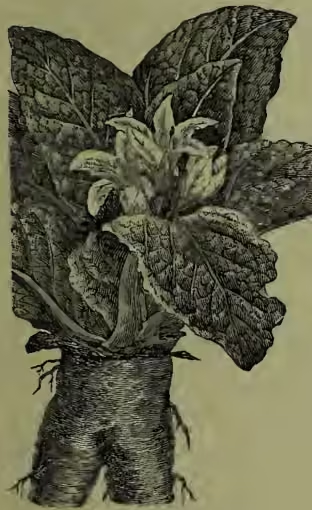
Mandrake (Mandragora officinalis), a Solanaceous plant closely allied to Belladonna (q.v.). There are two varieties, the vernal and the autumnal; both are natives of the Mediterranean region and the East, and especially abound in Greece. The whole plant has a very fetid narcotic smell; and all parts have poisonous properties like those of belladonna, but more narcotic, for which reason a dose of the root was formerly sometimes given to patients about to endure surgical operations. The ancients were well acquainted with the narcotic and stupefying properties of mandrake, and it was a common saying of a sleepy or indolent man that he had eaten mandrake. The large taproot grows somewhat irregularly, and often seems divided into two, through the development of a branch which attains more or less equal size. Hence arises a rude resemblance to a human figure; and this is easily exaggerated by a little judicious pruning or carving, and by trimming the covering of fine hair-like roots. Hence Pythagoras speaks of the mandrake as anthropomorphic. To such mannikin-figures many magical virtues were ascribed: by the ancient Germans they were supposed to bring luck to their possessors, who accordingly dressed and tended them like dolls, yet kept them reverentially enshrined in caskets, and thus obtained their services for the curing of obstinate diseases of man and beast, for the prediction of the future, or the ensuring of supplies of money. From the most ancient times aphrodisiac virtues have been ascribed to mandrake, which was therefore supposed to cure barrenness (see Gen. xxx. 14-16); such repute is hardly borne out by the actual properties of the root (which would, however, relax the womb), but probably more commonly depended on its magical associations as a phallic figure. The extremely narcotic and poisonous properties of the plant could not but invest these figures with a more grim significance, of which the medieval imagination made the most. So large, deep, and well fixed a root needs some labour to dig out, and, if torn up by main force, breaks with more or less noise, hence the ancient legend that the mandrake shrieks when torn out of the ground. The subsequent possibilities of accident (not to speak of misuse) can easily be imagined, not only from the sweet and attractive berries, but the leaves, root, or even juice. On the base of caution there arose a whole fantastic ritual: the plant could only be safely dug up at midnight, and when loosened by careful digging should be dragged out of the ground by a black dog, which served as a vicarious substitute for the herbalist, in dread of the mandrake's vengeance.