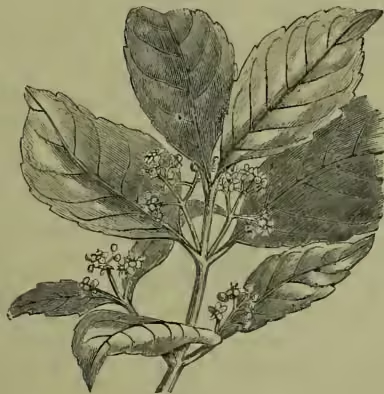
Maté, or PARAGUAY TEA, a substitute for tea, extensively used in South America, and almost universally through Brazil. It consists of the leaves and green shoots of certain species of Holly (q.v.), more especially Ilex Paraguayensis, dried and roughly ground; the leafy portion being reduced to a coarse powder, and the twigs being in a more or less broken state. The term maté, which has by usage attached to this material, belonged originally to the vessels in which it was infused for drinking; these were usually made of gourds or calabashes, often trained into curious forms during their growth. Into the hollow vessels thus formed a small quantity of the material, more properly called Yerba de Maté, is put, and boiling water is added; it is then handed round to those who are to partake of it, and each, being provided with a small tube about eight inches in length, with a small bulb at one end, made either of basket-work of wonderful fineness or of perforated metal, to act as a strainer and prevent the fine particles from being drawn up into the mouth, dips in this instrument, which is called a bombilla, and sucks up a small portion of the infusion, and passes the maté-bowl on to the next person. It is usual to drink it exceedingly hot, so much so as to be extremely unpleasant to Europeans. Its effect is much the same as tea, stimulating and restorative; and it derives this property from the presence of a large proportion of the same principle which is found in tea and coffee—viz. Theine. The collection and preparation of maté is a large industrial occupation in Paraguay and Brazil.