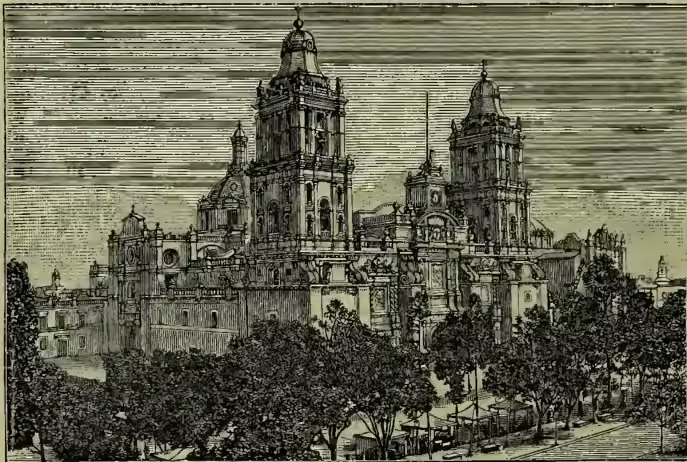
Mexico (City), the capital of the republic, is situated 7347 feet above the sea, at the lowest level of the great lacustrine basin (1400 sq. m.) of the Anahuac plateau. Lake Tezucuo, the largest of the six lakes that occupy this hill-girt valley, and amid whose waters, Venice-like, the city first rose, has now retired 2½ miles to the north-west—partly filled up by drainage deposits. In the Aztec city the principal thoroughfares radiated from an immense central square, in which towered the great temple of Huitzilopochtli; and this arrangement is yet preserved in the modern capital. All the main streets converge on the Plaza Mayor, where the site of the old teocalli is occupied by the no less famous cathedral (1573-1657). The walls of this imposing building, forming a cross 426 by 203 feet, alone cost nearly £400,000, and the interior, with its twenty chapels and elaborate ornamentation, much more. Built into the foot of one of the two open towers (218 feet) is the famous 'Aztec' (Toltec) calendar stone. Facing the cathedral is the Municipal Palace, and on the sides of the plaza are the National Palace (the old vice-regal residence), the national Monte de Piedad, the post-office, and the national museum. Other noteworthy buildings are the national picture-gallery and library, the school of mines, the mint, the Iturbide hotel, and the former palace of the Inquisition, now a medical college; and, mostly in secularised ecclesiastical edifices, there are also schools of law and engineering, a conservatory of music, and an academy of fine arts. There are still left fourteen parish and a number of other churches, including the cathedral of the American Episcopal mission. The principal streets are broad, clean, and well paved and lighted, with houses of stone gaily painted in bright colours. Among the monuments of the city are the noble Columbus monument (1877), the statue of Cuauhtemotzin, the last of the Aztec emperors, and that of the engineer Martinez (1883). In addition to the alameda, with its stately beeches, Mexico is remarkable for the extent and beauty of its paseos, or raised paved roads, planted with double rows of trees, which diverge far into the country from every quarter; and there are still on Lakes Chalco and Xochimilco, where a line of steamers runs, a few of the floating gardens for which the ancient city was so celebrated. Attempts have long been made to drain the valley of Mexico. A tunnel through the lowest hills to the Tula River (5 miles), cut in 1607-8 by Martinez, proved insufficient, and the city was flooded from 1629 to 1634; and even an open cut through the mountains (1637-67), now 10 miles long and with a greatest breadth of 361 and a greatest depth of 197 feet, has never entirely fulfilled its purpose. Consequently, in the city, with a temperature that never ranges beyond 70° and 50° F., from one-
JUAREZ and MAXIMILIAN. On the death of Juarez in 1872, the chief-justice, Lerdo de Tejada, assumed the presidency, in which, after a revolution, he was succeeded in 1876 by Porfirio Diaz, one of the ablest of Mexican rulers. He was re-elected in 1884, in 1888, and in 1896; and under him the position of the republic, with regard both to security and to development of its resources, has steadily improved.
See David A. Wells's Study of Mexico (New York, 1887); also Madame Calderon de la Barca, Life in Mexico (1843); Brocklehurst, Mexico To-day (1882); Castro, Mexico in 1882 (New York, 1882); F. A. Ober, Travels in Mexico (Boston, 1884) and Mexican Resources (1885); Von Hesse-Wartegg, Mexico, Land u. Leute (Vienna, 1890); Mrs F. C. Gooch, Face to Face with the Mexicans (1890); and Sir Francis Denys' Report on the Finances and Land System of Mexico (1890). An excellent history is H. H. Bancroft's Popular History of the Mexican People (1888); see also, besides the articles CORTES and LAS CASAS, Orteja's Apostólicos Afanes de la Compañía de Jesus en la América Septentrional (Barcelona, 1754; new ed.—Historia de Nayarit, &c.—Mexico, 1887); Mora, Mexico y sus Revoluciones (8 vols. Paris, 1834), and Documentos para la Historia de Mexico (20 vols. Mexico, 1853-57); Lerdo de Tejada, Comercio exterior de Mexico desde la Conquista hasta hoy (Mexico, 1853); Frost, History of Mexico (New Orleans, 1882); Ballou's Aztec Land (Boston, 1890); and Miss Susan Hale's volume in the 'Story of the Nations' series (1891). For the Antiquities, see Prescott's Conquest of eighth to one-fifth of the deaths are due to consumption and pneumonia, and one-third to typhoid and other fevers. It is only the extreme dryness of the atmosphere that renders the site habitable at all. New works, on a very large scale, intended to drain the valley, were begun in 1890 by two English companies, and were practically completed in 1895, at a cost of £2,600,000. The trade of Mexico is chiefly a transit trade, and its manufactures (cigars, religious art objects, pottery, silver-work, &c.) are unimportant. Foreign enterprise is already working great changes, and there are now railways to Vera Cruz (263 miles), to El Paso (1224), Laredo (840), and Ciudad Porfirio Diaz (1089)—the last three on the Texan frontier—as well as other points. Pop. 350,000.