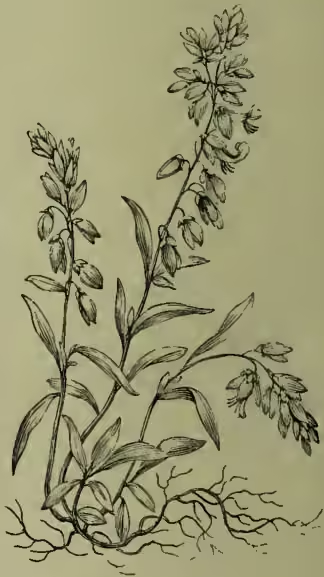
(Polygala vulgaris).
Milkworts (so called from the milky juice) are various species of plants belonging to the natural order Polygaleæ or Polygalaceæ. The order comprises about 20 genera and 500 species which are widely distributed over the tropical and subtropical parts of the world; several species are natives of North America and of Europe. They are herbaceous plants or shrubby, occasionally in the latter case being of climbing habit. The leaves are usually simple and destitute of stipules; the flowers are irregular. Their qualities are generally tonic and slightly acrid; and some, as Krameria, are very astringent.—The Common Milkwort (Polygala vulgaris) is a small perennial plant, growing in dry hilly pastures, with an ascending stem, linear-lanceolate leaves, and a terminal raceme of small but very beautiful flowers, having a finely-crested keel. It varies considerably in size, in the size and even shape of the leaves, and in the size and colour of the flowers, which are sometimes of a most brilliant blue, sometimes purple, pink, or white.—P. Senega is a North American species, with erect simple tufted stems, about one foot high, and terminal racemes of small white flowers. The root, which is woody, branched, contorted, and about half an inch in diameter, is the Senega Root, Seneka Root, or Snake Root of the United States, famous as an imaginary cure for snake-bites, but really possessing important medicinal virtues—stimulating, diuretic, diaphoretic, emmenagogue, and in large doses emetic and purgative—employed in catarrhs, pulmonary affections, rheumatisms, low fevers, &c. Its chief active principle is Polygalic Acid, . The root of P. Senega has been employed as a cure for snake-bites by the American Indians from time immemorial, and it is a curious fact that P. crotalariaoides is employed in the same way in the Himalayas. P. vulgaris is tonic, stimulant, and diaphoretic; and P. amara, a very similar European species, possesses the same properties in a higher degree, as does P. rubella, a small North American species. The root of P. poaya, a Brazilian species, with leathery leaves, is an active emetic, and in a fresh state is employed in bilious fevers. P. tinctoria, a native of Arabia, furnishes a blue dye like indigo. P. vcnenosa is by the natives of Java dreaded on account of its noxious heavy odour, which they say causes severe headache and violent sneezing. Another medicinal plant of the order is Rattany (q.v.) Root. The bark of the roots of Monnina polystachia and M. salicifolia is used in Peru as a substitute for soap; and Mundia spinosa, a South African shrub, produces an eatable fruit.