Mill. This word is now used in a general way as a name for almost all kinds of manufactories, as well as for machines used for grinding; but in this article we shall describe only a flour-mill. For other mills, see SPINNING, WEAVING, COTTON, FLAX, WOOL, &c.
From time immemorial, until quite recent times, wheat has always been ground between two stones. At first hand-mills were used such as are so often mentioned in the Bible, and are still met with amongst uncivilised peoples (see QUERN); but the mill subsequently passed through many mechanical developments up to the large merchant mills now found in every civilised country, some of which recently contained upwards of 100 pairs of large millstones. These were made of 'buhr,' a very hard silicate, the best stones coming from the valley of the Seine. The millstones were circular, usually about four feet in diameter, formed of wedge-shaped pieces strongly cemented together, and bound by iron hoops. The surfaces were cut into a series of radiating ridges and furrows, by which means the wheat was pushed from the centre to the circumference of the stones, as well as broken between the edges of the ridges. Great care had to be taken that the surfaces of the two stones were perfectly level and perfectly parallel to each other. Only the upper stone or 'runner' revolved, the lower or 'bedstone' being fixed. The first successful steam flour-mill was erected in London in 1784.
Iron rollers in place of millstones were first practically tried at the roller mill in Pest, founded in 1840 by the patriot Count Szechenyi. This new system, called 'the high grinding or gradual reduction roller system,' ultimately spread throughout Hungary, and made Budapest for many years the greatest flour-milling centre in the world. By 1875 this system had been adopted by the millers of the north-western states of America, and has enabled them to outstrip their teachers: Minneapolis is now the largest flour-milling centre in the world, and its mills send a great quantity of flour to England. Since 1880 this system has been universally adopted by large mills, and is being gradually introduced into small mills also. The great advantage of rollers over millstones is found to be that the former avoid the rasping of the outside of the wheat berry which was inseparable from millstones, and produced a small quantity of very dark powder which necessarily mixed with the flour and greatly deteriorated its colour.
The following is a description of the different processes which together form the 'high-grinding' or 'gradual reduction' system of flour-milling. (1) The wheat is cleaned or 'smutted,' as it is termed, by means of sifting, winnowing, and being put through a cylinder of wire-cloth, with rapidly revolving arms inside, which combines the actions of sifting and polishing the wheat. A machine furnished with hard brushes is often employed to scrub the wheat. (2) The cleaned wheat is sent to grooved chilled-iron rollers (see fig. 1), and slightly broken between them; the product is sifted by means of cylinders covered with wire-cloth or silk-gauze, by which means a proportion of flour is separated, mixed with a substance composed of small pieces of the floury part of the wheat berry, and called usually 'middlings,' sometimes 'semolina.' The pieces of broken wheat are sent to other rollers to be again broken, and the product sifted as before. This process is repeated from four to seven times, according to the ideas of the miller and the nature of the wheat, until, as far as possible, all the floury part has been scraped from the husk or 'bran,' which is sold for fodder.
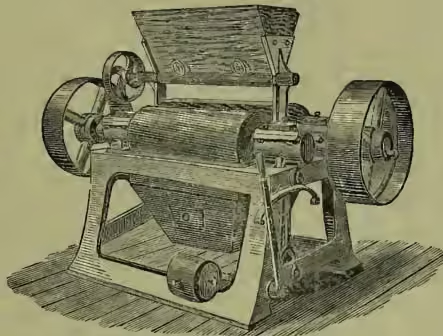
We are thus left with the mixture of flour and 'middlings' from the four to seven breaking processes. The products from the different breaking processes are generally mixed together and then sifted as before described, in order to separate the flour which is then ready for use from the 'middlings,' which are then put through the process called 'purification.' It may here be mentioned that the making of a large quantity of 'middlings' is the principal difference between the former 'low-grinding' and the present 'high-grinding' system, and is the chief advantage of the latter. By the former process it was sought to reduce the wheat at one grinding as far as possible into flour and bran: it was, however, found to be impossible to keep the two separate, a portion of finely-powdered bran being inevitably mixed with the flour, greatly to the detriment of the latter. By high-grinding, the floury part is reduced in the first instance principally to a granular state, and, though bran particles are mixed with the flour granules, they may be almost entirely separated, owing to the difference in their specific gravity, by means of this process of purification. (3) The size of the granules of the middlings varies from that of fine sand to that of a pin's head. The middlings are therefore first separated by sifting into as many sizes as may be thought desirable, and each size is sent to one or more machines called 'middlings' purifiers. These are of two types, called 'gravity' and 'sieve' purifiers. In the first type, which is generally used for the large sizes of middlings, the material is directly acted on by a draught of air. The machine usually takes the form of a series of sloping boards, or of revolving discs, by either of which devices the middlings are caused to fall repeatedly in a thin even stream through a current of air produced by a revolving fan. As the specific gravity of the flour granules is greater than that of the bran particles, it is obvious that the current of air may be so regulated as to carry away the particles of bran, leaving the flour granules to fall to the bottom of the machine.
The sieve purifier generally takes the form of an oblong box, or case, of wood; occupying the centre plane of this case a sieve formed of silk-gauze is suspended by springs from the top of the case, and is made to oscillate by means of a crank. A revolving fan is placed at the top of the machine, which draws air through the meshes of the sieve, the current of air being so regulated that the branny particles are either carried away by the draught to a suitable receptacle, or are kept suspended on the top of the sieve until they are carried over the end of it, while the heavier flour granules fall through the sieve. This type of machine is always used for the smaller sizes of middlings. It is the dust drawn from these machines by the fans that, when mixed in a certain proportion with air and accidentally ignited, has caused several very serious explosions in flour-mills. In consequence of this, whereas it was formerly usual to send this dust-laden air to a large chamber where the dust was allowed to settle by its own weight, and where the explosions generally occurred, within recent years many ingenious contrivances called 'dust collectors' have been invented for separating the dust in small quantities, and thus minimising the danger. These are now generally used. The middlings, after being thoroughly cleaned (by repetition of the process when necessary), are ground between smooth chilled-iron rollers and the product sifted; the flour thus produced is of fine quality, and is usually called 'patent' flour. Millstones may still be profitably employed to grind the finest sizes of middlings, but this is the only use to which they are put in a modern mill.
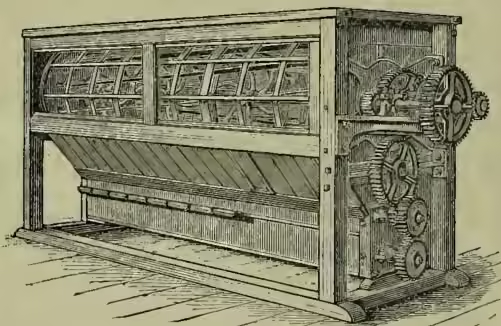
Fig. 2 represents one type of cylinder used for sifting (technically, 'dressing') the products in flour manufacture, to which we have several times had to refer. These cylinders are of two kinds, the ordinary 'reel' or cylinder being a framework covered round with wire-cloth or silk-gauze, and made to rotate, thus setting in motion the enclosed material. The other type is called a 'centrifugal dressing' machine (see fig. 2). In this machine, in addition to the rotating cylinder, there is a frame with long pieces of wood or iron attached, made to revolve independently inside the cylinder. By this means the material is thrown against the circumference of the cylinder, so that a much smaller surface is required than in the ordinary reel to do the same amount of work. The 'Plansichter,' introduced in Budapesth in 1888, which, as its name implies, is a horizontal sieve, has a special contrivance for keeping the material in motion, and the meshes clear. This machine has made considerable progress in Hungary, but it is as yet too early to predict that it will supersede the cylindrical 'dressing' machines. Almost all modern mills are constructed on what is termed the automatic system, which means that all the conveyance of the material from one point in the mill to another is done by mechanical means; so that of the great bulk of the flour it may be said that it is never stopped or touched on its journey from the time it leaves the wheat sack until it reaches the flour sack. The conveyor generally used to move material in a horizontal direction is a helical screw (sometimes called an Archimedean screw); and to lift to a higher level an Elevator (q.v.) is used.
See Fairbairn, Mills and Mill-work (1878); Kick, Flour-manufacture (trans. 1878); Voller, Modern Flour Milling (1889); Bennett and Elton, History of Corn Milling (1898).