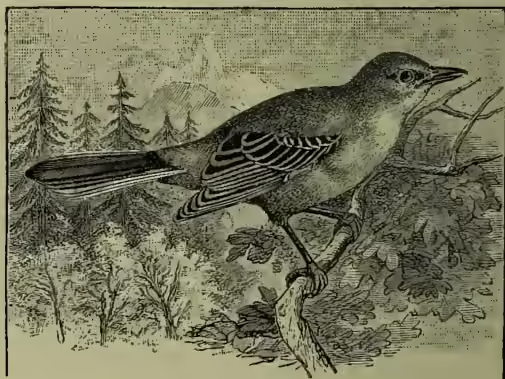
Mocking-bird, or MOCKING-THRUSH (Mimus), a genus of birds of the family Turdidae, order Passeres, having a more elongated form than the true thrushes, a longer tail, shorter wings, and the upper mandible more curved at the tip. Twenty species are known, ranging from Canada to Patagonia, and from the West Indies to the Galapagos Islands. The best-known species, the mocking-bird of the United States (M. polyglottus), is about the size of the song-thrush; the upper parts of a dark brownish ash colour, the wings and tail nearly black, the under parts brownish white. The mocking-bird is common in almost all parts of America, from the south of New England to Brazil; north of the Delaware it is only a summer visitant, but in more southern regions it is found at all seasons. It is one of the most common birds of the West Indies, and its exquisite song fills the groves with melody by night, for which reason it is there very generally known as the nightingale. By day the mocking-bird is generally imitative, excelling all birds in its power of imitation, now taking up the song of one bird, and now of another, and often deceiving the most practised ear by its perfect performance. By night its song is for the most part natural. It does not confine itself, however, to musical strains; it seems to take equal pleasure in repeating the harshest cries of the feathered tribes, and in domestication readily adds to its accomplishments the imitation of almost any sound which it is accustomed to hear, passing from one to another with great rapidity, so as to produce an incomparable medley. The mocking-bird readily learns to whistle a tune, even of considerable length, but there is no well-authenticated instance of its imitating the human voice. The barking of a dog, the mewing of a cat, the crowing of a cock, the cackling of a hen, the creaking of a wheel-barrow are all within the compass of its powers. During its performances it spreads its wings, expands its tail, and throws itself about, as if full of enthusiasm and enjoyment. The mocking-bird is vocal at all seasons of the year. It enjoys almost everywhere the protection of man, and often makes its nest in a tree or bush close beside a house. The nest is rudely constructed of dried sticks, withered leaves and grasses, and lined internally with fibrous roots. The eggs are of a short ovoid form, and of a light-green colour spotted with amber. For the first brood from four to six are laid; for the second, four or five; and when there is a third brood, seldom more than three. The first brood is hatched about the middle of April. The male is extremely attentive to his mate, and manifests extraordinary courage in driving away enemies from the nest. Mocking-birds often assemble on such occasions, and birds of prey, far superior to them in size and strength, are compelled to retreat. Snakes are killed by reiterated blows on the head, and cats learn to consider the vicinity of a mocking-bird's nest unsafe. The food of the mocking-bird consists chiefly of berries and insects. The mocking-bird is easily reared by the hand if removed early from the nest, but it is said that it never attains in captivity the same wealth of song as in its free state. Another species of mocking-bird is found in the Rocky Mountains, and species of the same genus are among the finest song-birds of the temperate parts of South America.