Monkey. This term may be conveniently restricted only to all the Primates exclusive of the Anthropoid Apes (q.v.). It has been sometimes applied to the tailed forms only, the rest being spoken of as Apes. This use of the words monkey and ape is ill-judged, inasmuch as it implies that the non-anthropoid Primates are divisible into tailed and tailless species. The real distinction is not to be found in this character. The quadruped as a whole are divisible into three great groups—(1) Anthropoid Apes; (2) Platyrrhini, the New-World monkeys; (3) Catarrhini, the
Old-World monkeys. It is the two latter divisions that are dealt with in the present article.
In the Platyrrhini the nostrils are far apart; the tail is prehensile, and the number of premolar teeth is in excess of that of the Catarrhini, the dental formula being (for the molars and premolars) p.m. , m. . In the marmosets the formula is p.m. , m. ; this, coupled with some other peculiarities in their anatomy, led to the institution of a distinct group—Arctopithecini, regarded as equivalent to either the Platyrrhini or Catarrhini. They are now, however, more usually referred to the Platyrrhini, though placed in a separate family.
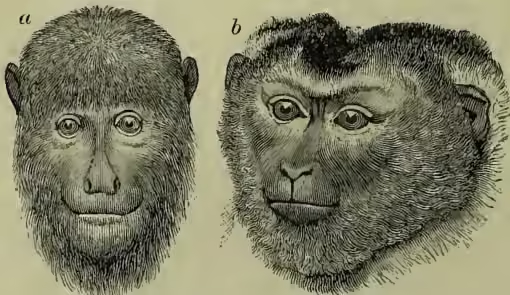
In the Old-World monkeys, or Catarrhini, the nostrils are near together; the number of teeth 32, and these arranged as in the anthropoid apes and man; the molars and premolars being p.m. , m. —the reverse of the condition seen in the Marmosets. The tail, when present, is never prehensile; and three are frequently ischial callosities developed, which structures are entirely unknown among the American monkeys.
The two divisions of the monkey tribe based upon those characters are absolutely distinct in their geographical distribution. The Platyrrhini are only found in America, the Catarrhini are limited to the Old World; further than this, the fossil species, which have not been found in strata earlier than of the Miocene period, show the same rigid correspondence between structure and distribution. No Platyrrhine has been met with in the Old World, and no Catarrhine in the New. Whether this indicates that the monkeys of the two hemispheres have had an independent origin or not, is a matter for further inquiry; it must indicate in any case the remoteness of the period during which there was a passable land connection between Asia and America.
In both the Old and New Worlds monkeys are almost confined to the more tropical districts; and yet this is not entirely due to an incapacity for bearing a rigorous climate, for monkeys occur high up on the sides of mountains in India. Monkeys do not occur in the tropical parts of Australia. During the Miocene and Pliocene periods these animals inhabited Europe and even England, for the remains of a Macaque have been described from the county of Essex. At present the only trace left in Europe of these inhabitants is the Macacus inuus or Barbary Ape, which occurs on the Rock of Gibraltar as well as on the opposite coast of Africa. But this animal is perhaps not truly indigenous; it may have been introduced.
In the New World monkeys are most abundant in South America. The forests of the Amazon and the Orinoco may be regarded as their headquarters. There are only ten species which occur north of the Isthmus of Panama, and only one of these extends its range into Mexico; this is a Spider Monkey.
The West Indian islands contain no indigenous monkeys. The American monkeys are all arboreal; and this of course limits their range to forest-clad districts. The prehensile tail has an obvious relation to their mode of life. But it is a most singular fact that the long-tailed monkeys of the Old World, which might often gain considerable advantage from being able to use their tail as a grasping organ, are totally unable to do so.
Some of the more remarkable kinds of monkeys are noticed in separate articles (BABOON, BARBARY APE, ENTELLUS, HOWLER, MARMOSET, &c.).