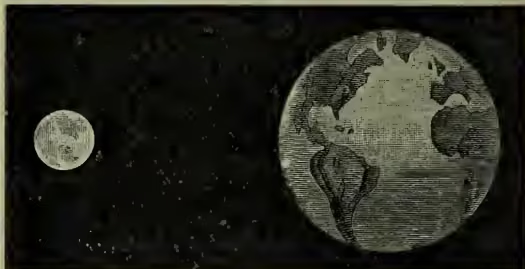
Moon, the satellite of the earth. It ranks among the larger satellites of our system, being an almost perfect sphere of 2160 miles in diameter. It revolves at a mean distance from the earth's centre of 238,833 miles. Its total surface is 0.074 of the earth's, or in sq. m. 14,657,402; and its volume 0.02034 of the earth's, or in cubic miles 5,300,000,000, or in terms of the sun's volume only . Its mass is 0.0128 of the earth's, or in tons 78,000,000,000,000,000,000. Its density is 3.57 that of water, or 0.63 that of the earth. It travels in its orbit with a velocity of 3334 feet per second, and its equatorial velocity of rotation is 10 miles per hour. Presenting as large a surface to the eye as the sun, and changing both its form and position with great rapidity, it has necessarily always attracted a large measure of attention, and has proved in early ages and among savage peoples the most useful of the heavenly bodies for the measurement of time. Its motions, always interesting, have in modern times been most carefully observed and calculated, from their great value in enabling the traveller and navigator to determine the longitude (see LATITUDE AND LONGITUDE).
The explanation of the moon's changes of shape, from a thin crescent to a full disc, is the first problem presented to the most careless observer. A little watching shows that these are due conjointly to the globular form of the moon, its motion, and the fact that it does not shine by native light, but simply reflects the solar rays. The illuminated (or convex) edge of its figure is always turned towards the sun. When right opposite the sun it appears as full, and sometimes is so situated as to be partially obscured by the earth's shadow, the earth intercepting the solar light by which alone it shines. When it is near the sun in the sky it appears as a thin crescent, turning almost entirely its dark side to the earth. Sometimes, at new moon, it comes between us and the sun, obscuring his disc either in a partial or total Eclipse (q.v.). At either half moon the moon is said to be in quadrature, or in the 'first' or 'last quarter.' At new and full moon it is said to be in syzygy (Gk. syn, 'together;' zygon, 'yoke'). Our own observation will soon show that these changes result from the constant illumination of one side of the moon, and constant darkness of the other, the crescent being larger or smaller as, from the moon's change of position, we see more or less of the bright side.
Thus we see that the moon's phases depend on its motions over the sky, with reference to the sun. These motions and their causes we next consider. And it is most convenient in doing so to discuss first the apparent motions—i.e. the manner in which the moon moves over the surface of the sky, changing place like a driving cloud, though not with the same rapidity.
We can reduce all such motions to movements in the two easily-noted directions, first, north and south; secondly, east and west. And it is most convenient to take the sun as our point of reference. Sometimes the moon is north of the sun, and sometimes south, sometimes east of it, and sometimes west. It moves, then, in both of our two directions. But when we compare the east and west motion with the north and south we soon note an important difference. The east and west motion is continuously and steadily from west to east, carrying the moon right round the heavens; starting at new moon near the sun, and progressing until at full moon nearly the whole breadth of the sky separates them; then still progressing, until the sun is approached again from the opposite side. In fact, if the sun stood still at its setting for a lunar month, we should see the moon soar steadily upwards in the western sky, cross the whole expanse of heaven, and pass down below the eastern horizon. Then it would continue its course, returning to the sun, beneath our feet, and reach nearly its original position. To perform this cycle the moon takes 29.53 days, which is called its synodical period. If we took a bright star as the starting-point and goal of the moon's circle, instead of the sun, we should find the moon only take 27.32 days to return to the star. This is called the moon's sidereal period. The cause of the difference is that the star is steady in its position, while the sun slowly moves in his annual course in the same direction as the moon, which therefore has to overtake the sun when returning to him. Thus the motion from west to east is always in the same direction; but this is not the case with the north and south motion. While performing its cycle from west to east, say in the month of March, the moon begins by travelling northward at first, but latterly swings as far southward. In autumn the reverse is the case (see below). In December full moon occurs at the most northern point of its course, and in June at the southernmost. In winter, therefore, we have at night most light from the full moon, and in summer least. In March the evenings have least moonlight, and in September they have most. Attentively considering all these movements, we soon see that the moon travels round the earth in a curve not differing very much from a circle, for as it always appears nearly of the same size, it must remain constantly at nearly the same distance from the earth.
We have now almost insensibly passed from the observation of apparent motions to the idea of an orbit or path, which the moon traverses. And this leads at once to the consideration of the nature of this orbit, or the moon's real motions. Accurate observation reveals that the moon's distance from the centre of the earth is not the same in different parts of its orbit. It varies in apparent diameter from a maximum of 33' 31" to a minimum of 29' 21". As this variation forbids the idea that the orbit is a circle concentric with the earth, so it also forbids the idea that it is a circle eccentrically placed in regard to the earth. The true form is found to be that of an ellipse having an eccentricity of 0.05491, with the earth in one of the foci. This ellipse is, however, continually distorted by various inequalities to be noticed hereafter, chiefly due to the sun's attractive energy, which continually contends with that of the earth for the mastery over its satellite.
The lunar orbit is inclined to the ecliptic (or earth's orbit) at an angle of 5° 8' 40". The points where the two intersect are called the Nodes (q.v.), and the line joining them the line of nodes. The point of her orbit nearest the earth is the perigee, that most distant is the apogee, and the line joining them is called the line of apsides. Both the line of nodes and line of apsides change their place, the former turning completely round in 6793.391 days = 18.6 years, the latter in 3232.57 days = nearly 9 years. These motions take place, however, in opposite directions: the line of apsides revolves with the moon's orbital motion, the line of nodes against it. These motions are due to the sun's disturbing influence (see PERTURBATIONS). Each day, on an average, the moon describes 13° 10' 35" of the circle of her path. To do this requires, at its distance, an actual velocity of 2273 miles per hour. This velocity is found to be exactly what is required to balance the moon's weight, supposing that to be reduced in proportion to the square of its distance from the earth. Thus Newton concluded that the force retaining the moon in its orbit is simply its weight, or the mutual gravitation between it and the earth. This conclusion is verified by the elliptic form of the orbit, and the place of the earth in one focus. For an orbit of this form is produced by a force varying inversely as the square of the distance. Both the form of the orbit, then, and the varying nature of the force governing it, as well as the powerful disturbing influence of the sun, cause variations in the moon's velocity. Usually these are allowed for by taking as a foundation the mean or average angular velocity given above, and considering its variations under the title of inequalities, which must all be allowed for if the moon's place in the sky is to be predicted with accuracy at any time.
First in order is the elliptic inequality discovered by Hipparchus. It is caused by the quicker or slower motion of the moon as it passes over the nearer or more distant parts of its elliptic orbit. Its value is 6° 18' nearly. Secondly, there is the annual equation (discovered by Tycho Brahe), a yearly effect, arising from the increase and diminution of the sun's disturbing force, as the earth approaches or leaves the sun in its annual course. This amounts to 11' 10", and, as our earth is nearer the sun in winter and farther off in summer, it causes the moon to be behind its mean place in the first part of the year and before it in the later months. Thirdly, there is the variation (discovered by Abul-Wefa). This arises from the changes in direction and amount of the sun's disturbing force, which are caused by the moon's motion in its own orbit. Its effect on the moon's longitude may amount to 39' 31". Fourthly, there is the evection, depending on the position of the axis of the moon's orbit, and the line of nodes, with regard to the sun. Its effects are complicated, but may amount to 1° 16' 27" on the moon's longitude, and 8' 57" on its latitude.
Besides these, the parallactic inequality is interesting, as giving a means of calculating the sun's distance from our earth. The sun's disturbing action varies in amount as the moon in its orbit is nearest or farthest away from the sun. This variation depends on the ratio of the moon's distance to that of the sun; so that, knowing the amount of the inequality and the distance of the moon, a value may be found for the sun's distance. Hansen showed by this means that the value long received for the sun's distance required to be diminished. See PARALLAX, SUN.
The secular acceleration of the moon was discovered by Halley in 1693 from a comparison of the times of Eclipses (q.v.) many centuries apart. This inequality is an increase of the moon's mean motion by about 12" per century. It is partly due to a slow change in the form of the earth's orbit, by which the sun's disturbing force is slightly lessened, which is equivalent to an increase of the earth's attractive force, whereby the moon's angular velocity is increased. This part will, however, compensate itself in the course of ages. It is partly also due to a slow lengthening of the day—i.e. the period of the earth's rotation, which arises from the frictional action of the tides, that act like a brake upon the earth's surface. This portion remains uncompensated, of course.
The moon's distance from the earth is obtained by observations of its place from two widely-separated stations, such as the observatories at Greenwich and the Cape of Good Hope. If simultaneously observed from these, the moon will not appear to both observers in the same position among the stars; the amount of difference in apparent position depending on its distance from the earth at the time. From this difference is deduced the moon's horizontal parallax. This is the change in the moon's place which would be noted by an observer on shifting his place from the centre of the earth to a point on its surface where the moon would be seen on the horizon. The moon's mass being very nearly th of the earth's, the force of lunar gravity at the moon's surface is then such that any object would weigh there only 0.15 of its weight at the earth's surface, and a falling body would there only traverse 2.48 feet in the first second of its course. The moon's rotation on its axis agrees in period with its revolution round the earth, so that, as has been said, we have tion. The delicate colouring and shade of terrestrial scenery is entirely absent. All is marked in white and black, or in various shades of yellowish gray. Nothing like mist, cloud, or vapour has ever been seen, except in some doubtful instances on the floor of the crater Plato, or other deep depressions. There is neither water to furnish vapour, nor atmosphere fit to bear clouds. Observation of the stars occulted by the moon (see OCCULTATIONS) confirms this, and, if there be even an attenuated atmosphere, it cannot have more than th of the surface-density of our own. Bessel's maximum value for this of th has been shown by Neison to be too small, and it is not improbable that the moon possesses an atmosphere of extreme rarity, having a surface-density of probably about th that of the earth. Vegetation and animal life appear to be equally absent from the moon, and the best modern theories of its state require us to regard the surface as either bare rock and sand, or as ice and snow. These theories have arisen in the attempt to explain the strange forms of the lunar surface. These forms have been classified, and the arrangement commonly in use is followed here as convenient. But it must not be regarded as a really scientific one. For some formations, while in their general aspect belonging to one class, might really be assigned to other classes in other respects.
The term Mare (Lat.) has been applied to the large dark plains, an example of which is the Mare
Crisinum, easily seen as an oval dark spot near the edge of the new moon. There are also large level areas which are brighter, and to which no special name has been attached. To one large irregular dark plain the title of Oceanus Procellarum has been given. The terms Palus (marsh), Lacus (lake), and Sinus (gulf) have been somewhat fancifully used to denote smaller dark areas.
Under the broad title craters have been grouped many formations, so different from one another that selenographers now divide them into walled plains, mountain-rings, ring-plains, crater-plains, craters, craterlets, crater-pits, crater-cones, and depressions—names expressive enough of more or less circular ramparts varying in size from 150 miles in diameter to a few hundred yards, and in depth, or height of walls, ranging from 18,000 feet downwards. In some parts of the lunar surface these literally swarm, crossing and interrupting one another, smaller ones perched on the edge or sides of larger ones, and, generally, in the flat bottom of the larger ones several of the smaller kinds are sure to be seen. Any moderately good telescope will show the larger kinds. Besides these there are the true mountain ranges, called the Lunar Alps, Apennines, Cordilleras, &c., similar in most respects to terrestrial chains. These range from 20,000 feet in height downwards, and where their profile is seen at the edge of the lunar disc they form distinct notches. The lunar rills (so named by Schröter, their discoverer, in 1787) are clefts or cracks in the surface, passing often right through mountains and valleys, sometimes for a distance of 300 miles, their breadth being relatively so small as to give them the appearance of true cracks.
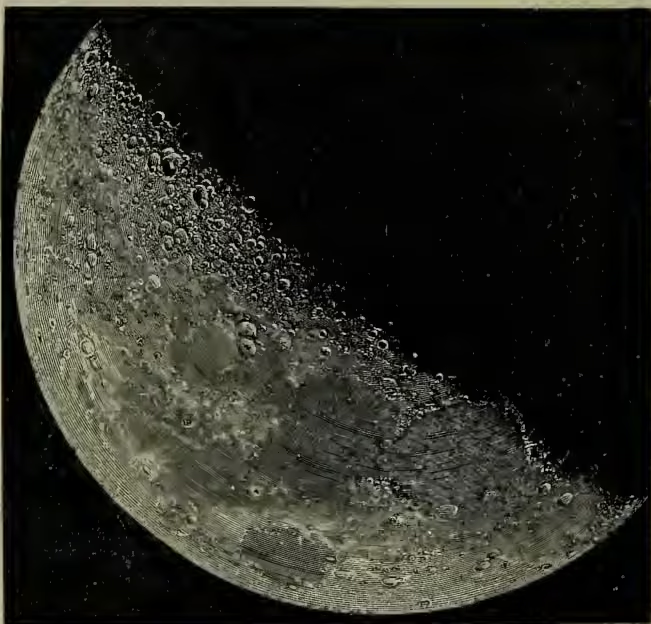
Most striking of all lunar appearances are the broad white rays, which diverge from some of the principal lunar ring-plains. Those proceeding from Tycho extend, in one case at least, nearly 2000 miles. There are hundreds of them, and they always the same side presented to our view. Occasionally, however, we see a little round one or other edge owing to Libration (q.v.).
From these conditions of size, density, and mass we should expect that, while presenting some features of agreement, in most respects the moon would differ widely from the earth in physical condition. Even to the naked eye some peculiarities are obvious. Attentively watching the full moon, we soon become familiar with its irregularly-spotted surface, which never changes. It cannot then be like that of the earth, which is often obscured by clouds and mist. The telescope confirms this impression. All the details of the lunar surface are hard, cold, and glaring in their delineation. range from 10 to 20 miles broad. They pass right on over mountains and plains, partaking of the shape of the surface at all points, but distinct from it in brightness. There are seven principal systems of these inexplicable streaks.
To denote the relative brightness of lunar formations a scale is used, the brightest being called , and the less bright , , &c., down to . These formations are variously named. The principal mountain ranges have been named after those on the earth. The craters are named after astronomers or philosophers, as Tycho, Plato, Aristotle, &c. The different parts of these, and smaller objects near them, are known by Greek or Roman letters, attached to the name of the chief object. Greek letters are used for peaks and hills, Roman letters for craters and depressions. Capital letters imply measured objects. For rills the letters , , , , , and are chiefly used. But there are occasional variations from these rules, as in the case of most astronomical nomenclature.
These peculiar appearances, so different from those around us on the earth, have much puzzled astronomers. The usual theory attributes them to volcanic action, combined with shrinkage of the lunar globe on cooling. A recent theory explains them as the result of slow glaciation, the craters being lakes, around whose margins the quickly condensed vapour from their surfaces has fallen in mountains of ice. The craters are vents for water-vapour, and their cones masses of ice. To this theory the extreme rarity of the lunar atmosphere is favourable, but it cannot be said, any more than the volcanic theory, to meet all the difficulties. No thoroughly satisfactory explanation has as yet been proposed.
The total amount of light given by the full moon is probably less than th of the sun. Its photographic intensity, however, has admitted of several fine photographs being taken, notably by Rutherford of New York, and recently by the fine telescope of the Lick Observatory, California.
Harvest-moon.—At or about the time of harvest in the north temperate zone the sun in its annual course is approaching the celestial equator, which it crosses from north to south on September 22. On that date it sets close to the exact western point of the horizon. If it happens to be then also full moon, the sun rises that evening as the sun sets, and is at its rising opposite the sun, or close to the exact eastern point of the horizon. Thus it begins to give light at sunset, and continues to do so until sunrise, when it sets opposite to the sun, just as the latter rises. This arrangement holds good without any great change for several days, so that there is practically no darkness, especially if the weather be fine. The full moon which thus illumines the autumn nights is called the harvest-moon. No other full moon in the year rises for so many days in succession so soon after sunset. If the date of full moon be not exactly September 22, still the same phenomena occur, though not with the same perfection, and the longer the interval between full moon and that date the less perfect they are. This is because the full moon, being on September 22, coincides with the time when the moon (being at full moon necessarily opposite the sun) is crossing the celestial equator from south to north, at which time its northward motion is most rapid. The position of any body on the Celestial Sphere (q.v.) determines the time of its rising at any place in our latitudes, and, if that position be altered, the time of rising will be altered also. If it moves southward the moon will tend to rise later, if it moves northward it will tend to rise earlier. We have seen that the moon's northward motion is most rapid when crossing the equator. Hence it has then a strong tendency to rise earlier each evening. But its motion towards the east (or downwards, when it is on the eastern horizon) gives it a tendency to rise later. These opposite tendencies, in the case of the September full moon, approach a balance, if the observer be in the latitude of northern Europe. Therefore the moon in that case rises only a few minutes later each evening for about a week. Farther north, about lat. , a balance is attained, and for two evenings the moon rises at the same time. Still farther north it rises earlier the second evening. But the most generally observed phenomena are of course those to be seen between latitudes and , which consist in the nearly full moon rising but little after sunset for several days, in succession. In these latitudes of the southern hemisphere March enjoys the benefit of the harvest-moon, as September does in the north. And as celestial appearances are reversed to observers in different hemispheres, it follows that, when we have most benefit from the full moon, our neighbours at the antipodes have least.
The best charts of the moon's surface are those by Lohrmann, Beer, and Mädler, Schmidt of Athens (a gigantic work), and the Committee of the British Association. For further information readers may consult Der Mond, by Beer and Mädler (1837); The Moon, by Ed. Neison (1876); The Moon, by Nasmyth and Carpenter (1874; new ed. 1885); and for the lunar theory, popularly treated, Airy's Gravitation, and Sir J. Herschel's Outlines of Astronomy.
Superstitions regarding the Moon.—The moon was anciently an object of worship, and even in the 17th century she was supposed by the common people of England to exercise great influence over human affairs. The times for killing animals for food, gathering herbs, cutting down wood for fuel, sowing seeds of various kinds, were all regulated by the 'age' of the moon, and these set periods were considered to be a necessary part of practical knowledge, and ignorance or neglect of them to be infallibly productive of loss. There were similarly defined periods for taking particular medicines and attempting the cure of particular diseases. Many such superstitions prevailed till a recent period in the Highlands of Scotland, favourable or unfavourable consequences from any occurrence being predicted according to the age of the moon at the time it happened. Throughout Scotland the waning moon was considered to have an evil influence, and full or new moon to be the most auspicious season for commencing any enterprise. The same opinion was held in Scandinavia and Germany, and the history of all nations teems with similar superstitions. The special influence of the moon on persons of weak or wavering reason is preserved in our words lunatic and moonstruck, and is still an article of popular belief. Amongst mere superstitions must be ranked the old and widespread belief that the changes of the moon influence the weather on the earth, bringing about fair or rainy, settled or stormy weather; so that from the moon's periods predictions as to the weather may be made. The only known weather influence is a slight but appreciable tendency to dispersion of clouds shortly after full moon. See the article ECLIPSES.
In the Edda we read that 'Mundilföri had two children—a son, Máni ('noon'), and a daughter, Söl ('sun');' and in German the moon is masculine and the sun feminine to this day. It was the same in Anglo-Saxon, although modern English has in this matter followed the classic mythology, in which Phœbus and Soi are gods and Selene, Luna, and Diana are goddesses; Grimm (Deutsche Mythologie, p. 666) quotes an old invocation to the 'New Moon, gracious lord' (Neuer Mon, Holder Herr), for increase of wealth; and down to recent times the German people were fond of speaking of 'Frau Sonne' and 'Herr Mond' ('lady sun' and 'lord moon'). The same inversion (as it appears to us) of gender is found among the Lithuanians and Arabians, and even the ancient Mexican Meztle ('moon') was masculine. Among the Slavs, according to Grimm, the moon is masculine, a star feminine, and the sun neuter. See the Rev. T. Harley's Moon-lore (1886), itself containing a good bibliography.