Mushroom, or AGARIC, the popular name of a somewhat diverse group of genera and species of fungi belonging to the sub-order Hymenomycetes, of the great class Cryptogams. The best known of the true mushrooms to English readers is the Common Mushroom (Agaricus campestris), and it is the type of the sub-order named. In Britain it is the most esteemed of its tribe, though little valued in countries where fungi more generally form an article of diet of the people; in Italy it is disapproved. It should be noted that some of the forms common to Europe and North America are esteemed in England, but found unpalatable in the United States. The Common Mushroom varies considerably in appearance according to soil and locality, but presents in all its variations the same essential characters. It has a fleshy head or pileus, smooth or scaly on the upper surface, varying in colour from white to different shades of tawny or fuliginous brown. The gills (hymenium) on the under side of the head are free, at first pallid, changing by gradations in age to pink, purple, and brown-black. The stem is white, varied in shape, full, firm, furnished towards the top with a white persistent ring. The Common Mushroom is widely distributed in most of the temperate regions of both the northern and the southern hemispheres. In Britain it is abundant chiefly in autumn in pastures and orchards.—The Horse Mushroom (A. cervensis) is very frequently found growing in company with the Common Mushroom. It is altogether
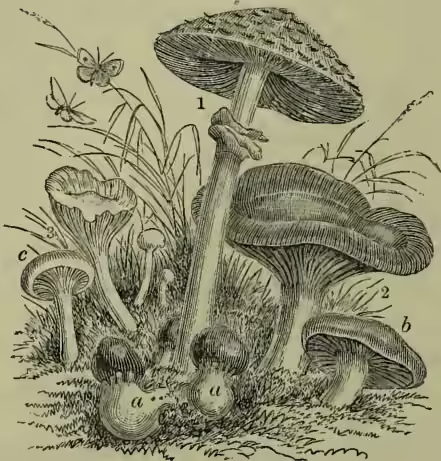
1. Parasol Agaric (Agaricus procerus); a, young. 2. Orange-milked Agaric (A. delicosus); b, young. 3. White Field Agaric (A. virgineus); c, young. a coarser and larger form, and is less favoured for culinary purposes except in the making of ketchup. It often attains enormous dimensions; the top is generally smooth and snow-white, gills brownish white, ultimately with age becoming brown-black, stem pithy or hollow, with a ragged or floccose ring. This is the 'White-caps' Mushroom of some parts of England.—The true St George's Mushroom (A. gambosus of some, or primulosus of others), so called from appearing about St George's day (April 23), is sometimes confounded with the Common Mushroom. The head is thick and fleshy, at first convex, becoming undulated and irregular in outline, light yellow in colour in the centre, fading to opaque white at the edges, gills yellowish white, irregularly interposed, smaller and larger, overlying each other like the plaits of a frill; the stem is solid, white, when young bulging at the base, but in age either equal throughout or tapering to greater thickness above. The skin of this mushroom is soft and firm to the touch, and in appearance has been aptly described by Berkeley as resembling a cracknel biscuit. It is one of the most prized of the Agarics on the Continent, so much so in Rome that a dish of it is considered the most fitting present to any one whose good offices are to be propitiated.—The Fairy-ring Mushroom (A. oryzae; Marasmius oryzae of some), also the Champignon of the French, is common in pastures and in lawns in Britain, and in most parts of Europe. The head is small, smooth, fleshy, convex, having a boss (umbo) in the centre, tough, leathery, elastic, wrinkled; when soaked with water brown, when dry buff. The gills are free, distant, somewhat paler than the head; the stem equal in thickness, twisted, tough, fibrous, of a pale silky-white colour. This species is much esteemed by all who know it. Its flavour is extremely fine, and it is employed in the making of the best kinds of ketchup. On the Continent it is dried and used in the form of a powder to flavour various made dishes. Its peculiar mode of growing in circular patches or in rings, which procured for it its popular name, leads to the risk of an allied but poisonous species which sometimes grows in the same manner being confounded with it. This is the False Champignon (A. or Marasmius urens), which is readily distinguished from the true Fairy-ring Mushroom by its having a flat top without any boss, and by its narrow gills being closely crowded together. The foregoing are the most commonly esteemed of edible British mushrooms. But there are a number of others which are not only wholesome but extremely delicate in flavour and nutritious. There is the Parasol Mushroom (A. procerus); the Maned Mushroom (Coprinus comatus), of which young specimens only should be used; the Red-fleshed Mushroom (A. rubescens); the Clouded Mushroom (A. nebularis), appearing late in autumn in moist places on the borders of woods; and the Orange-milk Mushroom (Lactarius or A. deliciosus). This last is much prized by connoisseurs in edible fungi on the Continent and in Britain. It has, as the name implies, orange-coloured milky sap in the head, and when broken or bruised both the flesh and the milk become green by exposure to the air. This is an
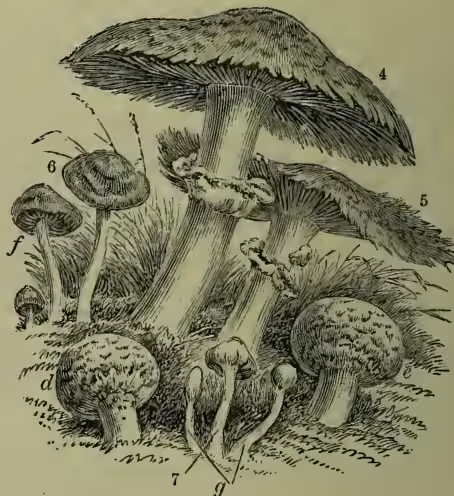
4. St George's Agaric (Agaricus georgii); d, young. 5. Common Mushroom (A. campestris); e, young. 6. Fairy-ring Mushroom (A. oryzae); f, young. 7. Clavaria phalloides; g, young. excellent test when there is any doubt as to the identity of this and an allied but virulently poisonous species—L. torminosus—in which both the flesh and the milk are white, and do not change colour when broken or bruised. Although many of the British fungi are wholesome and nutritious food, yet it is proper that the inexperienced in diagnosing them should be cautioned strongly against eating any species of the wholesome qualities of which they are not absolutely assured. In many continental cities inspectors are appointed to examine all fungi that are brought to market, lest deleterious species should perchance be sold to the people. Those who desire to acquire an accurate knowledge of edible British species of fungi may refer to Dr Badman's Esculent Funguses (1863), M. J. Berkeley's Outlines of British Fungology (1860), M. C. Cocke's Edible and Poisonous Fungi (1894), and other works cited at FUNGI.
The culture of the common mushroom for profit in Britain has since 1875 become an important branch of gardening industry. About London in particular it is entered into by market-gardeners and even by specialists who live and thrive solely by the production of mushrooms for the million. To a lesser extent the industry is also being taken up in the vicinity of the larger provincial towns. In Paris the catacombs are utilised for the growing of mushrooms, as are caves in all parts of France; and in Edinburgh the disused Scotland Street tunnel was acquired in 1886 for the same purpose. The principles of the culture of mushrooms are very simple, though considerable attention and skill are required in working out the practical details. For these, see W. Robinson's Mushroom Culture (1880).