Music. European music is by no means a spontaneous expression of ideas and sentiments, and it is only in a poetical sense that we can talk of the 'music' or 'melody' made, for example, by birds. Music is an art, and in order to make an impression on our minds it must take as its foundation the succession of sounds embodied in the scales we have chosen, and to which we are accustomed; it must also conform to the rules which have become the canon of music. We must look for its birth in Egypt, but it would serve no purpose here to occupy any space with the little that is known of Egyptian, or its offspring Greek music.
It is not improbable that the Israelites took with them to Palestine some songs they had learned in Egypt; and that many of the hymns of the early Christian church were identical with Temple melodies. As from these hymns was formulated the first authoritative musical system, we may say that in a double sense we are indebted to Egypt for the beginning of the modern art. It was St Ambrose towards the close of the 4th century, and Gregory the Great two centuries afterwards, the indication of the measure 'two semibreves to the bar' (Alla Breve). In order to avoid a certain false relation of sound called the tritonus, which the pious old theorists called 'the very devil' ('Mi contra fa diabolus est in musica'), some of the church modes used B instead of B. This was the only 'license' allowed, and was indicated by the 'B rotundum' (b) instead of the 'B quadratum' (b). These signs are the origin of our 'accidentals'—the flat (♭), which lowers the pitch of a note one semitone, and the natural (♮), which restores it. The sharp (♯), which raises the pitch, is also a development of the 'B quadratum.' See also GUIDO ARETINUS.
Counterpoint (1400-1600 A.D.).—Such were the materials with which Johannes Ockenheim or Okeghem (c. 1420-1513) and Josquin des Prés (c. 1450-1521) laid the foundation of Counterpoint (punctus contra punctum, 'note against note'), the art of combining one or more melodic parts with a principal melody called the 'Canto Fermo,' or fixed song. Counterpoint was the workshop in which were made many of the best tools used by great musicians of modern times. The art attained its perfection under Orlando di Lasso and Palestrina at the end of the 16th century, just when a new departure by Monteverde became the inauguration of the new school of harmony which was to supersede the old contrapuntal school by assimilating all that was good therein. Other influences which helped to break the monopoly of church counterpoint were the growing popularity and secularity of Madrigals (q.v.), at first distinguishable only by their words from church music; the improvement in organ-building and organ-playing, which encouraged freer part-writing and bolder melodic progressions than the limitations of unsupported human voices allowed; and doubtless also the natural warmth of musical feeling which had found expression among the troubadours of France and the minnesingers of Germany, and in the rude popular songs of these early ages.
Florence Academy.—Most potent factor of all in this new birth of music was the invention (in 1584-1600) of recitative music and the introduction of the dramatic principle by the Florence Academy—a group of literati and artists who met in the house of Count Bardi, a Florentine nobleman. Their aim and ambition was to restore the ancient accompanied Greek play; and by making use of all the slender resources which harmony could then put at their disposal they stumbled, as it were by accident, on the form of recitative, or, as they called it, 'Stilo rappresentativo.' The development of opera and oratorio, with all the various forms of aria, &c., was a natural consequent, a particular account of which will be found under their proper headings.
Monteverde.—The great landmark which separates the old school of counterpoint from the new is the compositions of Monteverde, whose importance is explained in the article on Harmony. It was only gradually that the new leaven spread through the schools of Europe, and nearly one hundred years elapsed between the setting of Palestrina's sun and the appearance of the twin morning-stars of modern music—Bach and Handel. The time, however, was well occupied. In vocal music greater freedom in the use of established forms was gradually attained, and new forms were invented, chief among which was the Aria introduced by Alessandro Scarlatti (1659-1725). He first used the 'second part,' which, followed by a da capo or repetition of the first strain, summarised for vocal music the tendency which was dominating all musical development.
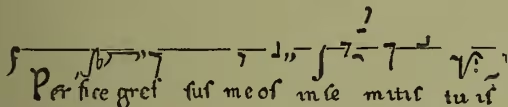
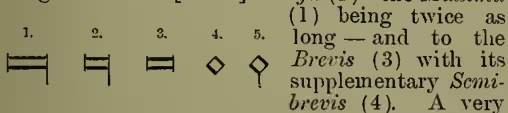
The French Grand Opera school, founded by the Florentine Lully (1633-87), studied the art of who selected eight scales or 'modes' (the 'Gregorian') as proper for use in church music (see HARMONY), and till about 1600 A.D. the legitimate development of music was in the hands of the clergy. At first a rude system of dots and scratches (neumes) above the syllables in the Rubric served to indicate approximately when and how far the voice should be raised or lowered in pitch. This could only have been an aid to memory. The relative pitch of the notes was more definitely shown when a line of normal pitch was drawn through these neumes; and to this line was added three others in order to attain a more exact definition of intervals. The key or clef (clavis) was given to this stave of lines by a sign—usually or on the line which represented that note (C); sometimes F ( ). Later the G () clef came into use, of which our treble or violin Clef (q.v.) is a corruption. With the idea of singing in parts instead of unison came the necessity for indicating the relative duration of notes as well as their pitch, and for this purpose different shapes were given to the [Nota] Longa (2)—the Maxima (1) being twice as long—and to the Brevis (3) with its supplementary Semibrevis (4). A very short note was added—the Minima (5). When music came to be printed these signs were made open, and convenience in writing substituted the round form for the square or diamond. The semibreve () is now our longest note, although the breve is still to be met in church music, and in expressing in sound the most fleeting emotions to be found even in the ever-varying turns of thought in an operatic recitative.
Of still more importance was the progress made during the century in instrumental music. A great impetus to solo-playing in particular, and execution in general, was given by the improvement in the manufacture of violins. The centre of this industry was Cremona, where the three famous families of Stradarius, Guarnerius, and Amati worked for three generations. Some of their instruments are to-day literally worth more than their weight in gold.
Handel and Bach.—In 1685, on the 23d of February and 18th of March respectively, were born Handel in Halle and Bach in Eisenach. From 1710 till 1739 Handel devoted all his energies and genius to writing operas after the Italian school, and most of his works have shared the fate of their contemporaries and rivals. He was then led into the path of oratorio, and a brilliant succession of well-known compositions sheds an undying radiance on the last twenty years of his active life (see ORATORIO). Bach's influence has been wider and more far-reaching even than that of his great contemporary. Indeed, no less a critical authority than Schumann has declared that music owes as much to Bach as Christianity does to its founder. By virtue of his complete and easy command of all the resources of harmony and counterpoint, his boundless originality and fertility, the invariably high level of his compositions—even when judged by his own high standard—he takes a place above all ancient and modern composers. Under his influence also the German school of composition chose the path of instrumental music, in which the voice is only one of a large orchestra of instruments, entitled to no more consideration than its limits demand. The attempt in Gluck's operas to reconcile the requirements of expressive instrumentation and the demands of the vocal school was more successful in theory than in reality (see GLUCK), and the true central column of progress has moved up till now in Germany along instrumental lines in the hands of Bach, Mozart, Beethoven, Schumann, Wagner, and their contemporaries.
Sonata.—The most important form of instrumental music has hitherto been the Fugue (q.v.), and in its strait and heavy harness these giants of old moved with ease, grace, and dignity. But the age of monothematic work was already past, and the old dance forms (allemande, courante, sarabande, gavotte, gigue) did not readily lend themselves to the requirements of thematic development, so necessary to instrumental music as a conception distinct from music, to which words at once give inspiration and impose limitation. Corelli, A. and D. Scarlatti, Bach, and others each strove to solve the problem in his own way, and the sum of their influences was handed from Emmanuel Bach to the 'formulator of the modern sonata,' Joseph Haydn (1732-1809).
The name 'sonata' was first used in Italy for music which was only to be played or 'sounded,' contrasted with 'cantata,' which was to be sung. The particular form, however, gradually separated itself from all other instrumental music, and when generations of earnest musicians had lavished care, thought, and experience on its development it was accepted, and is accepted, as the form par excellence. In its mould are cast sonatas, symphonies, quartetts, concertos, &c., and even the most romantic and daring of fantasias find it necessary to recognise its broad and accommodating principles. Haydn's sonatas are still very formal; so also are Mozart's, though he had more in common with the Romantic school of the next century than the elder composer. This is shown by a comparison of their symphonies.
Haydn's are beautiful and graceful, but the themes and subjects he chooses are never very deep, nor can they move the depths of the heart. He is most successful in his airy and humorous quick movements. In Mozart's symphonies a nobler and more romantic spirit breathes—sometimes with most intense passion, sometimes with a dignified melancholy. And so the way was prepared for the most powerful and the most widely honoured of all rulers in the realms of sound. In the works which are classed as his 'first period' Beethoven showed how he had studied and mastered the work of his great predecessors. In his second period he proceeded to build on the solid foundation that wonderful structure to which the vast conceptions of his third period form a fitting and glorious crown. Nothing important has been added to sonata form since Beethoven wrote the works between the Eroica and the Choral Symphonies (1803-23); and although much has since been written, much that is new, much that is original—although a ready appreciation is granted to the passion of Schumann, the romantic power of Schubert, the poetry of Chopin, the refined elegance of Mendelssohn, the successful use of new colour shown in later works by Brahms, Dvorák, Liszt, &c.—Beethoven's sonatas and symphonies still stand unrivalled, unchallenged.
Fantasia.—A desire for some more direct, more unfettered expression of feeling not unnaturally succeeded this long striving after adequate form. But, while all great composers devoted most of their genius to its development of perfect form, the growth of the fantasia was much neglected. Only when the greatest minds turned their attention for a moment from the more important aim was anything of lasting importance produced; and that because it is only the mind trained in the strict school of form to use all available resources which can wisely enjoy a liberty so easily converted into license. The earliest attempts in fantasia form were called 'toccatas' during the 17th century; and, notwithstanding excellent modern toccatas by Schumann, Rheinberger, and others, we may say that the history of the toccata was brought to a close by the magnificent specimens written early in the 18th century by J. S. Bach. The same composer left a freer model than the somewhat formal toccata in one of the most famous and successful fantasias in existence, and instrumental music has never attained nearer to the definiteness of articulate speech than in the great Chromatic Fantasia.
The strong romantic movement which naturally ensued after the perfecting of the classical school in Beethoven's hands eagerly followed out the path he so often and with such effect indicated in his works; and, although the name fantasia has lately fallen into much disrepute by reason of many unworthy and worthless compositions, it may recover its fair fame when Schumann's and Schubert's fantasias have survived their contemporaries. In any case the endless varieties of fantasia (i.e. unfettered) form, and their adoption in rhapsodies, symphonic poems, and the like, have proved as valuable and as potent a factor in modern romantic music as the various modifications they have effected in the classical sonata form (e.g. Liszt's concertos and sonatas). Schumann adopted some very curious whimsical or poetical names for his smaller compositions—novelette, humoreske, carneval, &c.—and the idea has found great favour with many modern writers. The nocturne invented by the Irish pianist Field is more identified with Chopin's dreamy genius. The latter composer also transfused the waltz and the polonaise and mazurka of his own unhappy country with such an intensity of passion, such a chivalrous nobility, and surrounded them with such a halo of poetry and romance that they are an important addition to the resources of a modern composer, and Chopin's name overshadows that of Schubert and Weber, earlier workers in the same field (Deutsche Tänze, L'Invitation à la Valse). The latest developments in instrumental music are intense nationality in colour and thought, as shown in the works of Grieg, Dvorák, Liszt, Mackenzie, and a new striving after more definiteness which was inaugurated by Berlioz.
Vocal Music.—The progress of vocal music from its first great triumph in 16th-century counterpoint was much slower and varied than that of instrumental. The reason of this is not hard to find; for the conception of vocal writing in the contrapuntal school was sound and artistic, and it reached a point of absolute perfection in that epoch called the 'Golden Age.' Thus there was not the necessity for that advance which ever improving instruments and the feeling for instrumental effects demanded. Indeed, in choral music exactly the same principles which formulated the rules of counterpoint in the 16th century, must be recognised by composers of to-day who wish to produce the purest and grandest effects; and the rules themselves have been rather extended in scope than relaxed in meaning by Bach, the most daring choral writer, and his successors. Where the letter of the law has been modified it has been so from within, and the spirit remains the same. It will be convenient here to treat of choral and solo vocal music, leaving the other obvious subdivisions of sacred and secular to be treated in the articles ORATORIO and OPERA.
Monody.—From the invention of part-singing till the end of the 16th century (i.e. during the course of its legitimate development in the church) vocal music was entirely choral. When a solo was required, the most melodious part was selected from a choral movement, with what must have been a most unsatisfactory and incomplete result. The first example of a piece conceived and written for one voice seems to have been Ugolino, a dramatic scena with viola accompaniment, written (1584) by Galilei (father of the philosopher), one of the Florence Academy. It was this invention of Monody which prepared the way for opera and made it possible. Unfortunately, the first writers in this new school, which aimed after expressive melody, were little proficient in the more solid art of counterpoint which they affected to despise; and this tendency consistently followed out has procured for Italian music its unenviable reputation of being gracefully melodious at the expense of depth and meaning. The rude recitations of earlier composers became more and more melodious till A. Scarlatti formulated the first Aria—i.e. a regular strain of melody, followed by a second in contrast and complement, and thereafter repeated (Da Capo). Almost any of Handel's well-known songs will furnish an advanced specimen of this form, which was brought to perfection by Mozart. The more serious style required for sacred works, as well as the greater skill in the science of music which was at the disposal of composers like Handel, Bach, and Mozart, saved the Aria from its friends, and in northern Europe it chose a slower development but a worthier end. In the schools of Bach, Gluck, Beethoven, Schumann, Wagner, and Liszt the voice is treated as only one instrument, to which indeed the important part is assigned of giving the words intended for illustration—the expression, however, being entrusted to the whole mass of instruments employed. The claims of any settled form to absolute consideration are likewise disregarded where these seem to clash with the higher demands of expression and dramatic truth. Hence the opposition offered and the accusations brought against all these composers in succession by the professional and amateur melodists of each day. None of their styles may be entirely exonerated, but their ideal is certainly the true one, and their work shows a progressive development along at least closely related lines.
Ballads.—Alongside this scientific progress there has always been the popular love of melody which has found expression in folk-song and ballads. Each nation has its characteristics strongly reflected in these, and where they have been recognised and accepted as a veritable and refreshing fount of inspiration—as in Germany, Hungary, and Norway—the gain has been great. They are of course the origin of the simple strophic song or ballad (e.g. Mendelssohn's Es ist bestimmt), however skilfully modern composers adorn it with graceful accompaniment (e.g. the same composer's Auf Flügeln des Gesanges). The Ballade, which aims at a dramatic setting of some romantic story, is the offspring of the same influence which inspired Weber's operas. In this style Loewe showed Schubert the way (Erl König), and following composers have used the device very successfully (Villiers Stanford's La Belle Dame). A later form is the art song which tries to reflect the most delicate turn of meaning and the deepest subjectivity to be found in the words. It was to a great extent the result of Heine's poetry, and its first great exponent was Schumann.
Choral Music.—The chosen home of modern choral music has been Germany and England. In the beginning of the 17th century H. Schütz left his home in Dresden to study the 'new music' of the Florentine school in Italy, and he took the weakling back with him to be reared among the great instrumental masters of Germany. The noble German chorale was chosen as a foundation, and in the effort to illustrate the text no device of counterpoint, no resource of the ever-improving science of harmony, was left unused. Graun, Bach, Haydn, Handel, Mozart, Beethoven, Mendelssohn have enriched the church with innumerable and inestimable treasures in their Passions, Oratorios, Masses, and Psalms; and it is surprising how well fitted the strict writing of all these masters has proved in their hands to convey the most elevated, the most dramatic, the most touching emotions. More modern works are such as Dvorák's Stabat Mater, Liszt's Masses, &c. But the same principle has always commanded the same success; whatever modern development in modern instrumentation, harmony, &c. may be added to a composer's resources, there is only one foundation, that on which the great masters have ever built when rearing their great choral works.
Formal choruses have never been an important part of operatic writing since the first rude beginnings. In plays the single characters will be rather brought together, as it were, than introduced with a distinct intention of giving each an equal part. This feeling for dramatic truth is the origin of the concerted writing in operas—duets, ensembles, finales—the treatment of which is indebted partly to solo vocal writing, partly to choral. The handling of crowds, again, and the best expression in music of their feelings requires different treatment, and it is interesting to compare how each great reformer has approached the problem. Curiously enough, it is the composers who have shown the greatest capacity for many-part writing who have most successfully given the correct impression. No two works are wider asunder than Bach's Matthew Passion (1729) and Wagner's Meistersinger (1867); and yet it is impossible to deny that the single terrible shout of the multitude 'Barabbas!' and the complicated chorus 'Let Him come down from the cross,' show that a genius in no way inferior to Wagner's, but with comparatively very limited resources, could grapple with the same problem which is so marvellously solved in the street riot scene (Meistersinger, act ii.). Gluck's correct feeling saw the difficulty, but his powers were not great enough to overcome it. Mozart's greater, and in this matter somewhat irresponsible, genius never troubled itself on the subject.
Orchestra.—It only remains to describe shortly the growth of the orchestra before closing with an account of the latest development in European music. Monteverde laid the foundation of the modern orchestra when he multiplied the stringed instruments and relegated the pianoforte (or rather its precursor the harpsichord) to a somewhat subordinate position. The latter, however, maintained its place in the orchestra till after Handel's day. Between Monteverde and Haydn many experiments were made in the arrangement and combinations of instruments; also in the manufacture of the instruments themselves. By-and-by the various forms of 'Viol' (Viol di Gamba, di Braccia, &c.) resolved themselves into the viola or tenor violin, and the violoncello (i.e. 'the little violone' or smaller double bass). The violin is of course the little viol. And these remain the foundation of our orchestra. The wind-instruments were the flute and the oboe (a compromise among various forms—Oboi d'Amore, di Caccia, &c.), to which the bassoon gave the bass. To these were added trumpets and drums for special effects. Such was the orchestra with which Haydn laid the corner-stone of modern instrumentation. Mozart added the expressive clarinet, which was at once incorporated in the band. The piccolo, or little flute, and the double bassoon (Contra Fagotto) can hardly be called additions in the sense of novelty; and from Mozart's time to Wagner's the improvement, with one important exception, has been in the direction of improvement in mechanism, and in power of variety in combinations and tone colours. The exception is the trombone, first used with its full effect by Mozart in Don Giovanni, and ever becoming more important in the hands of Beethoven, Schubert, Schumann, and Wagner. Berlioz, the greatest master of instrumentation the world has seen, embodied the result of his experience in a 'Treatise' which will ever remain one of the greatest monuments of his extraordinary genius. He has been worthily followed by the scarcely less successful Wagner, and an enumeration of the instruments at his masterly disposal will show what limitless combinations and permutations are now possible. In Tannhäuser, the orchestra for which he writes comprises, besides the usual stringed band (about 12 first violins, 12 second violins, 8 violas, 8 violoncellos, and 6 double basses), 3 flutes, 1 piccolo, 2 oboes, 2 clarinets, 1 bass clarinet, 2 bassoons, 2 horns, 2 valve horns, 3 trumpets, 3 trombones, and 1 bass tuba, with 1 pair of kettledrums, bass drum, cymbals, triangle, tambourine, and harp; and, on the stage, 4 flutes, 2 piccolos, 4 oboes, 6 corni Inglesi, 6 clarinets, 6 bassoons, 12 trumpets, 12 horns, 4 trombones, cymbals, triangle, and tambourine.
Programmatic Music.—Many attempts of a more or less legitimate kind have been made to illustrate by abstract music a certain story, set of scenes, or progress of emotions. Probably the earliest examples which can be pronounced artistically successful are the famous Pastoral Symphony and the sonata Les Adieux, l'Absence, et le Retour, by Beethoven. To criticise this tendency would lead us far beyond the limits of this article, and a mere enumeration of names and compositions will suffice to show what an attraction the idea has had for almost all modern composers. Mendelssohn has tried to paint Fingal's Cave in his Hebrides overture, and in his Scotch Symphony he seeks to convey the impressions made on him during his visit to Scotland. Schumann has painted a whole set of figures and characters in his Carneval, and in his great Fantasia in C he has set out with a very definite intention to convey the meaning of a verse by the poet Schlegel. Berlioz has gone further and proposed to tell the Episodes in the Life of an Artist in a symphony. Unfortunately, his morbid and rather gruesome genius has chosen very repulsive pictures to paint; and he also makes the mistake of entrusting a certain character or sentiment to a certain phrase—evidently impossible without words set to the music or a previous explanation. Raff's Lenore Symphony, Mackenzie's La Belle Dame, and Liszt's Mazepa are good examples of well-known poems set forth in music alone. MacCunn's Land of the Mountain and the Flood is a descriptive overture; and Liszt's and Saint-Saëns' Symphonic Poems are very beautiful and expressive.
Of course, descriptive music which occurs in the course of a cantata (e.g. in David's Le Désert or Berlioz's Faust) has the advantage of a definite starting-point in the words which surround and explain it, and therefore is distinct from these works mentioned which aim at dispensing with words except as an inspiration. The success which has attended the attempts is certainly unequal, but an immense new field of effort has been opened to composers which will doubtless yield a rich harvest.
Whither music is tending in the 19th century it is difficult to say; but so long as the treasures left us by the great composers are as reverently and as earnestly studied and accepted as they are at present: so long as composers recognise that their genius is a call to labour and not to enjoyment: so long as criticism is honest and based upon sound knowledge, there is no fear that the heritage of the ages will be lost. It is noteworthy that in almost every country in Europe, a keenly national spirit is alive, which lovingly studies all available treasures of national music and melody, appreciating it with an insight and breadth only to be obtained in a school of wide and deep musical culture.
See the general histories of music by Naumann (Lond. 2 vols. 1882-86), Ritter (1880), Rockstro (1886), Rowbotham, (1886). Ambros (Leip. 2d ed. 1881), Fétis, (Paris, 5 vols. 1868-76), F. Weber (1892), Parry (1894); Davy, History of English Music (1895); Marx, Music of the 19th Century (2d ed. 1873); Hullah, Modern Music (1861; new ed. 1875); Riemann's Dictionary of Music (trans. 1896); and Grove's Dictionary of Music and Musicians (4 vols. 1878-89). See also the articles in this work on famous composers and musicians, and on
| Accompaniment. | Conservatoire. | Orchestra. |
| Accoustics. | Cornet. | Organ. |
| Adagio. | Counterpoint. | Overture. |
| Andante. | Double Bass. | Piano. |
| Anthem. | Drum. | Pitch. |
| Arrangement. | Flute. | Plainsong. |
| Bagpipe. | Fugue. | Rondo. |
| Band. | Glee. | Sax-horn. |
| Banjo. | Harmonics. | Scale. |
| Bass. | Harmony. | Solleggio. |
| Bassoon. | Harp. | Song. |
| Bugle. | Horn. | Sound. |
| Catch. | Madrigal. | Symphony. |
| Cavatina. | National Hymns. | Temperament. |
| Chant. | Oboe. | Trombone. |
| Choirs. | Opera. | Trumpet. |
| Chord. | Opheicleide. | Violin. |
| Clarinet. | Oratorio. | Violoncello. |