Musk-rat, a name applied to several distinct animals. (1) The Desman (Myogale), a genus of insectivorous quadrupeds of the Shrew (q.v.) family (Soricidae), differing from the true Shrews (Sorex) in having two very small teeth between the two large incisors of the lower jaw, and the upper incisors flattened and triangular. Behind these incisors are six or seven small teeth (lateral incisors or false canine teeth) and four jagged molars. The muzzle is elongated into a small flexible proboscis, which is constantly in motion. The eyes are very small; there are no external ears; the fur is long, straight, and divergent; the tail long, scaly, and flattened at the sides. All the feet have five toes, fully webbed; and the animals are entirely aquatic, inhabiting lakes and rivers, and making holes in the banks with the entrance from beneath the surface of the water. Only two species are known, one (M. pyrcnaica), about 8 inches long, with tail as long as the body, a native of the streams of the
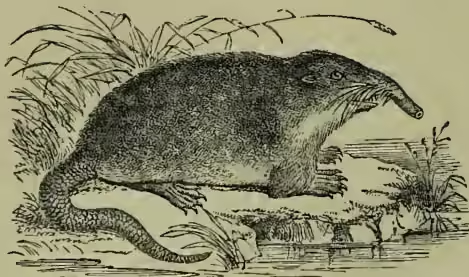
Pyrenees; another larger species (M. moschata), very plentiful in the Volga and other rivers and lakes of the south of Russia, nearly equal in size to the common hedgehog, with tail about three-fourths of the length of the body. The Russian desman is blackish above, whitish beneath; it has long silky hair, with a softer felt beneath, and its fur is held in some esteem. Desman skins, however, are chiefly valued on account of the musky odour which they long exhale, and which is derived from a fatty secretion produced by small follicles under the tail of the animal. The desman feeds on leeches, aquatic larvae, &c., searching for them in the mud by means of its flexible proboscis. It seldom, if ever, voluntarily leaves the water, except in the interior of its burrows, which are sometimes 20 feet long. (2) The name of Musk-rat is also a common name for an Indian species of Shrew (Sorex murinus), in size about equal to the common brown rat, in form and colour much resembling the common shrew of Britain, but remarkable for the powerful musky odour of a secretion which proceeds from glands on its belly and flanks. (3) The name is also given to the Musquash (q.v.).