Naples (Gr. and Lat. Neapolis, Ital. Napoli), till 1860 the capital of the kingdom of Naples, is the largest of Italian cities, and, with the doubtful exception of Constantinople, the most beautifully situated in Europe, 161 miles by rail SE. of Rome. It is the seat of an archbishop. Pop. (1881) 463,172; (1895) 539,500. Naples is one of the busiest ports of the kingdom, exporting wine and olive-oil (£504,150), chemicals and perfumery (£285,800), live animals and animal products (£249,700), hemp and flax (£293,450), cereals (£94,700), curriery (£100,250), &c., to the annual value of £1,672,000; and importing cereals (£1,363,500), metals (£736,800), cottons (£707,250), woollens (£386,300), live animals (£354,900), earthenware, glass, &c. (£336,150), curriery (£256,250), silks (£179,500), groceries (£173,400), specie, hemp and flax, dyes, chemicals, &c., to an average total of £5,563,000. She trades principally with Britain (annual total, £2,266,400) and France (£1,861,900). Naples has many employments but few industries, and these insignificant, consisting mainly of woollen, silk, and linen manufactures, gloves, soap, perfumery, jewellery, earthenware, hats, and carriages. Macaroni (q.v.) is almost indigenous to the Neapolitan seaboard. Fishing supports many of the inhabitants. The neighbourhood is the market-garden of Italy.
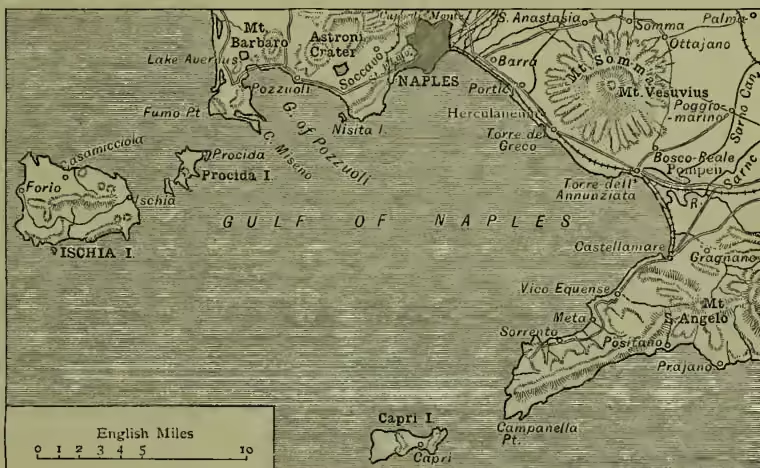
Its attractiveness, due not only to its site, but to its tonic and bracing climate, specially delightful in autumn and winter, and, thanks to the sea-breeze, quite tolerable in the summer-heat, has inspired the well-known proverb, 'See Naples and then die.' Its charms have remained proof against innumerable sanitary drawbacks, defective drainage, impure water-supply, and the fever preserves of its poorer quarters with their subterranean dens, in course of removal since June 1889. The impetus to this work was given by the fearful cholera explosion of September 1884, when in one night nearly 2000 people were attacked, and about 1000 of them died. The new drainage-works carry the sewage to Cumæ, thus relieving the sea-margin, under the principal hotels, of the liquid poison that used to stain the water black hard-by the most frequented marine-baths, and infect the oysters moored in baskets near the shore. An aqueduct opened in 1885 furnishes pure drinking-water to every part of the city. Along the quay considerable improvements are in progress—a new harbour, solid embankments, and commodious promenades following up the handsome squares, planted with trees and parterres, new streets cut through the more populous quarters, a fine embankment carried along the sea-front, and the Corso Vittorio Emanuele, a road traversing all the heights above the city—these latter improvements begun and partly finished under King Victor Emmanuel.
Naples occupies the base and flanks of a hill-range rising, amphitheatre wise, from the sea, and divided into two unequal parts by the Capodimonte, S. Elmo, and Pizzofalcone heights, the latter ending in the small ridge crowned by the
Castel dell'Ovo. The most ancient and populous part of the city lies in the eastern crescent, and is intersected from north to south by the Via Toledo (now Via di Roma), the main historic street of Naples, more densely peopled than any other of equal space in Europe. Numerous broad streets have lately been built on this side of the city. A fine quay extends eastward to the Castel del Carmine. To the back of this lies the poorest and most populous quarter, now being dismantled. Westward runs the less ancient city, smaller in extent, but freer as to air and prospect, and frequented by the more favoured classes, resident and migratory. Along the sea-margin extend the royal gardens and the Riviera di Chiaja, the lower boundary of the comparatively new quarters built against the slope. On the Vomero Hill, in the north-west, house-construction is busily going on to accommodate the inhabitants of the dismantled 'rookeries' near the harbour, for whom dwellings have also been built beyond the railway station to the east of the city. Naples is three miles long and two broad. It has a modern look, but in spite of external change still presents the same noisy, vivacious, mercurial life so astonishing and ere long so oppressive in its monotony to the newcomer from the north. From the precocious street arab to the gray-haired and vociferous mendicant, with a whole army of importunate pedlars, cabmen, newsvendors, flower-girls, and touts between, there is no pause night or day—that 'Naples never goes to bed' is indeed a scarcely exaggerated saying! The historic interest of the suburban quarters along the shore is greater than in the city. But its poverty in Græco-Roman antiquities is made up for by its National Museum, becoming daily richer in archaeological treasure-trove from Pompeii, while its splendid aquarium teems with typical specimens of the flora and fauna of the Mediterranean, and forms the exhibition-room of its Zoological Station. Of architectural interest Naples has little. Besides her five forts and four gates of mediæval construction, she has upwards of 300 churches, including the cathedral (1272-1316) of St Januarius (q.v.), whose blood is said to liquefy in the phials containing it on three yearly festivals. The university (1224), with nearly 100 teachers and 4150 students, the royal palace, the catacombs, and, still more, the law-courts are worth visiting. Naples is excellently equipped with libraries: the National Library (1804) has 275,000 books and 8000 MSS.; the University Library (1812), 150,000 books; and the Brancaeciana (1673), 150,000 books and 3000 MSS. The San Carlo Theatre (chiefly for opera) is one of the largest in Italy, though much less popular than the San Carlino, sacred to 'Pulcinella' (the Italian Punch). In fine art Naples is poor—her music, in spite of her devotion to opera, adding nothing to the European repertory; the plaintive songs of her fishermen are as distinctive of the Mediterranean as the Venetian barcarole are of the Adriatic. See Clara Erskine Clement's Naples, the City of Parthenope (1895).