Numismatics (Gr. nomisma, from nomos, 'law,' 'a legally current coin') is the science which embraces the study of the current coins of all nations. In the wider, though less accurate, acceptance of the term it includes also that of medals, both artistic and historical. The various branches of numismatics are (1) Greek, Phœnician, &c.; (2) Roman and Byzantine; (3) Mediæval and Modern; and (4) Oriental. The chief value of numismatics consists in the light which coins throw upon history. The secondary importance of the science is purely artistic. The study of coins is also of great use in elucidating the mythology of the ancients, in fixing the chronology of the different systems of alphabetical writing
(Palæography), and in indicating the origin and gradual extension over the civilised world of the principal systems of weighing the precious metals (Metrology). Historically, coins are of the utmost importance as being contemporary and authentic documents furnishing us with in many cases the only means of ascertaining the names of obscure cities and peoples, together with the chronological succession of their kings, tyrants, or chief-magistrates. Artistically, they faithfully record the successive phases of art from its earliest beginnings to its culminating point, and through all the stages of its decline, subsequent temporary revival, and second decadence, to the present day.
I. Greek Coins.—The use of the precious metals as mediums of exchange may be traced back to the remotest ages of which we possess any historical accounts. Thus, for instance, we read that Abraham was 'very rich in cattle, in silver, and in gold' (Gen. xiii. 2; xxiv. 35), and in the account of his purchase of the cave of Machpelah (Gen. xxiii. 16) it is stated that 'Abraham weighed to Ephron four hundred shekels of silver current with the merchant.' This use of gold and silver as uncoined money, weighed in the balance, must, however, be carefully distinguished from its use as 'coin,' a word which implies that the ingot or piece of metal is impressed with an official device, mark, or 'type,' serving the purpose of a guarantee of just weight and value. 'So far as we have any knowledge,' says Herodotus (i. 94), 'the Lydians were the first nation to introduce the use of gold and silver coin.' The adoption of this apparently simple means of facilitating exchanges appears to have been due in the first instance to the custom of depositing treasure for safe custody in the sacred temples of the gods. Ingots or small lumps of gold or silver, committed to the care of the priests, were consecrated to the local divinity by being impressed with a badge or symbol, usually the head of some sacred animal. These pieces of metal were subsequently put into circulation, the sacred badge being known and accepted in the district as a reliable guarantee of value. The earliest Lydian coins which have been handed down to our times belong probably to the reign of Gyges, who ascended the throne about 700 B.C. They are bean-shaped lumps of the native Lydian gold ore, which contained a large admixture of silver, and went by the name of electrum or pale gold. The face or obverse of the coin bears the figure of a lion, the sacred symbol of the goddess Cybele, and the reverse consists merely of the impress of the rude unengraved punch or nail-head which served to keep the ingot in its place while it was being struck. The ingot, held in position by a pair of tongs, was placed on this square nail-head, and on the top of the ingot the engraved die was laid while the moneyer struck it with successive blows of a heavy sledge-hammer until the impressions of the engraved die on the obverse and of the square nail-head on the reverse were brought into sufficient relief and intaglio respectively.
These one-sided coins with an intaglio or 'incuse' square on the reverse are characteristic of the early stages of the art of coining not only in Lydia, but in all the Greek cities, for the use of coined money rapidly spread from Lydia over all the coasts and islands of the Ægean Sea, each city issuing money bearing the symbol of its local divinity. In Greece proper the earliest coins were of silver, and are said to have been struck by Pheidon, king of Argos. They bear the symbol of a tortoise, a creature sacred to the goddess Aphrodite, in whose temple at Ægina these earliest Greek coins were issued. On this occasion it is related that Pheidon hung up in the temple of the goddess Hera at Argos specimens of the cumbrous bronze and iron bars, δβελσκοι, which served the purpose of money before his time, in memory of the old order of things. From the time of Pheidon onwards the coinage of Greece and of the East may be classified historically in the following eight periods: (i.) 700-480 B.C.—Period of archaic art, ending with the Persian wars.—The art work on the coins of these two centuries is characterised at first by a rude strength of style, and afterwards by a gradual development into clearly-defined forms, which, however, are always distinguishable by their angularity and stiffness from the freer work of later times. Thus, for instance, the eye of the human face is always drawn, even when in profile, as if seen from the front; both corners being visible, while the mouth wears the fixed and formal smile with which we are familiar on the Egyptian monuments. Towards the end of the archaic period a type in relief begins to appear within the incuse square of the reverses. The coins which circulated most widely were, in silver, those of Ægina with the tortoise above referred to; the tetradrachms of Athens, first introduced by Solon 590 B.C., obverse, head of Athena, reverse, owl, the sacred bird of that goddess; and, in gold, the famous Darics, on which the Persian king is represented as a kneeling archer. In the west the chief coins were those of the Greek colonies in Southern Italy, Sybaris, Croton, Tarentum, &c., which differ from those of Greece proper in having the figures on the reverse in intaglio instead of in relief. (ii.) 480-400 B.C.—Period of transitional and early fine art, to the end of the Athenian supremacy.—The coins of this period are characterised by a great advance in the technical skill with which the dies were engraved. The name of the city or of the chief-magistrate now occurs frequently on the reverse, usually in an abbreviated form.
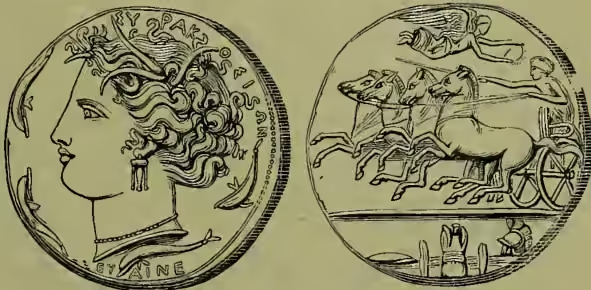
In Asia Minor the chief coinage of this period is the electrum currency of the flourishing commercial city of Cyzicus on the Propontis, so often alluded to under the name of 'Cyzicene staters' by Xenophon and other historians. In Greece proper the Athenian money was still the chief, though by no means the only medium of exchange, and in the West the Corinthian staters, with the figure of Pegasus on the obverse, had a wide circulation. In Sicily Syracuse affords a larger variety of types than any other Greek city, though the finest specimens of the Syracusan monetary art fall into the next period. (iii.) 400-336 B.C.—Period of finest art, age of the Spartan and Theban supremacies, and of Philip of Macedon.—The art of die-engraving attained in this period a higher point of excellence than it has ever since reached. The coin-types are remarkable for sculpturesque reserve, intensity of action, or rich and varied ornamentation, according to the requirements of the subject represented. These are most frequently ideal heads of divinities on the obverses, and mythological figures on the reverses, or agonistic types referring to the local games and religious festivals, such as the victorious quadrigæ on the famous Syracusan medallions, which are generally recognised as the finest and most beautifully executed coins that have ever been struck. In this age the practice of coining money had become universal; the number of mints throughout the civilised world was enormous, every little town striking its own 'autonomous' silver or bronze, and, in some cases, gold currency. In European Greece the gold staters of Philip of Macedon obtained a wide circulation, and his conquests in Greece gradually put an end to the independent issues in that country. (iv.) 336-280 B.C.—Period of later fine art; age of Alexander the Great and the Diadochi, charac- terised by the introduction of the portrait of the reigning monarch in place of the head of the divinity on the obverse.—Before Alexander's time no tyrant, however despotic, had ever ventured to place his own head upon the coinage of the state, for hitherto the coinage had continued to maintain intact its original religious character. The regal money of Alexander and his successors now gradually superseded the autonomous coinage of the smaller Greek states, except in the west, which was beyond the sphere of Alexander's conquests, and where the cities of Italy and Sicily continued to strike gold and silver until they were in turn brought under subjection by the growing power of Rome (see below). (v.-vii.) 280 B.C. to the Christian era.—Periods of early and later decline; age of the Epigoni, the Attalids, and of Mithradates the Great.—The silver and gold coinage during these three centuries is almost exclusively regal, and presents us with a remarkable series of lifelike portraits of the long succession of the Seleucid kings of Syria, of the Ptolemies of Egypt, of the kings of Macedon, of Pontus and Bithynia, of the Attalids of Pergamum, and of the successors of Alexander in Northern India, many of whom are known to us only from their coins. The chief characteristic of the art of numismatic portraiture, which attained its highest perfection about 250 B.C., is its realism, which is carried in some cases almost to the verge of brutality, as for instance on the tetradrachms of some of the kings of Pontus, the ancestors of Mithradates the Great. It is to this period that the earliest coins of the Jews belong—the well-known shekels of Israel, struck at Jerusalem by Simon Maccabæus, 143–135 B.C. Among the latest portraits on Greek coins is that of the famous Cleopatra on a coin of Ascalon. She is represented with wide-open and eager eyes, a prominent and slightly aquiline nose, and a large and expressive mouth, but with none of the seductive beauty which we should expect to find on the coins of this fascinating princess. Among the non-regal coins of the 2d century B.C. the large tetradrachms of some of the Greek cities of the western coast of Asia Minor, which regained their freedom after the defeat of Antiochus the Great by the Romans, 190 B.C., are worthy of note; those of Cyme, Myrina, Smyrna, and Magnesia being especially remarkable. Throughout the greater part of this period Athens continued to coin very plentifully her tetradrachms with the helmeted head of the chryselephantine statue of Athena Parthenos by Phidias on the obverse. These coins formed the chief currency for the trade between Europe and the East. (viii.) From the Christian era to the reign of the Emperor Gallienus.—During this period of nearly three centuries the Romans permitted the Greek cities in the eastern half of the empire to strike bronze money for local use. It is known to collectors as the 'Greek imperial' coinage. Artistically it is quite without interest, but archaeologically it is perhaps more important than the matchless silver and gold currency of the free and independent cities of more ancient times. The Greek imperial coins illustrate the local festivals, religious rites, and municipal institutions which prevailed in the outlying provinces of the Roman empire, and are also of value as recording the names of the successive chief-magistrates and high officials of the various cities, who appear to have been responsible for the coinage in each locality.
II. Roman and Byzantine Coins.—The Romans for the first four centuries of their history had no regular coinage, the chief medium of exchange being bronze, circulating by weight, aes rude, in lumps of irregular form. It was probably about the middle of the 4th century B.C. that the pound-weight of bronze (12 oz.) was first cast into large unwieldy pieces of circular shape, aes grave, having on the obverse a head of Jannus, and on the reverse the prow of a galley. This was the Libral As; and its divisions were the Semis (6 oz.), the Triens (4 oz.), the Quadrans (3 oz.), the Sextans (2 oz.), and the Uncia (1 oz.), each of which bore a distinct type and mark of value. As time went on the As was gradually reduced in weight until (circa 264 B.C.) it stood at no more than 2 oz. At this point the law stepped in and endeavoured to check the further debasement of the coin by fixing the weight legally at 2 oz. (sextantal reduction), and by issuing for the first time a silver coin, the Denarius, equivalent to ten asses. The fractions of the silver piece were the Quinarius (five asses) and the Sestertius (two and a half asses). In 217 B.C. the weight of the as was further legally reduced to 1 oz. (uncial reduction), and again in 89 B.C. to half an ounce (semuncial reduction). All these successive reductions were financial expedients, the object of which was to bring a little order into the state currency, which continually tended to become more and more deteriorated. The types of the silver coins, at first constant and uniform, were subsequently varied according to the pleasure of the triumviri monetales, as the officers were called who were entrusted with the supervision of the coinage. The long series of the Republican silver money, which extends from 264 B.C. to Imperial times, is now incorrectly known as the Consular or Family series, because the types usually allude to events connected with the family history of the triumviri monetales. The Imperial series commenced in 2 B.C., when Augustus abolished the office of the monetarii and reserved for himself all rights connected with the coinage of gold and silver, though leaving to the senate the privilege of striking bronze, which was henceforth distinguished by the letters S.C. (Senatus Consulto). All coins now bore the portrait of the reigning emperor, or of some member of the imperial family, and on the reverse, for the most part, allegorical personifications, representations of historical events, architectural monuments, or public buildings. Their inscriptions furnish us with the exact date of issue. The chief denominations were, in gold, the aureus; in silver, the denarius; and in bronze, the sestertius (now known as the large bronze), tariffed at four asses; the dupondius (middle bronze), two asses; and the as and its divisions (small bronze). The large bronze from Augustus to Commodus supplies us with a magnificent series of imperial portraits, but from Septimius Severus onwards there is a rapid deterioration both in art and workmanship. From the reign of Caracalla to that of Diocletian the utmost disorder prevailed in the coinage, each successive emperor debasing it more and more, until the so-called silver denarius became merely a copper coin washed with tin. In 296 A.D. Diocletian entirely reformed the currency, which was again modified by Constantine, who reduced the weight of the aureus from sixty to seventy-two to the pound. The new gold piece was henceforth known as the Solidus, and it maintained its full weight and purity of metal as long as the empire lasted. This coin received in western Europe the name of Bezant or Byzant, from Byzantium or Constantinople, the capital of the eastern empire. The types of the coins of the Christian emperors retained for a time their pagan character, though little by little Christian symbolism crept in, until at length all pagan influence disappeared, and figures of Christ and the Virgin took the place of the allegorical representations of pagan times. The Latin language in the inscriptions on Byzantine coins continued to be used until the latter part of the 11th century, when it was finally displaced by the Greek.
III. Mediæval and Modern Coins.—The coinage of western Europe, down to the time of Charlemagne, consisted mostly of imitations of the Byzantine coins. That emperor (circa 768 A.D.) introduced a new silver coin called the new denier, which soon came into general use.
English.—The denier was introduced into England, under the name of the penny, by Offa, king of Mercia (ob. 794), previous to whose time the currency of the Anglo-Saxons had consisted of small silver coins (sceattas) and copper coins (stycas), which were rude copies of the Merovingian money. Under the Anglo-Saxon and early Norman kings local mints were established at all the considerable towns in England, and the penny bore on its reverse both the name of the town and of the moneyer by whom it was struck. The earliest English gold coins were struck by Henry III., but gold money did not come into general use until the reign of Edward III., who introduced the gold noble (6s. 8d.) and the gold florin (6s.), with their divisions. This king also first struck multiples of the penny, groats (4d.) and half-groats. Edward IV. added new denominations called the rose noble and the angel, so called from its type, St Michael slaying the dragon. With the accession of the Tudor dynasty authentic portraits of the reigning sovereign make their first appearance on the coins of the realm, and many new denominations, such as ryals or sovereigns in gold, and crowns, half-crowns, shillings, &c. in silver, were added. In the time of Charles I. we note a remarkable improvement in the art of die-engraving, of which the celebrated Oxford crown is a good example; on the obverse of which is the king on horseback, with a view of the city of Oxford in the distance. In this reign a Frenchman named Briot, employed in the English mint, introduced the use of the mill and screw. On the coins of the Commonwealth the inscriptions are in English instead of Latin, and some of Cromwell's portraits by the famous engraver, Thomas Simon, are worthy of the highest praise. To the series of Charles II. belongs the beautiful Petition crown, also by Simon. This coin takes its name from Simon's petition to be reinstated as engraver to the mint, inscribed on the edge: 'Thomas Simon most humbly prays your majesty to compare this, his tryal piece, with the Dutch, and if more truly drawn and embossed, more gracefully ordered, and more accurately engraven, to relieve him.' In Charles II.'s reign the first guineas were struck from gold brought from the Guinea Coast, and copper coins, consisting of halfpennies and farthings, were first regularly established. From this time onwards the English coinage declines very greatly in artistic interest,
George IV.'s crown by Pistrucci being perhaps the only modern piece worth noticing.
Scottish.—The coinage of Scotland down to the reign of Robert III. followed closely the English types. From this time original designs became more frequent. It reached its highest point of artistic excellence in the reigns of James V. and Mary; and few modern pieces are more beautiful than the bonnet-piece of the former, representing the king wearing a bonnet, and the ryal of the latter, bearing the queen's portrait in profile.
Irish.—The earliest Irish coins were struck by the Danish and Norse invaders, 929-1029. They were copied, as a rule, from the pennies of Ethelred II. After this we have no Irish coinage until the partial conquest of the country by Henry II., in whose reign mints were established at Dublin, Cork, Drogheda, Limerick, Trim, Waterford, and Wexford. Among the more modern Irish coins the gun-metal money of James II. is historically interesting. This was 'money of necessity,' struck after his flight from England. It was decried in the reign of William and Mary, and redeemed only at metal value.
Western Europe.—The mediæval and modern coinage of the various European states, from the time of the issue of the new denier by Charlemagne in the 8th century down to the middle of the 17th century, is no less interesting than that of Britain. The Italian and Papal coins are artistically superior to the rest, especially in portraiture, where the influence of the Renaissance of art may be clearly traced. An important landmark in the numismatic history of western Europe is the re-introduction of gold money, dating from the first issue of the florino d'oro in Florence, 1252. In France the coins of Francis I. and Henry II., and in Germany those of the Emperor Maximilian I., are especially noteworthy; some of the latter being ascribed to the hand of Albert Dürer. Many of the later German thalers are also of considerable historical value, as their types record the chief events in the history of the cities by which they were struck.
IV. Oriental Coins.—Oriental coins fall into three principal divisions: (i.) The coins of India beginning with those of the successors of Alexander the Great in the 3rd century B.C. in Bactria and the Punjab, and extending down to recent times. The gold and silver coins of the Pathan kings and of the Mogul emperors may be here particularised, more especially the gold moohurs and silver rupees of Jehangir with the signs of the zodiac engraved in bold relief. (ii.) The coins of the numerous Arab dynasties in Asia, Africa, and Spain, consist of dinars in gold and dirhems in silver. The interest of these Mohammedan issues is purely historical, as they bear no representations of living beings, all such images being forbidden to true believers. Many of these coins possess, however, a beauty of their own as specimens of oriental calligraphy. The inscriptions consist of formulae of the faith from the Koran, together with the name of Calif, the place of mintage, and the date of issue. The Kufic coins are the subject of a special article. (iii.) The coins of China, Japan, and the far East.—Those of China date from the 7th century B.C., the earliest being in the form of tools, such as adzes, chisels, spades, knives, &c. In the 1st century B.C. these pieces are replaced by circular discs of brass called cash, with a square hole in the centre, a form of coin which has survived until quite recent years. The coins of Japan begin about the 7th century A.D., and are modelled on the later Chinese pattern. Among the more modern Japanese issues are oblong pieces of gold and silver, and large oval plates, called oho-ban. and ko-ban, some of which are more than 6 inches in length. Like China, Japan has now adopted a currency modelled on the European pattern.
The standard works on Greek Numismatics in general are Eckhel's Doctrina Numorum (1792-98); Mionnet, Description des Médailles grecques (1807-37); B. V. Head, Historia Numorum (Oxford, 1887), and Guide to the Principal Gold and Silver Coins of the Ancients (3d ed. 1889); and the Catalogues of Greek Coins in the British Museum (1873 et seq.). On Roman coins the chief works are Mommsen, Histoire de la Monnaie romaine (trans. by Blacas, Paris, 1865-75); E. Babelon, Monnaies de la République romaine (1885); and J. Sabatier, Monnaies byzantines (1862). On mediæval, modern, and oriental coins there are L. W. Wellenheim, Catalogue de Monnaies et Médailles (1845); C. F. Keary, Coinages of Western Europe (1879); Coins and Medals (ed. by S. Lane-Poole, 1885); J. A. Blanchet, Numismatique du Moyen Âge et Moderne (1890); A. Engel and R. Serrure, Traité de Numismatique du Moyen Âge (1891); Ruding, Annals of the Coinage of Great Britain (1840); Hawkins, Silver Coins of England (1887); Kenyon, Gold Coins of England (1884); and the British Museum Catalogues of Oriental Coins, by S. Lane-Poole and R. S. Poole (1875-90).