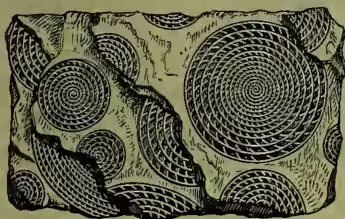
Nummulites, or NUMMULINA ('money-fossils'), a genus of fossil foraminifera, the shells of which form immense masses of rock of Eocene age. They are circular bodies of a lenticular shape, varying in magnitude from the merest point to the size of a florin or larger. The shell is composed of a series of small chambers arranged in a concentric manner. The growth of the shell does not take place only around the circumference, but each whorl invests all the preceding whorls, so as to form a new layer over the entire surface of the disc, thus adding to the thickness as well as the breadth, and giving the fossil its lenticular form. A thin intervening space separates each layer from the one which it covers, and this space at the margin swells out to form the chamber. All the internal cavities, however, seem to have been occupied with the living sarcode, and an intimate connection was maintained between them by means of innumerable parallel tubuli, which everywhere pass from one surface to another, and which permitted the passage of the sarcode as freely as do the minute pores or foramina of the living foraminifera. The name is given to them from their resemblance to coins. The genus appears first in the Carboniferous system, where it is represented by one small form. Several species are also met with in Jurassic and Cretaceous rocks, but the genus reached its maximum in Eocene times. It is represented at present by only a few small forms.
NUMMULITE LIMESTONE, an important member of the Eocene system of southern Europe, &c., consists of a limestone composed of nummulites held together by a matrix formed of the comminuted particles of their shells, and of smaller foraminifera. It attains a thickness of several thousand feet, and has been traced over a vast area. It occurs on both sides of the Mediterranean basin, in Spain and in Morocco. It enters largely into the composition of the Apennines, the Alps, the Carpathians, and the Balkans; it extends through Greece, Egypt, and Asia Minor, and thence through Persia and the Himalayas to the coasts of China and Japan.