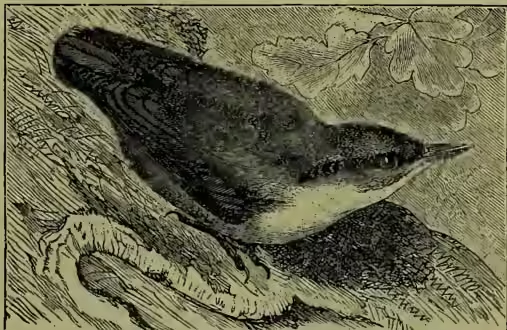
Nut-hatch (Sitta), a genus of birds of the family Sittidæ, having a straight conical or prismatic bill, short stout legs, the hind-toe very strong, and large hooked claws. They run up and down trees with great agility, moving with equal ease in either direction, and without hopping, so that the motion is rather like that of a mouse than of a bird. They feed on insects, in pursuit of which they examine the crevices and remove large pieces of the bark; at other times on seeds, as those of pines, and the kernels of nuts, to obtain which they fix the nut in some crevice and then hammer it with their bill until the shell is broken, each blow being delivered with the whole strength of the body working from the hip-joint; hence the name of Nut-hatch or Nut-hack. Seventeen species are known, ranging south in the Old World to Southern India and Burma, and in the New World to Mexico, being well represented in North America. One species (S. cæsia) is fairly common in many districts of England containing old timber. It occurs in the south of Scotland, and has been reported as seen in Skye and in the Shetlands; but as yet it is unknown in Ireland. It extends through central and southern Europe to Persia and even south-eastern Siberia. Its whole length is about 5½ inches. The upper parts are generally of a blue slate colour; the wing-quills grayish brown; the middle tail-feathers more slate-gray, the remainder black at their bases and barred and tipped with white and gray; a black band runs from the base of the bill through the eye to the nape of the neck; the throat and under parts are of a pale cinnamon or rich buff colour; the bill, legs, and feet are brown. The plumage of the female is somewhat duller. Its nest is made of dry leaves or scales of cones, generally in the hole of a tree. From five to seven eggs are laid, of a white colour spotted with reddish brown.—A closely allied species (S. europæa), with nearly white under parts, is found in the Danish Islands and throughout northern Europe and northern Asia as far as Japan. The nut-hatch is absent from Malta and Sardinia, but in Corsica a distinct species (S. whiteheadi) is found, the under parts being white and the head jet-black in the male. The nut-hatches of Australia and New Guinea belong to a distinct though closely allied genus, Sitella. The Blue Nut-hatches (genus Dendrophila) are found from Ceylon and India to Burma and Malaya. The Coral-billed Nut-hatch, the only species of another genus (Hypherpes), is found only in Madagascar.