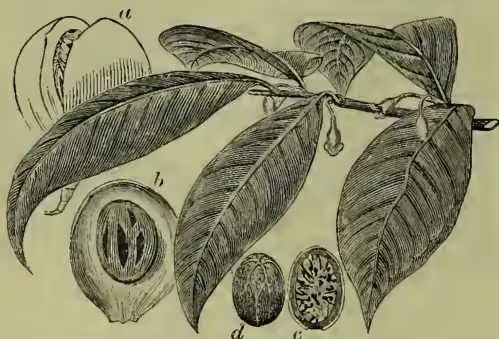
Nutmeg. This well-known and favourite spice is the kernel—mostly consisting of the albumen—of the fruit of several species of Myristica. This genus belongs to a natural order of exogens called Myristicaceæ, which contains about forty species, all tropical trees or shrubs, natives of Asia, Madagascar, and America. They generally have red juice, or a juice which becomes red on exposure to air. The leaves are alternate and without stipules. The flowers are unisexual, the perianth generally trifid, the filaments united into a column. The fruit is succulent, yet opens like a capsule by two valves. The seed is nut-like, covered with a laciniated fleshy aril, the albumen penetrated by its membranous covering. All the species are more or less aromatic in all their parts; their juice is styptic and somewhat acrid; the albumen and aril contain both a fixed and an essential oil, and those of some species are used as spices. The species which furnishes the greater part of the nutmegs of commerce is M. fragrans; but the long nutmeg (M. fatua), from the Banda Isles, is now not uncommon in our markets. The common nutmeg-tree is about 25 feet in height, with oblong leaves and axillary few-flowered racemes; the fruit is of the size and appearance of a roundish pear, golden yellow in colour when ripe. The fleshy part of the fruit is rather hard, and is of a peculiar consistence, resembling candied fruit; it is often preserved and eaten as a sweetmeat. Within is the nut enveloped in the curious yellowish-red aril, the Mace (q.v.), under which is a thin shining brown shell, slightly grooved by the pressure of the mace, and within is the kernel or nutmeg. Up to 1796 the Dutch, being the possessors of the Banda Isles, jealously prevented the nutmeg from being transplanted; but during the British occupation plants were sent to Penang, India, the West Indies, Brazil, Réunion, where they are now successfully cultivated. Nutmegs are very liable to the attack of a beetle, which is very destructive, and it is a common practice to give them a coating of lime before shipping them to Europe to kill the vitality of the germ. The nutmeg yields by expression a peculiar yellow fat, called oil of mace, because from its colour and flavour it was generally supposed to be derived from mace; and by distillation is obtained an almost colourless essential oil which has very fully the flavour of the nutmeg. Nutmegs are chiefly used as a spice, but medicinally they are stimulant and carminative. They possess narcotic properties, and in large doses produce stupefaction and delirium. Great Britain imports from 300,000 to 700,000 lb. annually, besides mace to the extent of 60,000 to 80,000 lb. The culture of nutmeg is somewhat peculiar. The plantations are always made from seed, and the plants do not produce flowers till they are eight or nine years old. The sexes being on different trees, when the plants are two years old the greater number composing a plantation are headed down and grafted with scions taken from the female tree, a few only being grafted with scions of the male to ensure fecundation. Other species of Myristica besides those already named yield nutmegs sometimes used, but of very inferior quality. The fruits of several species of Lauraceae also resemble nutmegs in their aromatic and other properties, as the cotyledons of Nectandra puchury, the Pichurim Beans of commerce, and the fruit of Acrodiclidium camara, a tree of Guiana, the Camara or Ackawai nutmeg. The clove nutmegs of Madagascar are the fruit of Agathophyllum aromaticum, and the Brazilian nutmegs of Cryptocarya moschata. All these belong to the order Lauraceae. The Calabash Nutmeg is the fruit of Monodora myristica, of the natural order Anonaceae.