Opium, one of the most valuable of medicines, is the dried juice of the unripe capsules of a species of Poppy (q.v.), Papaver somniferum, of which several varieties are cultivated, the most usual in India, Persia, and China being apparently the variety album. The cultivation of the poppy for the sake of opium is carried on in many parts of India, although the chief district is a large tract on the Ganges, about 600 miles in length and 200 miles in breadth, which is divided into two agencies, that of Behar and that of Benares, the central factory of the former being at Patna, and that of the latter at Ghazipur. The poppy is also extensively cultivated for opium in the Asiatic provinces of Turkey, in Egypt, in Persia, and in China; and opium of fair quality is produced, although not to any considerable amount, in some parts of Europe, and even in Britain.
The poppy requires for its profitable cultivation a rich soil, and in India is generally sown in the neighbourhood of villages where manure can be easily obtained. The soil ought to be fine and loose when the seed is sown. The subsequent cultivation consists chiefly in thinning and weeding. Irrigation is practised. Mild moist weather, with night-dews, is deemed most favourable during the time of the collection of the opium. Very dry weather diminishes the flow of the juice, and much rain is injurious. The opium poppy is cultivated for its seed or oil and other purposes besides the production of opium, concerning which see POPPY.
Opium, as a commercial article, is of great importance, exceeding indeed that of any other drug in use. The cultivation of the opium poppy in British India forms a most extensive branch of agriculture, and the collection and preparation of the drug itself employs a large number of persons. The seed is sown in India in the beginning of November; it flowers in the end of

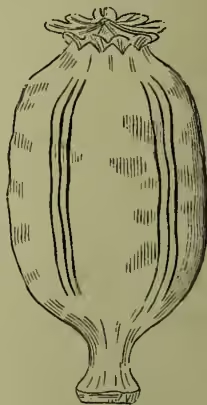
January, or a little later; and in three or four weeks after the capsules or poppy-heads are about the size of hens' eggs, and are ready for operating upon. When this is the case the collectors each take a little instrument (fig. 1), made of four small knives tied together, the blades appearing like the teeth of a comb; with these instruments they wound each half-ripe poppy-head (fig. 2) as they make their way through the plants in the field. This is always done in the afternoon, and on the following morning the milky sap is collected by scraping it off with a kind of scoop, and transferred to an earthen vessel hanging at the side of the collector. When this is full it is carried home and placed in a shallow open brass dish, and left for a time tilted on its side, so that any watery fluid may drain out; this watery fluid is very detrimental to the opium unless removed. It now requires daily attention, and has to be turned frequently, so that the air may dry it equally, until it acquires a tolerable consistency, which takes three or four weeks; it is then packed in small earthen jars, and taken to the factories, where the contents of each jar are turned out and carefully weighed, tested, valued, and credited to the cultivator. The opium is then thrown into vast vats, which hold the accumulations of entire districts, and the mass being kneaded is again taken out and made into balls or cakes for the market. After being fully dried these balls are packed in chests for the market. Of the Indian opium there are several qualities, as Patna, Benares, Malwa, &c. The area under cultivation in India with the poppy varies from year to year; in some years the area in Bengal alone has been as high as 560,000 acres. Certain districts are permitted to cultivate the plant, but the cultivators must obtain a license. Government purchases the opium at about 10s. a seer of 2 lb., and an acre yields from 10 to 15 seers of opium over and above the petals, capsules, and seed.
In Persia the drug is prepared at Ispahan, Shiraz, and Yezd; the latter is considered the best. The morphia in Persian opium is only 2 to 8 per cent., against 7 to 11 per cent. in Turkish opium. In Khorassan the cultivation of the poppy increased tenfold between 1875 and 1890. A quantity of opium for local consumption is prepared in the shape of sticks or cylinders. That destined for China is mixed with linseed-oil in the proportion of 6 or 7 lbs. to each chest; but that sent to London is pure. The exports of Persian opium, which in 1874 and 1875 were only 2000 chests, rose before 1897 to 13,000 chests. In Turkey the production is also large.
For the relation of the opium trade to the revenue of British India, see INDIA, Vol. VI. p. 115. There has been a good deal of controversial discussion carried on of late years as to the effects of opium-smoking (see below), and the abolition of the Indian trade is by many earnestly demanded. Those who support the present fiscal system of India say it is on the whole better that the preparation and sale of Indian opium should be in the hands of the government as a monopoly, for if abandoned by them its culture and manufacture would be carried on in many other localities favourable to the growth of the poppy. Indeed its culture has been already tried in Australia, Africa, and parts of America. It should also be remembered that China itself produces opium largely; there is virtual permission and open connivance of all the local authorities at the culture of the poppy over the length and breadth of the empire. Professionally forbidden, its culture is free to all. The local production of opium is indeed believed to be as large as the foreign import, since the authorities prefer to quietly encourage the home-grown produce, so as to prevent the export of bullion for the foreign. In south-western China the production of opium is stated to exceed 280,000 cwt., and it sells at two-thirds the price of the Indian.
In 1880 the annual revenue from opium in India was nearly £10,500,000, of which the excise opium (or that locally consumed) yielded £1,000,000, and the 'provision' or export opium the rest. In 1897 the net revenue from this source was only about £4,000,000. About 40,000 chests (of 140 lb.) are produced in the native states of Central India, Rajputana, and Baroda, which pay a transit duty for export from Bombay. The following figures (in cwts.) show the decline in the export, and the countries to which the Indian opium goes.
| 1880. | 1890. | |
|---|---|---|
| Hong-kong..... | 83,055 | 76,493 |
| Treaty Ports..... | 46,046 | 19,997 |
| Cochin-China..... | 1,541 | |
| Straits Settlements..... | 15,417 | 20,184 |
| Other Countries..... | 120 | 383 |
| Total..... | 144,638 | 118,598 |
In 1898 the amount exported had fallen to 39,000 chests of 140 lb. each (48,750 cwt.), at the rate of £68 per chest (whereas the price in 1860 was £185). It is sold monthly by public auction at Calcutta. To prevent speculation and to steady prices, the quantity to be sold during the year is duly notified in the previous year. The bulk of the Indian opium, it will be seen, still finds its way to China. Persian opium, like the Chinese, has increased greatly in recent years, and, being cheaper than the Indian article, has begun to have a distinct effect upon the market. The foreign exports from India by no means represent the total trade in the drug. There is an immense internal consumption of what is known as 'excise opium,' averaging about 4500 chests yearly. This is retailed to the Indian consumer as a decoction, or in the form of two smoking mixtures, chandu and madak.
The quantity of the different kinds of opium imported into China (added to the stock held in bond from the previous year) was in 1889 as follows, in piculs of about cwt. each.
| Malwa..... | 36,200 |
| Patna..... | 26,165 |
| Benares..... | 18,177 |
| Persian..... | 3,414 |
| Turkey..... | 2,414 |
| Total..... | 86,370 = 108,000 cwt. |
The net imports into China were, in 1888, 82,612 piculs, and in 1889, 76,052 piculs. The likin or local duty and the import duty amount to 110 taels per chest, or about £26. From 1830 to 1840 the imports of foreign opium into China amounted to 20,619 piculs; from 1840 to 1850 they increased to 52,925 piculs. In 1860, when the trade was legalised, the imports reached 89,744; in 1870, 95,043; in 1880, 96,839; and in 1895 they fell to 83,500 piculs. The imports of opium into Great Britain average 600,000 to 700,000 lb. annually. This is chiefly re-exported—about 140,000 lb. to the United States, and over 200,000 lb. to South America and the West Indies. The United States imports nearly 600,000 lb. of crude opium, and from 45,000 to 75,000 lb. of opium prepared for smoking.
In Europe opium is mainly used for medicinal purposes, and large quantities of it undergo further manufacture, in order to separate from it the active principles morphine, narcotine, &c. In Great Britain the chief manufacture of these salts of opium is carried on in Edinburgh, where two firms manufacture these products upon an immense scale, supplying probably a fifth of the whole quantity manufactured.
Chemical Properties, &c.—All kinds of opium have a bitter, nauseous taste, and a peculiar narcotic, heavy odour. Chemically it is a gum-resin containing a very large number of alkaloids, meconic and other acids, and the ordinary constituents of a plant juice. Its exact composi- tion varies greatly, but is somewhat as follows: Alkaloids—morphine (4-15 per cent.), narcotine (4-6 per cent.), thebaine, codeine, narceine, papaverine (of each from about -1 per cent.), cryptopine, rhœadine, laudanine, laudanosine, pseudo-morphine, codamine, meconine, protopine, lanthopine, papaveramine, oxynarcotine, hydrocotarnine, gnoscopine, tritopine, and others, all in very small amount. They exist free or in combination with meconic, lactic, sulphuric, and phosphoric acids. There is about 8 per cent. of saccharine matter, about 35 per cent. of gum, resin, fat, albumen, &c., various inorganic bases, and a variable amount of water. It may be adulterated with sugar, gum, or molasses, and sometimes contains nails, lead, or stones in the centre of the mass.
The chief and most easily applied chemical test for opium depends on the presence of meconic acid, which is an organic acid peculiar to it. A watery or alcoholic solution turns blood-red in colour on the addition of a solution of perchloride of iron, and this colour is discharged by a solution of protochloride of tin. Its smell and taste are also very characteristic. Turkey opium is generally considered the best, and in the British Pharmacopœcia it alone is directed to be used for making the official pharmaceutical preparations (twenty in number). Before use it must be dried and powdered, and standardised to a strength of as nearly as possible 10 per cent. of morphine. For making the official alkaloids any kind of opium may be used. A method of assaying the amount of morphine in it is given with great detail in the British Pharmacopœcia.
Action and Medicinal Uses.—The action of opium depends on its alkaloids, and is chiefly determined by the morphine present in it. Ordinary medicinal doses ( to 3 grains) depress the activity of the brain and cause deep sleep with contracted pupils, slow respiration, and insensibility to pain. On awakening there are usually disagreeable after-effects, such as loss of appetite, slight nausea, constipation, mental fatigue, and headache. When minute doses are taken there ensue symptoms of excitement and stimulation, as shown by increased mental and bodily activity, restlessness and sleeplessness. The imagination is more active, and mental work can be accomplished with greater ease and celerity. It is disputed whether these effects are due to actual stimulation of the brain, or whether the higher centres are blunted, and thus allow the imaginative faculties to have fuller play. Most probably the latter is the case. Self-consciousness and self-criticism are lulled, the judgment is less controlled by the higher centres and by impressions from without, and left to itself part of the brain lapses into uncontrolled activity. It is for these reasons that opium is habitually used by some brain-workers. Individual susceptibility and race influence its effects very largely. The Teutonic races and phlegmatic people in general tend to sleep after it, while Easterns and persons of highly nervous temperament tend to become excited. Man, owing to the greater development of his brain, is somewhat differently affected from the lower animals. Frogs, after a primary stage of narcosis, pass into a condition of exquisite tetanic spasm from stimulation of the spinal cord, and the lower mammalia exhibit the same condition to a lesser degree. In adult man tetanic convulsions are rarely seen, and only occasionally after enormous doses; but in children convulsions are not infrequent, the explanation given being that in them the spinal cord is relatively largely developed in proportion to the brain. Opium diminishes all the secretions except the sweat, and thus causes constipation. It does not materially affect the heart or circulation in medicinal doses.
When opium is used habitually a tolerance for it becomes established, and enormous doses may be taken without any special effects. In medicine it is used chiefly to procure sleep and relieve pain. For these purposes it has no equal. It is also employed to arrest secretions, to allay irritation, and in diarrhoea. In diabetes, heart disease, hæmoptysis, and many other conditions it is given with great advantage. Probably no remedy has such wide and universal applications.
It must be given with great caution to young children, but many other factors, such as pain, habit, idiosyncrasy, and various diseases influence its action and dosage.
Poisoning.—About half the deaths from poison which occur in the United Kingdom are due to opium or its preparations. When the effects of a large dose become fully developed the person lies in deep coma and in a state of complete insensibility. Respiration is slow, noisy, and stertorous, the pupil is contracted to a 'pin-point,' and insensible to light, the pulse is rapid and weak, or sometimes full and slow, the face and skin generally are pale and livid, and covered with cold perspiration. Constant stimulation may rouse the patient partially, but he always tends to relapse into stupor. Death is due to paralysis of the respiratory centres in the brain, but may be due to apoplexy or collapse. Such are the usual symptoms, but many cases present peculiar features, such as convulsions, vomiting, diarrhoea, delirium, dilated pupils, and other anomalous symptoms. The post-mortem appearances are not characteristic, but the cerebral blood-vessels are usually very full, and there may be effusion of serum into the ventricles. The smallest fatal dose recorded for an adult is four grains, but enormous quantities are often taken without serious symptoms. In infants very minute doses ( to grain) may prove fatal. Death may occur in about two hours or even less; few cases are prolonged beyond twenty-four hours.
The treatment consists in making the patient vomit, and in washing out the stomach with large quantities of water. Owing to the state of insensibility emetics sometimes fail to act. Atropine is often given subcutaneously, while coffee or tea or caffeine may be also freely given. The patient may be further aroused by keeping him moving about supported by attendants, by cold cloths applied to the chest, and by electric stimulation. Any violence or measures which tend to exhaust the patient should be carefully avoided.
Opium-eating.—The habitual consumption of opium or any of its preparations by persons otherwise in good health is known as opium-eating, the opium habit, morphine habit, or morphinism. Opium, laudanum, chlorodyne, black drop, nepenthe, morphine, and other forms are all used. They are most commonly taken by the mouth, the subcutaneous injection of Morphine (q.v.) being almost entirely confined to the more cultured and educated classes. Its habitual use is usually begun to relieve pain or sleeplessness, and one month's constant use is said to be sufficient in many cases to confirm the habit. The amount consumed by different individuals varies greatly. Of morphine most habitués take about three grains daily, some five or six grains, while a few go much higher. De Quincey says that at one time of his life he consumed 8000 drops of laudanum daily, but his ration was very excessive. The immediate effects are a feeling of stimulation and well-being, but as soon as these have passed off there ensues a state of despondency, to banish which a fresh dose is taken. It is a craving brought on by indulgence, and is to be ranked with such habits as drinking, smoking, gambling, &c. Many persons indulge this craving during their whole life, and do their daily work well. Such persons do not, however, go to any great excess, although they may have the craving as markedly as others who suffer intensely from well-developed symptoms of chronic opium poisoning. The typical opium-eater is lean and pale, with dull, glazy eyes; he suffers from chronic dyspepsia, from nervous irritability, and disturbances of the circulation. Albuminuria, glycosuria, and various other disorders are sometimes present. Sudden deprivation causes severe nervous disturbances and not seldom alarming collapse. For successful treatment of the opium craving the patient had better be removed from his own home and friends to some institution where he can be under strict and constant medical supervision. There is a difference of opinion as to whether the opium should be abruptly or gradually withdrawn. Recovery is generally complete in a few weeks, but relapses into the habit are exceedingly apt to occur.
Opium-smoking.—The smoking of opium as a stimulant-narcotic is practised chiefly in China, India, Borneo, and the far East. In China probably about 1 per cent. of the entire population smoke opium, but the habit is growing rapidly. In 1767 only about 200 chests of opium were imported yearly, while in 1854, 78,000 chests were needed. Fines, penalties, and even death have been found ineffective to stop the practice. Opium prepared for smoking is called chandu, which is simply a watery extract, about twice the strength of the original drug. A special form of pipe is used, a piece of prepared opium about the size of a pea is placed, by means of a small flattened iron pen, into a small cup at one end; this is ignited and the smoke inhaled, and then slowly exhaled through the nostrils. As a result, Easterns experience mental and physical excitement, followed by a pleasant sense of well-being and content, and then narcosis. Europeans, as a rule, are not affected by it to any appreciable extent. In the pipe the opium is destructively distilled, and chiefly the products of destructive distillation come over in the smoke—pyridine, collidine, and similar bases. There is probably scarcely a trace of morphine. The flavour of the smoke is mild and aromatic. In China and Singapore there are public smoking-houses, but it is also largely practised in private. It is reported that there are a million opium-smokers in the United States, especially in San Francisco and New York.
There is great difference of opinion regarding the hurtfulness of the habit. Some authorities hold that in moderation it is not more hurtful than tobacco, while missionaries and others maintain that the habit is fraught with moral, social, and individual degradation. This seems to depend largely on the extent to which it is carried, and the question is probably on all fours with that of alcohol in this country. Many Chinese smoke opium all their lives in strict moderation without apparent harm, while others have excessive debauches lasting a week or more, and often become confirmed in its excessive use. The latter without doubt wreck their constitutions and suffer in much the same way as confirmed alcoholics do.
See the articles LAUDANUM, MORPHINE, POISONS; the medical works on stimulants and narcotics. As to the harmfulness of the use of opium, see Calkin, Opium and the Opium Appetite (Phila. 1870); H. H. Kane, Opium-smoking in America and China: a Study of its Prevalence and Effects (New York, 1882); the publications of the Society for the Suppression of the Opium Trade (founded 1874); W. J. Moore, The Other Side of the Opium Question, and W. H. Brereton, The Truth about Opium (1882, for the defence). The Report of the Indian Opium Commission (1895) indicated great diversities of opinion—many affirming it to be less harmful than alcohol; but by a majority advised against interference by government. For the Opium Wars, see CHINA.