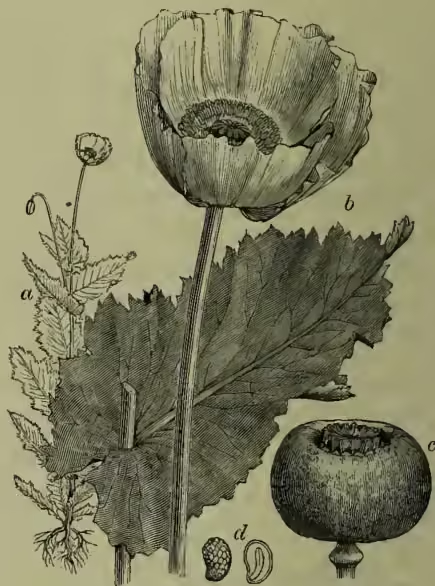
a, whole plant; b, flower and leaf; c, ripe capsule; d, seed and section of do. enlarged. (Bentley and Trimen.)
Poppy (Papaver), a genus of plants of the natural order Papaveraceæ, having a calyx of two (or rarely three) sepals, which very soon fall off; a corolla of four (rarely six) petals; numerous stamens seated on a receptacle; the stigma crowning the ovary, without a style, and in the form of 4 to 20 rays; the capsule opening by pores under the persistent stigma, imperfectly divided into cells by partitions as numerous as the rays of the stigma, but which do not reach the centre, and the seeds extremely numerous. There are numerous species of poppy, mostly natives of Europe and Asia, some of them found even in very northern regions, but most of them in the warmer temperate parts. They are herbaceous plants, annual, biennial, or perennial, mostly sprinkled with bristly hairs. They have a white milky juice; a disagreeable narcotic smell, particularly when bruised; pinnatifid or bipinnatifid leaves, more rarely jagged or toothed leaves; and large showy flowers, which readily become double by cultivation. The capsules are curious from the manner in which they fling out their seeds when the plant is shaken by the wind; each capsule being somewhat like a round or oval pepper-box, with holes, however, not in the top, where rain might get in by them, but under the projecting rim. By far the most important species is that known as the Opium Poppy (P. somniferum), also called the White Poppy and the Oil Poppy (see OPIUM). But the same species is important on account of the bland fixed oil of the seeds, and is much cultivated as an oil-plant. Poppy-oil is as sweet as olive-oil, and is used for similar purposes. It is imported into Britain in considerable quantities from India. The poppy is also extensively cultivated for it in France, Belgium, and Germany. The use and manufacture of this oil were for a long time, during the 18th century, strictly prohibited in France, from a mistaken notion that it must partake of the narcotic properties of the milky juice of the plant. The seed, however, contains no opium or any narcotic principle, and was well known to the ancients as a pleasant article of food, fit to be eaten by itself or with bread; some German cakes have poppy-seed plentifully sprinkled on the top. The oil expressed from it is perfectly wholesome, and is much used in
France and elsewhere as an article of food. It is believed that one-half of the oil used for cooking and otherwise for alimentary purposes in France is of this kind. The seeds yield about 40 per cent. of oil, and the oil-cake is useful for manure or for feeding cattle. The oil is sometimes used by painters and by soap-boilers; but it is not good for burning. In the cultivation of the poppy for oil the seed is often sown in autumn, where the severity of winter-frosts is not to be feared; in more northern parts it is sown in spring, and sometimes the seed is scattered on the top of the snow with which the ground is covered. Being very small it needs little or no harrowing. Early sowing is favourable to the size of the plant and the abundance of produce. Hoeing and thinning are advantageous. An open but rich soil is best for the poppy; and a sheltered situation is necessary, as in exposed situations much of the seed is scattered by the wind. The poppy does not exhaust the land so much as colza, rape, and some other oil-plants. Harvesting ought to begin when one-fourth of the capsules of each plant are open. It is accomplished by pulling the plants in such a manner as not to shake the seed out of the capsules, and tying them in sheafs, which are placed together in an erect or slightly sloping position, till the ripening of the capsules is completed, when the seed is taken out by shaking the capsules into a tub or on a cloth, great care being used to prevent any earth from the roots from getting mixed with them. Some farmers in Flanders sow poppies in alternate rows with carrots. The variety of poppy chiefly cultivated as an oil-plant has flowers of a dull reddish colour, large oblong capsules, and brownish seeds; but the white-flowered variety, with globular capsules and white seeds, is also used. The Oriental Poppy (P. orientale), a native of Armenia and the Caucasus, a perennial species, is often planted in gardens on account of its very large, fiery-red flowers. Its unripe capsules have an acrid, almost burning taste, but are eaten by the Turks, and opium is extracted from them. Several species are British, all of them local, rare in some places, and troublesome weeds in cornfields in other places apparently quite similar in climate. Among them is the Corn Poppy or Common Red Poppy (P. rhoeas), with bright-red flowers, and deeply pinnatifid leaves. The petals are mucilaginous and slightly bitter; they have a slight narcotic smell; and a syrup made of them is sometimes used as an anodyne in catarrhs and children's complaints; but they are more valued for the rich red colour which they yield. A variety with double flowers is cultivated in flower-gardens, under the name of Carnation Poppy. Among the ancients the poppy was sacred to Ceres.