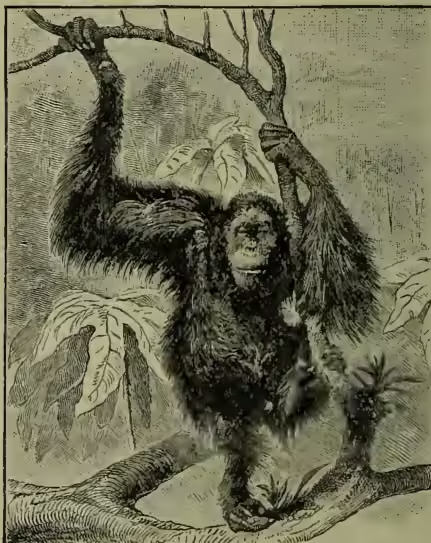
Orang, or ORANG-OUTANG (Simia satyrus), an anthropoid ape, found only in the forests of Sumatra and Borneo. There is only one species, though it has been said that another smaller variety occurs in Borneo. The orang is distinguished from other anthropoid apes by its reddish-brown colour; and it has been noticed that the colour corresponds to that of its human neighbours, just as the black colour of the chimpanzee and gorilla answers to that of the African tribes inhabiting the same country. Miklucho-Maklay asserts that the Malays never use their words Orang útan ('man of the woods') for any ape, but for an uncultured tribe of Malays living in the woods.
Like other anthropoids the orang is arboreal in habit, and can move with considerable swiftness through a forest, passing from tree to tree; on the ground it is awkward. It has a curious habit of building among the branches a temporary hut or nest as it is usually called. The orang was formerly regarded as capable of all manner of iniquities, such as carrying off women and children, and throttling people with its hind-foot as they passed under the trees. When these beliefs were proved to be false they were transferred to the chimpanzee, and particularly to the gorilla. They were mainly dispelled by Wallace, who stated, however, of the orang that 'there is no animal in the jungle so strong as he;' but strength does not necessarily imply ferocity, and the orang seems to be a very tamable creature.
Hornaday, an American traveller, observed the orang in the act of making its nest. He thus describes the process: 'I got there just in time to see the orang build a large nest for himself. He took up a position in a fork which was well screened by the foliage, and began to break off small branches and pile them loosely in the crotch. There was no attempt at weaving, nor even regularity in anything. He reached out his long, hairy arm, snapped off the leafy branches with a practised hand, and laid them down with the broken ends sticking out. He presently got on the pile with his feet, and standing there to weight it down, he turned slowly, breaking branches all the while and laying them across the pile in front of him until he had built quite a large nest. When he had finished he lay down upon it, and was so effectually screened from us that I could not dislodge him, and after two or three shots I told the natives that they would have to cut down the tree.' During one day's travel in Borneo thirty-six old nests and six fresh ones were seen; there appears to be nothing like house-building, which has been stated by some to exist among the orangs.
The structure of the orang shows its near relationship to the other anthropoids and to man. The curvature of the spine, which is an important character, appears, according to Cunningham, to be different from that of a full-grown man, but to correspond to that of a boy of six years old. The extension of the cerebral hemispheres in the brain backwards over the cerebellum is about equal to what is found in the chimpanzee; naturally this is considerably less than in man, but greater than in the new-born child. The orang comes nearest among the anthropoids to man in certain other characters, especially in brain characters; but, as the gorilla and chimpanzee show a nearer approximation in various other points, it would not be safe to call the orang the most man-like of apes. See ANTHROPOID APES.