Orange (Lat. aurantium; from aurum, 'gold'), the name of one or more species of Citrus (q.v.), of which the fruit is much prized. Botanists generally regard all the oranges as of one species, Citrus aurantium, but some make the Sweet Orange, the Bitter Orange, the Bergamot Orange, &c. distinct species. The wild state of the orange is not certainly known, although its characters may be pretty confidently inferred from the degeneration of cultivated varieties; and no cultivated plant shows a greater liability to degenerate, so that seedling oranges are almost always worthless. From a remote antiquity it has been cultivated in India; and thence it seems to have spread into western Asia and Europe. It has been alleged that the orange is a native of North America, near the Gulf of Mexico; but the probability rather seems to be that it has been introduced, and has become naturalised.
The Common Orange, or Sweet Orange (Citrus aurantium), is an evergreen tree of moderate size, with greenish-brown bark; the leaves oblong, acute, sometimes minutely serrated, the leaf-stalks more or less winged, the flowers white, the fruit roundish, the oil-cysts of the rind convex, the juice sweet and acid. It is cultivated in almost every part of the world of which the climate is warm enough, but succeeds best in the warmer temperate or subtropical climates, as in the south of Europe, where it is very extensively cultivated, as far north as the south of France. The orange does not seem to have been cultivated by the Greeks or Romans, but was probably brought to Europe by the Moors, and is supposed to have been introduced into Italy so recently as the 14th century, fully 1000 years after the citron. In the north of Italy oranges are sometimes grown in conservatories, but often in the open air, except during winter, when they are covered with temporary houses of boards. In the south of England they are sometimes in like manner grown in the open air, with a shelter of boards or matting in winter, but trained against a south wall; they attain a large size, and yield good fruit. The abundant importation of the fruit, however, renders the cultivation of the orange in Britain unnecessary; and, in general, only small plants are to be seen in greenhouses or conservatories, as mere objects of interest. In some parts of Queensland and south-west Australia the orange is grown to great perfection, but its culture does not appear to be regarded as a profitable industry—probably owing to the absence of markets and the facilities of conveyance thereto. A few counties in the colony of New South Wales appear to be particularly well adapted to orange cultivation. A government report on the area under orangeries gives it as 10,857 acres in 1889. Excellent oranges have been exported from the colony to Britain at remunerative rates. There are many varieties in cultivation, which are perpetuated by grafting upon seedling orange stocks and by layers. The principal orange-growing sections of the United States are Florida, Louisiana, and California.
Of the varieties of the sweet orange perhaps the most deserving of notice are the Portugal or Lisbon Orange, the most common of all, having the fruit generally round or nearly so, and a thick rind; the China Orange, said to have been brought by the Portuguese from China, and now much cultivated in the south of Europe, having a smooth thin rind and very abundant juice; the Maltese or Blood Orange, remarkable for the blood-red colour of its pulp; the Egg Orange, having fruit of an oval shape; the Mandarin Orange, or Clove Orange (C. nobilis), has fruit much broader than long, with a rind very loosely attached to the flesh, and small leaves; and the Tangerine Orange, apparently derived from the Mandarin. The St Michael's
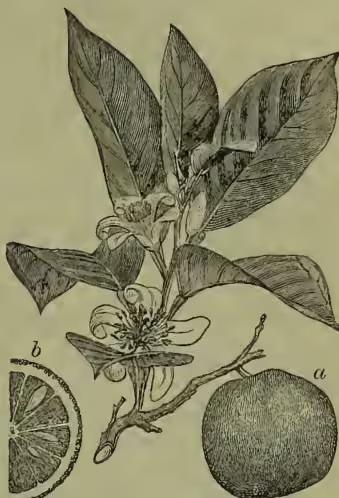
Branch in Flower:
a, fruit; b, transverse section of same.
(Bently and Trimen.)
Orange is a sub-variety of the China orange. The Jaffa Orange has now a great reputation. The Majorca Orange is seedless. The Kum-quat (C. japonica), from China and Japan, is little bigger than a gooseberry, and grows well in Australia.
The Bitter Orange, Seville Orange, or Bigarade (C. vulgaris, or C. bigaradia), is distinguished from the sweet orange by the more truly elliptical leaves, the acid and bitter juice of the fruit, and the concave oil-cysts of its rind. Its branches are also spiny, which is rarely the case with the sweet orange. The varieties in cultivation are numerous. The bitter orange was extensively cultivated by the Moors in Spain, probably for medicinal purposes, as stomachic and tonic. Its chief use, however, is for flavouring puddings, cakes, &c., and for making marmalade. The Bergamot Orange (C. Bergamia) is noticed in a separate article.
Orange-leaves are feebly bitter, and contain a fragrant volatile oil, which is obtained by distilling them with water, and is known in the shops as Essence de Petit Grain. Orange-flowers yield, when distilled with water, a fragrant volatile oil, called Oil of Neroli, which is used in making Eau de Cologne and for other purposes of perfumery. The flowers both of the sweet orange and of the bitter orange yield it, but those of the bitter orange are preferred. Dried orange-flowers, to be distilled for this oil, are an article of export from the south of Europe. They are packed in barrels, and mixed with salt. The dried flowers have a yellowish colour; the fresh flowers are white and very fragrant. The use of them as an ornament in the head-dress of brides is common throughout great part of the world. The small green oranges, from the size of a pea to the size of a cherry, which fall from the trees, both of the sweet orange and the bitter orange, when the crop is too great to be brought to maturity, are carefully gathered and dried, and are the Orange berries of the shops. They are used in making Curaçoa, and yield a fragrant oil on distillation, the original essence de petit grain. The dried and candied rind of the ripe bitter orange, well known as Orange-peel, is used as a stomachic, and very largely for flavouring puddings and articles of confectionery. The rind of the sweet orange is sometimes employed in the same way, but is inferior. A fragrant essential oil is obtained from the rind of the orange by distillation with water, and is sold by perfumers as Oil of Sweet Orange, or Oil of Bitter Orange, according as it is obtained from the one or the other, although the two kinds of oil are very similar. The rind of the orange is used in the preparation of a fine liqueur called Orange Rosoglio, which is an article of export from some parts of Italy. Besides the use of the sweet orange as a dessert fruit, and as a refrigerant in cases of sickness, its juice is extensively used as a refrigerant beverage, and is valuable in febrile and inflammatory complaints.
Orange-trees are often extremely fruitful, so that a tree 20 feet high and occupying a space of little more than 12 feet in diameter sometimes yields from 3000 to 4000 oranges in a year. One tree in Florida has often borne 10,000 oranges in a single season. The orange-tree attains an age of at least 100 to 150 years. Young trees are less productive than old ones, and the fruit is also less juicy, has a thicker rind, and more numerous seeds.
The fruit of the orange-tree is of great commercial importance, for not only is it one of the most delicious and wholesome of fruits, but fortunately it is also the most easily kept and carried from place to place. No fresh fruit possesses in the same degree as the orange and its congeners, the lemon, citron, lime, &c., the property of being easily packed in boxes when nearly ripe, and being in that state able to stand the close confinement of a ship's hold during a voyage of two or three weeks. The orange is much cultivated in the Azores, Malta, Sicily, Spain, Portugal, the Syrian coast, and latterly in Florida, and it is from these localities that Britain receives its supply. Those from St Michael's, one of the Azores, and from Malta are the best varieties in the English markets; but the Mandarin Orange of China and the Navel Orange of South America are much superior. The latter occasionally reach Britain in small quantities from Brazil; they are nearly double the size of the ordinary orange, and have a peculiar navel-like formation on the top of the fruit, which is somewhat oval in shape.
Oranges when gathered for export must not be quite ripe; those fully formed and with the colour just turning from green to yellow are chosen. Each is wrapped in a piece of paper, or in the husk of Indian corn, and they are packed in boxes and half-boxes, chests and half-chests—the former are the Sicilian packages, the latter are St Michael's, Spanish, and Portuguese. A box contains about 250, a chest about 1000 oranges.
Orange-peel, or the rind of the orange, is used both in medicine and in confectionery—for the former purpose it is merely cut into long strips, and dried; for the latter it is carefully separated, either in halves or quarters, from the fruit, and, after lying in salt water for a time, is washed in clear water, and then boiled in syrup of sugar, or candied, and is sold extensively as candied peel. The rinds of the citron and lemon are treated in the same manner.—The wood of the orange-tree is yellowish white and close-grained. It is used for inlaying and for turnery.
The orange may be successfully cultivated in climates the winter temperature of which does not fall below 40°. The tree prefers strong loam or clayey soil, but succeeds in any kind of soil if well fertilised. See Dr Moore's Handbook of Orange Culture (New York and Lond. 1885); and United States Consular Report on Fruit Culture (1890).