Osier, the popular name of those species of Willow (q.v.) which are used chiefly for basket-making and other wickerwork. They are of low bushy growth, few of them ever becoming trees, their branches long and slender; and they are the more valuable in proportion to the length, slenderness, suppleness, and toughness of their branches. The Common Osier (Salix viminalis), a common
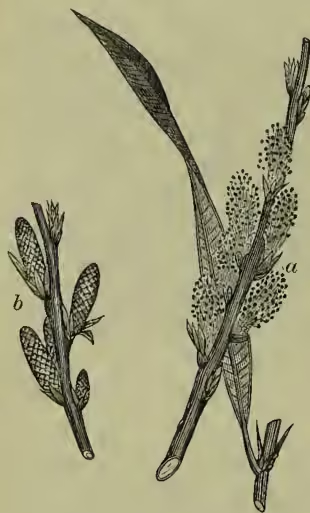
Osiers are very extensively cultivated in Holland, Belgium, and France, on alluvial soils, especially near the mouths of rivers; and from these countries great quantities of 'rods' are imported into Britain. They are cultivated also to a considerable extent in some parts of England, particularly on the banks of the Thames and the Severn, and in the level districts of Cambridgeshire, Huntingdonshire, &c. Islets in the Thames and other rivers, entirely planted with osiers, are called Osier holts. Osiers grow particularly well on grounds flooded by the tide. Much depends on the closeness of planting of osier grounds; as when space is too abundant the shoots of many of the kinds do not grow up so long, slender, and unbranched as is desirable. The French cultivators, when they wish osiers for the finest kinds of basket-work, cut branches into little bits with a bud or eye in each, and plant these pretty close together, so as to obtain weak but fine shoots; but generally cuttings of 15 or 16 inches in length are used, and of tolerably thick branches, and these are placed in rows from 18 inches to 2 feet apart, and at distances of 15 to 18 inches in the row. Osier plantations in light soils continue productive for fifteen or twenty years, and much longer in rich alluvial soils. Osiers succeed best in rich soils, but not in clays. No cultivation is required after planting; but the shoots are cut once a year, at any time between the fall of the leaf and the rising of the sap in spring. After cutting they are sorted, and those intended for brown baskets are carefully dried and stacked, care being taken that they do not heat, to which they are liable, like hay, and by which they would be rotted and rendered worthless. The stacks must be protected carefully from rain. The osiers intended for white baskets cannot at once be peeled, but, after being sorted, they are placed upright in wide shallow trenches, in which there is water to the depth of about four inches, or in rivulets, being kept secure in their upright position by posts and rails; and thus they remain till they begin to bud and blossom in spring, which they do as if they remained on the parent plant, sending forth small roots at the same time into the water. They are then, in ordinary seasons, easily peeled by drawing them through an instrument called a break, but in cold springs it is sometimes necessary to lay them for a while under a quantity of litter. After being peeled, they are stacked, preparatory to sale. See BASKET.