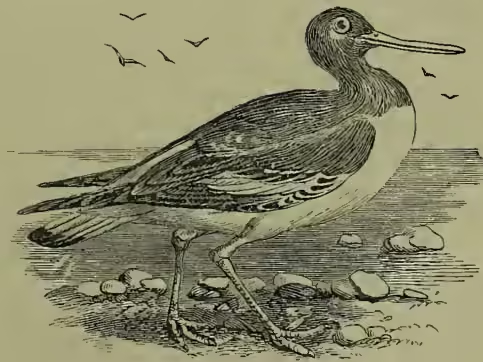
Oyster-catcher (Hæmatopus), a genus of birds of the family Charadriidae, closely allied to the Plovers, and distinguished chiefly by the long, strong, straight, wedge-shaped bill, legs of moderate length, feet with only three toes, all directed forwards and united at their base by a small membrane. The genus, which is cosmopolitan in its distribution, embraces nine species. The only European species, H. ostralegus, known also as the Sea-pie and Mussel-picker, is found on many parts of the English coast, and is common in Scotland along the whole east coast, on the adjacent islands even as far as St Kilda, and also on the Irish coasts. Although a coast bird, it often wanders inland, and may be found breeding near inland lochs and on the banks of large rivers. It occurs in Greenland, is common in Iceland, and in many parts of Europe, Asia, and Africa. Its southern migrations extend to Burma, Ceylon, Persia, Mozambique, and Senegambia. The adult bird is about 16 inches long, has black and white plumage, orange-yellow bill, crimson irides, and flesh-coloured legs and toes. It is very regular in its feeding habits, passing with great punctuality to and from its feeding-grounds, where it regales itself with mussels, whelks, limpets, annelids, crustaceans, and small fish. Its eggs, usually three or four in number, are laid on shingle, more rarely among sandhills or even in fields inland, and sometimes on the top of a fairly lofty stack. The oyster-catcher swims well, and takes to the water of its own accord. Its flesh, though dark in colour, is palatable. H. capensis is a black species ranging from the Cape to the Canaries. Three or four species are confined to America.