Oyster (Ostrea), a genus of bivalves, the members of which are well known to be very passive and very palatable. Structure.—The fundamental characteristics, as displayed by the favourite European species, Ostrea edulis, are those of other bivalve Molluscs (q.v.), but the 'foot,' with which many less sedentary forms move, is almost completely degenerate, the two valves of the shell are unequal, the hinge which unites them is without teeth, and
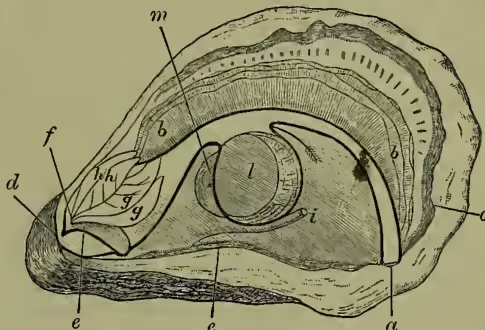
The dorsal surface is downwards, the anterior or head end to the left. a, region where water enters and leaves the animal; the dark lines indicate where one mantle-flap has been cut away to expose the other structures; b, gills; c, margin of one of the mantle-folds; d, anterior part of hinge; e, hood over mouth; f, position of mouth; g, h, labial palps; i, end of intestine; l, the closing muscle of the shell; m, position of the heart. the powerful closing muscle is almost median in position. The left valve of the shell, that by which the animal fixes itself, is hollowed out, while the other is almost flat, and the whole animal is slightly unsymmetrical. On an opened oyster it is easy to detect the fringed mantle which lines and makes the shell, the ciliated gills or 'beard,' two somewhat similar flaps (labial palps) on each side of the mouth, which, overhung by a hood, lies near one end of the hinge, the brownish digestive gland, the heart and the kidneys close beside the shell-shutting muscle. 'I suppose,' says Professor Huxley, 'that when the sapid and slippery morsel—which is and is gone like a flash of gustatory summer lightning—glides along the palate, few people imagine that they are swallowing a piece of machinery (and going machinery too) greatly more complicated than a watch'—in fact a living organism of a high order.
General Life.—The oyster feeds on microscopic organisms which are washed into the gaping shell and on to the mouth by the ciliary activity of the gills and palps; and it may be noted that the greenish tinge, regarded by epicures as one of the highest credentials of an oyster, is probably due to a copious diet of minute green algae. As every one knows, oysters live gregariously in 'beds' or 'banks' at depths of 3 to 20 fathoms, and are strangely fastidious as to locality. They have many enemies besides the dredger, such as the little sponges (Clione), which bore in the shells; marine worms, and sea-snails (e.g. Purpura and Murex), which also effect an entrance; besides starfishes, which swallow little ones intact, or, embracing larger specimens, insert their arms when the shells gape. Although these passive animals have no eyes or ears they can detect the shadow of an approaching boat; the mantle-fringe and some other parts are undoubtedly sensitive; and some enthusiasts have even inferred 'intelligence' from the fact that in the 'oyster-schools' and elsewhere the molluscs learn to keep their shells shut when the tide retires or when they are transported by rail!
Life-history.—There are many interesting facts connected with the life-history of the oyster. Thus, O. edulis is hermaphrodite, being first an egg-laying female, afterwards a sperm-producing male, while O. angulata and the American O. virginica have the sexes separate. Maturity is sometimes rapidly attained, but usually not until the third or fourth year of life, and the maximum fertility is between the fourth and seventh year. The reproductive season generally begins in May, and continues till the beginning of autumn, but its limits are extended or lessened by the conditions of temperature. When the oyster becomes 'sick,' 'milky,' or 'out of season,' the mantle-cavity and the inter-spaces between the gills are packed with developing eggs, which fishermen call 'white,' and at a later stage 'black spat.' Buckland likened this black spat to fine slate-pencil dust, and the emergence of the young from the mother to a puff of smoke from a railway-engine. He computed the number of developing eggs in an oyster at from 276,000 to 829,000; and Professor Möbius, the greatest German authority on oysters, calculates that 1000 full-grown parents produce 440 million embryos annually.
These embryos are only about th of an inch in length, and about two millions of them might be packed into a cubic inch, but the numbers which rise from an oyster-bank are so immense that the water seems to be clouded. They are very unlike the adults in habit, for they swim actively for some days by means of a protrusible ciliated cushion or velum. The valves of the shell are transparent and symmetrical; the gills, palps, and some other adult structures have yet to be developed. In the American oyster, the eggs are set adrift at an early stage, fertilisation and the whole of development taking place outside the shelter of the parent. In either case the mortality is enormous; multitudes are washed away to unsuitable localities, and multitudes are devoured by hungry animals; in fact Möbius computes that out of 440 million embryos only 421 individuals reach maturity.
Those that survive become weighted by their growing shells, draw in their ciliated velum for the last time, and sink to the bottom as a 'fall of spat.' They settle on stones, shells, or other 'culch,' and often nowadays on chalked tiles or on floating collectors which are placed for the purpose of receiving them. Moored by their left shells, they grow rapidly, from th of an inch when first attached, till at the end of six to eight months they are like threepenny pieces, and are known as 'brood.' 'The diameter of an oyster at two years is about two inches, another inch is added in the third year, after which the growth is much less rapid.'
Different Kinds.—Oysters are represented by several widely distributed species—e.g. the European O. edulis and O. angulata, the American O. virginica with several varieties, two others from the western coasts (O. conchophila and O. lurida)—all of them edible, while the Cape of Good Hope, Australia, Japan, &c. are not without their share. They vary considerably in size; those from 3 to 6 inches are common, but Sir J. E. Tennent found one in Ceylon measuring a little over 11 inches in length. American oysters are often very large. The banks of oysters sometimes form important marine and shore deposits—witness the banks of long, narrow 'racoon' oysters off the coast of Georgia and other parts of North America, which are said to form natural breakwaters. The race is an ancient one, for oysters appear in the Carboniferous strata, and two related forms—Gryphaea and Exogya—with thick heavy shells, are common fossils. The name is sometimes extended to other bivalves, such as the false oyster Anomia (one valve of which is perforated by a tag of attaching byssus), the pearl-oyster Meleagrina (see PEARL), and the thorny oyster Spondylus.
Edibility.—The accumulations of oyster-shells in the 'kitchen-middens' of Neolithic ages show that the appreciation of oysters is no modern taste. To Roman palates the oyster was precious, and the praises of its appetising flavour (grata inluvies) were often sounded. Those of Rutupiae (Richborough, in Kent) were early known to the epicures and highly esteemed. When eaten alive or half-alive in the usual fashion, they are not only pleasant, but nutritious and readily digested, nor can any evil effects (such as parasites) be traced to moderate indulgence in these dainties. 'The points of an oyster are,' Frank Buckland says, 'first the shape, which to be perfect should resemble very much the petal of a rose-leaf. Next, the thickness of the shell; a first-class thoroughbred native should have a shell of the tenuity of thin china or a Japanese tea-cup. It should also have an almost metallic ring, and a peculiar opalescent lustre on the inner side; the hollow for the animal of the oyster should be as much like an egg-cup as possible. Lastly, the flesh itself should be white and firm, and nut-like in taste. It is by taking the average proportion of meat to shell that oysters should be critically judged. The oysters at the head of the list are of course "natives" (oysters artificially reared); the proportion of a well-fed native is one-fourth meat.'
Oysters and Disease.—Many cases of enteric illness and death having been of late referred to the eating of oysters, the Local Government Board made searching inquiry into the conditions of oyster culture and storage along the coasts of England and Wales, and carried on bacteriological investigations as to the power of the oyster to absorb, retain, and transmit the typhoid bacillus and the cholera vibrio. It appears from a report in 1894-96 that oysters contaminated by sewage, &c., can and do transmit disease; and that in many localities the conditions of culture and storage do expose oysters to the serious risk of such contamination.
Demand.—Some years ago 500 millions were sold annually in London, at a cost of £100,000; but the supply has decreased, and the price increased. The total British expenditure in oysters has since been calculated at £2,000,000, for about 240 million oysters. In Paris the annual consumption is said to be over 100 millions, which cost, it is said, 1,654,350 francs in 1853, and 4,500,000 in 1890. In the United States the business employs 60,000 persons and 5000 vessels; some 25 million bushels are sold for 15,500,000. In New York state alone the capital invested now exceeds 6,000,000. Oysters are sent from Baltimore, New York, and other principal markets in carloads to the west—to Milwaukee, Chicago, St. Louis, and even San Francisco. The great beds occur in Long Island Sound and Chesapeake Bay: the former is in part surveyed and divided into plots, not to exceed 500 acres for any one person, for oyster-culture. The bivalve is found, however, from the Gulf of St Lawrence to and along the north shore of the Gulf of Mexico, and, though smaller, at points on the west coast, as Puget Sound and Juan de Fuca Strait. In some parts of the United States the Clam (q.v.) rivals the oyster in popularity.
Supply.—The British supply is derived from three sources—from the national oyster-banks, which are gradually getting the attention which they deserve; from the continental banks and farms, especially those of France and Holland; and from the United States, with which a trade amounting to about half a million dollars annually has rapidly grown. Moreover, it must be noted that young oysters are largely imported from France and elsewhere to be 'fattened' on British culture-grounds. The practical problem is to keep up a supply sufficient to meet the large demand. For various reasons this seems to be difficult. As oysters live in 3 to 20 fathoms of water, they can hardly be gathered with much selection; they are sometimes lifted by 'rakes' and tongs, but usually by the dredge; this is a destructive process, probably killing more than it secures. There seems some evidence to show that sheer over-dredging has almost ruined some of the banks, but this probably has been exaggerated. Changes in the sea-bottom and in the food-supply have doubtless had more to do with the disappearance of oysters from localities where they once abounded. Those who permit all kinds of debris and foulness to be emptied into the sea can hardly expect a flourishing oyster-bank in the neighbourhood. To preserve the beds, to observe 'close time,' to re-stock when the supply wanes, and similar practical precautions are certainly effective; but regulations which are satisfactory on paper are often very unsatisfactorily realised. The reader should consult the Parliamentary Reports on British Oyster Fisheries (1870), and on the increasing scarcity (1876).
Oyster-culture.—Another practical endeavour which has been richly rewarded is that of artificial oyster-culture. This is of course no novelty, having been practised by the Romans. Thus, Pliny says that 'the first person who formed artificial oyster-beds was Sergius Orata (in the time of Augustus), who established them at Baiae . . . not for the gratification of gluttony, but for the sake of gain, as he contrived to make a large income by the exercise of his ingenuity.' In the days of the later emperors there were well-established ostearia, and Lake Fusaro, the Acheron of Virgil, a muddy salt-water pond, nowhere more than six feet in depth, has been for many centuries utilised for this purpose. Of oyster-culture there are many different kinds; it may be confined to 'fattening' oysters in some conveniently constructed pond; or 'fallen spat,' collected on tiles or artificial 'culch,' may be brought to the sheltered culture-grounds, where the young can grow in safety; or again, oysters may be bred in confinement, as Professor J. A. Ryder has succeeded in doing in America. In this last case the oysters were kept in a pond separated from the sea by a sandbank, through which water alone came and went with the tide; they produced eggs, these grew into 'spat,' the young fell on suitable collectors, which were afterwards removed to the natural beds. It has even been found possible to fertilise the eggs artificially with sperm from male oysters, and though this is not so feasible in the case of the European species, whose eggs are retained within the parent until they have to some extent developed, there is no theoretical obstacle against breeding them in confinement. Another possibility is to collect the free larvæ, which are sometimes very abundant, and transfer them to culture-grounds where the risks of mortality would be lessened. The success which has already attended various forms of oyster-culture, of which details will be found in the reports cited below, certainly warrants further extension and experiment, especially as many authorities believe that there is more hope in this than in any legislative measures to preserve the natural banks. Arcachon (q.v.) and Cancale are important French seats of oyster-culture; in England Whitstable is most notable. The frost of the winter of 1890-91 was estimated to have done £15,000 of damage to the oysters of two companies at Whitstable.
See Parliamentary Reports on Oyster Fisheries (1870, 1876, 1878); Report of the United States Fisheries Commission, viii., which contains not only the results of American observations and experiments, but translations of valuable memoirs by Hoek, Hubrecht, and Möbius; Report of Scotch Fisheries Board (J. H. Fullarton on Oyster-culture in France, &c.), 1890; Möbius, Die Auster und die Austernwirtschaft (1877); E. Ingersoll, The Oyster Industries of the United States (1881); W. K. Brooks, Development and Protection of the Oyster in Maryland (1884), and Studies from Biol. Lab. (vol. i. 1880); Huxley, in English Illustr. Mag. (vol. i. 1883); Marquis of Lorne, in Good Words (1890); Philpots, Oysters and all about them (2 vols. 1891).