Pagoda (a Portuguese corruption of the Persian but-kadah, 'idol-temple') is originally an Indian temple of the approximately pyramidal shape especially characteristic of the Dravidian style (see Vol. VI. p. 109). Thus, the great pagoda at
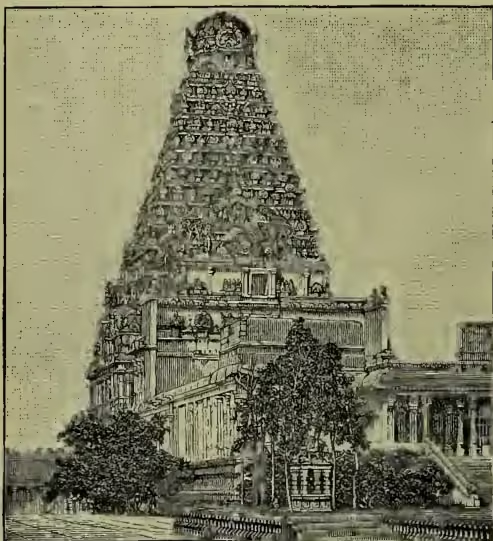
Tanjore has a perpendicular part two stories in height, 82 feet square, and above that thirteen stories, forming an elongated pyramid about 100 feet high. The basement section is simple in outlines, but adorned by niches and pilasters; the pyramidal portion is somewhat elaborately sculptured; and the whole is crowned by a dome (said to consist of a single stone), which brings the total height to 190 feet. The temple stands in one of two great courtyards, and in the same court stand several small shrines, one of which is so beautifully carved as to rival in interest the great temple.

The date of the latter is not certainly known, but is with much probability referred to the beginning of the 14th century. The so-called 'Thousand Pagodas' of Brambanan (q. v.) in Java are obviously modelled on Hindu originals, either Jain or Buddhist. The Burmese pagodas are described and and illustrated at Vol. II. p. 565. The term is also loosely applied to the Chinese taa, or tapering tower, of which the most famous was the Porcelain Tower of Nanking, described at Vol. III. p. 186. This was erected in the beginning of the 15th century; only nine of the proposed thirteen stories, cased in white porcelain, were completed, and the height never exceeded about 260 feet. It was destroyed by the Taipings in 1856. First-class pagodas have seven, nine, or thirteen stories, the more numerous second-class ones usually three or five. Pagodas are occasionally still erected—sometimes of iron.