Persia, called by the natives IRAN (see ARYAN RACE), the most extensive and powerful native kingdom of western Asia, is bounded on the N. by the Transcaspian provinces of Russia, the Caspian Sea, and the Transcaucasian provinces of Russia; on the E. by the Transcaspian provinces of Russia, Afghanistan, and Beluchistan; on the S. by the Strait of Ormuz and the Persian Gulf; and on the W. by Asiatic Turkey. It extends 900 miles from east to west and 700 miles from north to south, and has an area of about 638,000 sq. m. It consists for the most part of a great tableland or elevated plateau, which in the centre and on the east side is almost a dead level, but on the north, west, and south is covered with mountain-chains. The provinces of Azerbaijan, Mazanderan, Ghilan, Kurdistan, Luristan, and Fars are almost wholly mountainous. From the southern boundary of Azerbaijan the majestic range of the Elburz runs eastward, following the line of the Caspian coast at a distance varying from 12 to 60 miles. On reaching Astrabad the mountains sink into ridges of lower elevation, one of which joins the Paropamisus in Afghanistan. A hill-country lies north of this line; it terminates in the Daman-i-koh chain, which sinks abruptly to the low plain of Turkestan. South and east of Azerbaijan a broad mountain-belt traverses Persia from north-west to south-east, the chains and valleys of which it consists lying in the same direction. To this region belong the mountains running from Hamadan to Shiraz, some of the peaks of which are clad with perpetual snow, and the Zagros Mountains and Pushti Kuh on the western frontier. The Persian mountains are mostly primitive; granite, porphyry, felspar, and mountain-limestone enter largely into their composition. They also exhibit indications of volcanic action, Demavend, a conical peak 18,600 feet in height, the highest summit connected with the Elburz range (or ranges), being an extinct volcano; and earthquakes occasionally occur. The Persian plateau, which lies in an angle formed between these mountains, is intersected by many subsidiary ranges and groups of mountains, and spreads eastward to the plateau of Afghanistan, its general elevation ranging from 2000 to 5000 feet above sea-level, the lowest portion being the Great Salt Desert in the south-west of Khorassan, which has 2000 feet of elevation above the sea; while the average elevation of the whole plateau above the sea is about 3700 feet. See ASIA.
A great part of Khorassan, the north half of Kerman, the east of Irak-Ajemi, which form the great central plain, and detached portions of all the other provinces, with the exception of those on the Caspian Sea, forming more than three-fourths of the surface of Persia, are desert—that is to say, are uncultivated owing to the want of rain and of artificial irrigation. In some parts of this waste the surface produces a scanty herbage of saline plants; in other parts, called Kevir, it is covered with an efflorescence of saltpetre, which glitters and flashes in the sunlight, forcing the traveller on these inhospitable wastes to wear a shade to protect his eyes; but by far the greater portion of this region consists of light dry soil, which only requires irrigation to become fruitful. This great central desert contains a few oases, but none of great extent. A narrow strip of low and level country extends along the shores of the Persian Gulf and the Strait of Ormuz. It consists of a succession of bare plains, occasionally interrupted by a plantation of palms near the scanty rivulets which traverse it. It is called Dushistan, or by the generic name, applied to many other localities, of Garmisir—i.e. the warm region, in opposition to the mountainous districts, called Sarhad, or the cold country.
Although so much of Persia is desert, some parts of the country are of exceeding fertility and beauty; the immense valleys, some of them 100 miles in length, between the various ranges of the Kerman Mountains abound with the rarest and most valuable vegetable productions. Great portions of the provinces of Fars, Khuzistan, Ardalan, and Azerbaijan have been lavishly endowed by nature with the most luxuriant vegetation; while the provinces of Ghilan and Mazanderan, which lie between the Elburz and the Caspian Sea, and the southern slopes of the Elburz are as beautiful as wood, water, and a moderately hot climate can make them—the mountain-sides being clothed with trees and shrubs, and the plain, 300 miles long by from 5 to 30 miles wide, studded with mulberry plantations, rice-fields, vineyards, orchards, orange grounds, and sugar and cotton plantations.
Rivers and Lakes.—Persia has hardly one river that can properly be termed navigable, though some of them are several hundred miles in length, and of great width and volume of water. The Karun (q.v.) was opened to foreign steam-navigation from its mouth to Ahwaz (where there is a series of rapids) in 1889. The rivers which flow to the southward receive in the latter part of their course few tributaries, and fertilise only a narrow strip of land on each side of them, except when their waters are applied, by means of canals or other works, to the artificial irrigation of the soil. Most of the monuments of the architectural skill and laborious industry of the ancient Persians in this department are now ruinous. As a natural consequence of the nature and situation of its surface, Persia abounds with saline lakes, and there are nearly thirty of them having no visible outlets. The chief lake is Lake Urumiah (q.v.), in Azerbaijan. Lake Bakhtegan, in the east of Fars, the receptacle for the drainage of the northern half of that province, is about 60 English miles in length by 9 in breadth. Lake Shiraz is much smaller. Part of Lake Zirreh is included in the frontier of Persia.
Climate and Products.—The climate is necessarily very varied. What the younger Cyrus is reported to have said to Xenophon regarding the climate, 'that people perish with cold at one extremity of the country, while they are suffocated with heat at the other,' is literally true. Persia may be considered to possess three climates—that of the southern Dushistan, of the elevated plateau, and of the Caspian provinces. In the Dushistan the autumnal heats are excessive, those of summer more tolerable, while in winter and spring the climate is delightful. On the plateau the climate of Fars is temperate. About Ispahan the winters and summers are equally mild, and the regularity of the seasons appears remarkable to a stranger. To the north and north-west of this the winters are severe. The desert-region of the centre and east, and the country on its border, endure most oppressive heat during summer and piercing cold in winter. The Caspian provinces, from their general depression below the sea-level, are exposed to a degree of heat in summer almost equal to that of the West Indies, and their winters are mild. Rains, however, are frequent and heavy, and many tracts of low country are marshy and extremely unhealthy. Except in the Caspian provinces, the atmosphere of Persia is remarkable above that of all other countries for its dryness and purity.
The cultivated portions of Persia, when supplied with moisture, are very fertile, producing an immense variety of crops. The chief cultivated products are wheat (the best in the world), barley, and other cereals, cotton, sugar and rice (in Mazanderan), and tumbaku or tobacco for the narghileh or water pipe. The vine flourishes in several provinces, and the wines of Shiraz are celebrated in eastern poetry. Mulberries are also largely cultivated, and silk is one of the most important products of the kingdom. Owing, however, to the silkworm disease and the neglect of the Persian government to procure healthy grain from abroad, the silk cultivation has of late years greatly diminished.
The forests of the Elburz abound with wild animals, as wolves, tigers, jackals, boars, buffaloes, foxes, and the Caspian cat. Leopards abound in Mazanderan, and lions in parts of Fars and Arabistan. Among domestic animals the horse, the ass, and the camel hold the first place. The horses have always been celebrated as the finest in the East. They are larger and more handsome, but less fleet than the Arabian horses. The Caspian rivers abound with fish, especially sturgeon, great quantities of which are cured and exported to Russia. The mineral products of Persia are insignificant, with the sole exception of salt. Iron is abundant in Azerbaijan, but is not worked; copper occurs in considerable quantity in the mountains of Mazanderan and Kerman; and lead, antimony, sulphur, and naphtha also abound. Long before Dr Tietze's report (1874) coal had been successfully worked in the mountains near Teheran.
Inhabitants.—The settled population are chiefly Tajiks, the descendants of the ancient Persian race, with an intermixture of foreign blood. To this class belong the agriculturists, merchants, artisans, &c. The Tajiks are Mohammedans of the Shi'ite sect, with the exception of the remaining Parsees (some 9000 in number), who are found chiefly at Yezd, and still retain their purity of race and religious faith. The Tajiks have been spoken of as timid, cunning, and servile, but Vambéry testifies to their industry, and their capacity for and love of culture. The nomad or pastoral tribes, or eylats (eyl, 'a clan'), often spelt illyuts, are of four distinct races—Turks (not Ösmanlı Turk), Kurds, Lúurs, and Arabs. Their organisation is very similar to that which formerly subsisted among the Highland clans of Scotland, with the exception that the former are nomad, while the latter inhabited a fixed locality. Each tribe is ruled by its hereditary chief (ujak), and under him by the heads of the cadet branches (tirehs) of his family. Of the four nomad races the Turk is the most numerous, and to it belongs the present Kajar dynasty. The Kurds are few in number, the greater part of their country and race being under the sway of Turkey. The Arabs are also few in number, and at the present day can hardly be distinguished from the Persians, having adopted both their manners and language. The Lúurs are of nearly pure Persian blood. The nomad races are distinguished from the Tajiks by their courage, manliness, and independence of character; but they are inveterate robbers, and have been the cause of many civil wars and revolutions. There is a small population of native Christians—the Nestorians of Urmiah and Telmais, and Armenians, whose principal settlement is at Julfa (Ispahan), where there is an archbishop and a cathedral. Including those who have joined the Roman Catholic and Protestant churches, the whole number of Christians can hardly exceed 50,000. The Jews number 15,000.
We have no certain information regarding the population of Persia. There can be no doubt that in antiquity, and even during the middle ages, while the irrigation-works still fertilised great tracts of country, it supported a great population. In the 17th century the French traveller, Chardin, thought 40 millions not too high a figure. Recent travellers, however, reduced these sums to numbers varying from 15 to 8 millions. Much surprise was accordingly expressed when in 1868 Sir Ronald Thomson reported that the entire population did not exceed 5 millions, and was probably not over 4 millions. His estimate has since been generally accepted as the most trustworthy we have, although the official estimate in 1881 was 7,653,600. He divides the total roughly into a million inhabitants of cities, 1,700,000 nomads, and 1,700,000 peasants and villagers; and the following are his estimates of the population of the chief cities: Tabriz, 110,000; Teheran, 85,000; Meshhed, 70,000; Ispahan, 60,000; Yezd, 40,000; Kerman, 30,000; Kerman-shah, 30,000; Hamadan, 30,000. Teheran has largely increased since this estimate was made, and in 1891 was said to have 210,000 inhabitants. There can be no doubt that the population of Persia has been long diminishing, a fact attributable to misrule and extortion, neglect of the great irrigation-works, and the frequent occurrence of famines in a dry country where cultivation depends on an artificial supply of water.
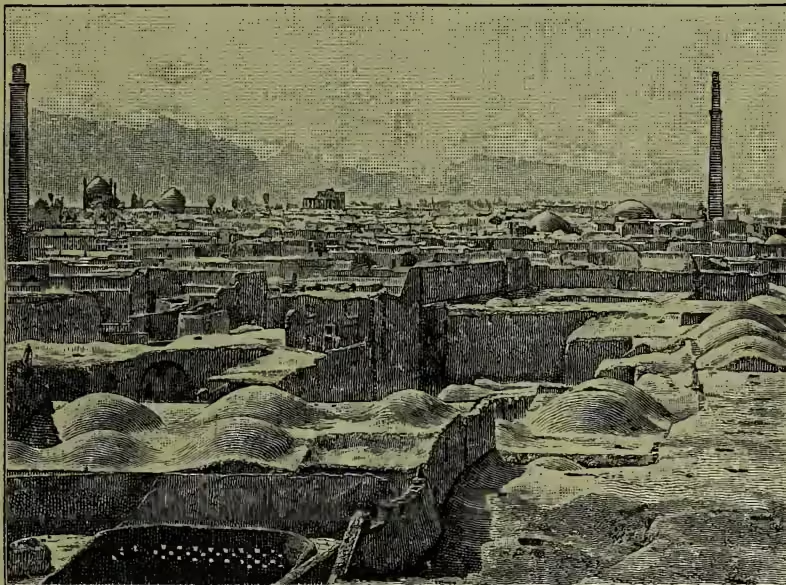
The roads are utterly neglected. The houses, those of the wealthiest people not excepted, appear contemptible, being generally built of earth or mud, and are grouped, even in the towns, with little attention to uniformity or order. They scarcely ever exceed one story in height, and they are surrounded by high blank walls. The public buildings, such as mosques, colleges, and caravanserais, are of similar appearance to the ordinary houses, and built of the same materials. The interiors, however, of the houses of the rich are sometimes perfect paradises of luxury and elegance. The miserable look of the towns is, moreover, greatly redeemed by the beauty of the gardens which surround them.
Manufactures and Trade.—The trade of Persia is comparatively of little importance. The silk used to be the great staple, and is produced in almost every province, but chiefly in Ghilan, Kashan, and Yezd. The repeated failure of the crop has, however, interfered very seriously with this branch of industry. Cotton and woollen fabrics, shawls, carpets, and felts are largely manufactured for use and export in different parts of the country. Trade is carried on by caravans with the interior of Asia and the chief towns of Persia. These caravans exchange the products of Persia for cloth, printed calicoes, shirting, copper sheets, hardware, glass and porcelain, tea, coffee, sugar, candles, paraffin-oil, lucifer matches, and fancy goods. The principal trade centres are Tabriz, Teheran, Ispahan, and Bushire. European goods are brought to Tabriz by Constantinople and Trebizond; to Teheran partly by Tabriz, partly by the Caspian, and partly by Bushire; while to Ispahan they are brought almost exclusively by Bushire. In recent times the communication between Persia and foreign countries has been greatly increased by way of the Caspian owing to the development of the copious petroleum-wells at Baku. By means of the cheap fuel thus obtained the Russian commercial fleet on the Caspian has increased fourfold, and railways have been made from Batoun on the Black Sea to Baku on the Caspian, and from the eastern coast of the Caspian to Askabad, Bokhara, and Samarkand. On the former sea there is a considerable Russian fleet of schooners and screw-steamers. Vessels sail weekly from Astrakhan and bi-weekly from Baku with merchandise for the Persian coast, touching at Enzelli, Mashadisar, and Ashurada. In the Persian Gulf the British India Steam-navigation Company have a regular line of fine steamers running weekly from Bombay to Basra, and touching at Bender-Abbas and Bushire. Fortnightly steamers were started in 1889 by an English firm on the Karun to ply between Mohammerah and Ahwaz in virtue of the concession of free navigation granted by the Shah in 1888. In 1890 Mr Curzon affirmed that in the north-west, north, and north-east districts a decided Russian superiority in trade was met and in parts disputed by British and Indian competition; in the south and west British ascendancy is established and is being increased. The exports consist of wheat, rice, wine, raisins, almonds and nuts, olive-oil, tobacco, drugs, gums, resins, manna, opium, colouring matters, boxwood, walnut-wood, silk, wool, carpets, skins and furs, wax, pearls, turquoises, sulphur, naphtha, salt; the chief imports are cotton goods from Britain, and broadcloths, jewellery, arms, cutlery, watches, earthen, glass, metal wares, &c. The whole foreign trade of Persia has been estimated roughly at—imports, £5,300,000; exports, £3,000,000. The imports of British produce into the three ports of Bushire, Lingah, and Bender-Abbas amounted in 1895 to over £370,000, not including Indian trade; while the exports to Britain thence were worth £175,000. In 1890–95 the average value of imports from Russia was £878,000, and of exports to Russia £1,486,000. The export of Persian carpets—of which there are thirty different kinds—amounts to £150,000 a year. Many projects of railways have been formed, but up to 1899 only one of them had been carried out—viz. from Teheran to Shah Abul Azim, a place of pilgrimage distant only 6 miles. Tramways were laid down in Teheran, and an imperial bank established with branches in the other large towns, in 1889.
Government, Taxation, Education, &c.—The government of Persia is a pure despotism, limited only by the power and influence of the Mohammedan mollahs or priests, domestic intrigues, dread of private vengeance, and an occasional insurrection. The first named is the principal check against unjust government on the part of the monarch, while the latter three operate as powerful restraints on his ministers. The monarch, who has the title of 'Shah' and 'Padishah,' possesses absolute authority over the lives and property of his subjects. His deputies, the governors of provinces and districts, possess similar authority over those under them; their actions are, however, liable to revision by the Shah, who may summarily inflict any punishment upon them for real or alleged misgovernment. Oppression of the sedentary agricultural classes is almost a necessity of such a form of government. The central government consists of a ministry, nominally modelled somewhat after the cabinets of European states. Usually, however, the power falls actually, if not nominally, into the hands of one of their number. The Shah, nevertheless, is in reality his own prime-minister, and even trivial matters are submitted for his personal decision. The principal ministers are those for the Interior (practically the head of the government), for Foreign Affairs, for Finance, for War, for Telegraphs, &c., for Justice, and the President of the Council, who is at the same time postmaster-general and general secretary of state. The law both in civil and criminal cases is administered by the governors, who not unfrequently refer points of law, which is based upon the Koran and its commentaries, to mollahs and mushteheds. The punishments commonly inflicted are fines, flogging (the bastinado), and death, either by decapitation, stabbing, or torture. The principal Hákim or governors of provinces are chosen for the most part from among the members of the royal family. As a rule life and property are much more secure than is generally supposed. The revenue is derived from (1) a tax on the gross produce of land—25 per cent. may be taken as the average assessment; (2) duties on cattle and flocks—in case of goats, sheep, and cows, 8 per cent. on value of wool and butter yielded; (3) customs dues; and (4) duties on provisions brought to market. It will thus be seen that the direct taxation falls almost exclusively on the land and its cultivators. In theory these are the taxes authorised by the government, but in practice a frightful system of bribery and extortion prevails. The wealthy and influential escape the rapacity of the provincial governors, but as much as possible is taken from the hard-working peasants. It is believed that the irregular exactions amount to a sum equal to the legal assessments, and that not a penny of the money so extorted is applied to public purposes. The annual revenue in 1890–97 may be stated at from £1,600,000 to £1,775,000.
Elementary education is very generally diffused among all classes. There are a large number of colleges where students are instructed in religion and Persian and Arabian literature. Among a considerable section of the upper classes it is asserted that the Mohammedan religion is losing its hold, and that unbelief is widely prevalent.
Political Divisions, &c.—From the earliest times down to the present century Persia was divided into seven or eight great divisions; but about the time when it was attempted to introduce European civilisation into the country, and discipline into the army, the country was anew divided into twenty-five provinces. There are many interesting ruins of ancient, populous, and celebrated cities in Persia—e.g. Persepolis (q.v.), and Istakhr, Rhages or Rhé, Shahpur, Tûs, Merv, Shushan, Hamadan, &c.
Army.—The standing army, according to the recent army laws, consists of 200,000 men, but the majority of these exist only on paper. The regular army is really composed of about 30,000 infantry and 1000 artillery, while there are about 10,000 irregular cavalry, a few thousand irregular infantry, and the guards. The officers in the Persian army are for the most part ignorant and inefficient, but the soldiers are obedient, sober, intelligent, and capable of enduring great fatigue. The irregular cavalry, which forms the bravest portion of the Persian army, is equal to the Cossacks in the Russian army, and much superior to the Turkish Bashi-Bazouks.
History.—According to the Shah Nameh of Firdausi, the history of Persia begins some thousands of years before the Christian era. Little has been done towards extracting the grains of historical truth that may be contained in the mass of fable that constitutes the native Persian annals, and as yet we must rest contented with the accounts derived from Greek writers. The north-western part of Iran, anciently called Media (q.v.), was, at the earliest period known to the Greeks, a part of the Assyrian empire, but the Medes revolted, and in 708 B.C., under Dejoce, established an empire which subdued both that of Assyria and their own kindred tribes of Persis. About 537 the Persians under Cyrus (q.v.)—the Kai-Khmsru of the Persians—rebelled, subdued their former masters, the Medes (who from this time became amalgamated with them), and established a mighty empire, which included, besides Persia, as far as the Oxus and Indus, Asia Minor, Syria, Palestine, and Mesopotamia. His son, Cambyses, a most ferocious and bloodthirsty tyrant (529–522), subdued Tyre, Cyprus, and Egypt. After the brief rule of the usurper Smerdis (522–521), Darius I. (q.v., surnamed Hystaspes—the Gushtasp of the Persians—521–485) mounted the throne. He was a politic and energetic prince, and succeeded in firmly establishing his dynasty, and adding Thrace and Macedonia to his empire; but his two attempts to subdue Greece were completely foiled, the first by the Thracians, and the second by the Athenians at Marathon (490). His son, Xerxes I. (485–465), renewed the attempt to subdue the Greek states, and, though at first successful, was compelled by the defeats of Salamis and Plataea to limit himself to a defensive warfare, which exhausted the resources of his kingdom. His son, Artaxerxes I. (465–425), surnamed Longimanus (the Bahman of the Persians, better known as Ardeshir Dirazdust), was a valiant prince, but he was unable to stay the decadence of Persia, which had now commenced. He, however, crushed a formidable rebellion in Egypt, though his wars with the Greeks and Ionians were unsuccessful. The empire now became a prey to intestine dissensions, which continued during the reigns of his successors, Xerxes II., Sogdianus, Darius II., Artaxerxes II., and Artaxerxes III. Darius III. Codomannus (336–329), the last of the dynasty, was compelled to yield his throne to Alexander the Great (known as Iskander or Secunder by the Persians), who reconquered all the former provinces of Persia, and founded a vast empire, which at his death, in 324, was divided into four parts, Persia along with Syria falling to the share of the Seleucidae, and its old dependency, Egypt, to the Ptolemies.
The Seleucidae soon lost Bactria (now Balkh), which became independent under a series of Greek sovereigns; and about 246 Parthia (q.v.; now Northern Khorassan) also rebelled under Arsaces I., who founded the dynasty of the Arsacidae, under whom the greater part of Persia was wrested from the Greeks, and maintained against both the Greeks and Romans. The Greek empire of Bactria, which is said to have included a great part of India, was overthrown by an influx of nomad tribes from Turkestan (160–140); and these invaders having been driven out by the Parthians, Bactria was added to their empire (138). But the dynasty of the Arsacidae, which maintained itself for four hundred and fifty years, was brought to an end by a Persian named Ardashir Babegan, who managed to gain possession of Fars, Kerman, and nearly the whole of Irak, before Ardun, the Parthian king, took the field against him. At last a great battle was fought (218 A.D.) on the plain of Hormuz, in which the Persians were completely victorious. Babegan was now hailed as Ardashir (Artaxerxes), king of Persia, and ‘Shahan Shah,’ or king of kings, his dynasty being named Sassanidae from his grandfather Sassan. The Sassanian kings raised Persia to a height of power and prosperity such as it never before attained, and more than once imperilled the existence of the eastern empire. The most notable kings of the dynasty were Shahpur I. or Sapor (240–273), who routed the Romans, and took the Emperor Valerian captive at Edessa; his grandson, Shahpur II., who also maintained an equal conflict with the Romans; and Chosroes I. and II. (q.v.), the latter of whom was ultimately crushed by Heraclius (q.v.) in 628.
The last Sassanian king, Yezdigerd (Yazdajird), was driven from the throne, after a great battle at Nahavend (639), by the Arabs, who now began to extend their dominion in all directions; and from this period may be dated the gradual change of character in the native Persian race, for they have been from this time constantly subject to the domination of alien races. During the reigns of Omar (the first of the Arab rulers of Persia), Othman, Ali, and the Ommiades (634-750) Persia was regarded as an outlying province of the califate, and was ruled by deputy governors; but after the accession of the Abbaside dynasty (750) Bagdad became the capital, and Khorassan the favourite province of the early and more energetic rulers of this race, and Persia consequently came to be considered as the centre and nucleus of the califate. But the rule of the califs soon became merely nominal, and ambitious governors, or other aspiring individuals, established independent principalities in various parts of the country. Many of these dynasties were transitory, others lasted for centuries, and created extensive and powerful empires. The chief were the Taherites (820-872), a Turkish dynasty in Khorassan; the Soffarides (Persian, 869-903), in Seistan, Fars, Irak, and Mazanderan; the Samani, in Transoxiana, Khorassan, and Seistan; the Dilemi (Persian, 933-1056), in western Persia; and the Ghaznevids (q.v.), in eastern Persia. These dynasties supplanted each other, and were finally rooted out by the Seljuks (q.v.), whose dominion extended from the Hellespont to Afghanistan. A branch of this dynasty, which ruled in Khaurezm (now Khiva), gradually acquired the greater part of Persia, driving out the Ghaznevids and their successors, the Ghurids; but they, along with the numerous petty dynasties which had established themselves in the south-western provinces, were all swept away by the Mongols under Genghis Khan (q.v.) and his grandson, Hulagu Khan, the latter of whom founded a new dynasty, the Perso-Mongol (1253-1335). This race, becoming effeminate, was supplanted by the Eylkhanians in 1335; but an irruption of the Tartars of Turkestan under Timûr (q.v.) again freed Persia from the petty dynasties which misruled it. After the death of Timûr's son and successor, Shah Rokh, the Turkomans took possession of the western part of the country, which, however, they rather preyed upon than governed; while the eastern portion was divided and subdivided among Timûr's descendants, till, at the close of the 15th century, they were swept away by the Uzbegs (q.v.), who joined eastern Persia to their newly-founded khanate of Khiva.
A new dynasty (Sufi) now arose (1500) in western Persia, the first prince of which (Ismail, the descendant of a long line of devotees and saints), having become the leader of a number of Turkish tribes who were attached by strong ties of gratitude to his family, overthrew the power of the Turkomans, and seized Azerbaijan, which was the seat of their power. Ismail rapidly subdued the western provinces, and in 1511 took Khorassan and Balkh from the Uzbegs; but in 1514 he had to encounter a much more formidable enemy—to wit, the mighty Selim, the Sultan of Turkey, whose zeal for conquest was further inflamed by religious animosity against the Shiites (q.v.). The Persians were totally defeated in a battle on the frontiers; but Selim reaped no benefit from his victory, and after his retreat Ismail attacked and subdued Georgia. The Persians dwell with rapture on the character of this monarch, whom they deem to be not only the restorer of Persia, but the establisher of the faith in which they glory as the national religion—viz. the Shiah, as distinguished from the Sunnî sect of Mohammedanism. His son Tamasp (1523-76), a prudent and spirited ruler, repeatedly drove out the predatory Uzbegs from Khorassan, sustained without loss a war with the Turks, and assisted Homayun, the son of Baber, to regain the throne of Delhi.
After a considerable period of internal revolution, during which the Turks and Uzbegs attacked the empire without hindrance, Shah Abbas I. the Great (1585-1628) ascended the throne, restored internal tranquillity, and repelled the invasions of the Uzbegs and Turks. In 1605 he inflicted on the Turks such a terrible defeat as kept them quiet during the rest of his reign, and enabled him to recover the whole of Kurdistan, Mosul, and Diarbekir, which had for a long time been separated from Persia; and in the east Kandahar was taken from the Great Mogul. Abbas' government was strict, but just and equitable; roads, bridges, caravanserais, and other conveniences for trade were constructed at immense expense, and the improvement and ornamentation of the towns were not neglected. His tolerance was remarkable, as he encouraged the Armenian Christians to settle in the country. Of his successors, Shah Sufi, Shah Abbas II., and Shah Soliman, the two former were sensible and judicious rulers, and advanced the prosperity of their subjects. During the reign of Sultan Hussein, a weak and bigoted fool, priests and slaves were elevated to the most important and responsible offices of the empire, and all who rejected the tenets of the Shiites were persecuted. The consequence was a general discontent, of which the Afghans took advantage to declare their independence and seize Kandahar (1709). Their able leader, Meer Vais, died in 1715; but his successors were worthy of him, and one of them, Mahmud, invaded Persia (1722), defeated Hussein's armies, and besieged the king in Isphahan till the inhabitants were reduced to the extremity of distress. Hussein then abdicated the throne in favour of his conqueror, who, on his accession, immediately devoted his energies to alleviate the distresses and gain the confidence of his new subjects. Becoming insane, he was deposed in 1725 by his brother Ashraf; but the atrocious tyranny of the latter was speedily put an end to by the celebrated Nadir Shah (q.v.), who first raised Tamasp (1729), of the Suffavean race, to the throne, then deposed him and made his young son the nominal sovereign, and finally, on the latter's early death, himself seized the sceptre (1736). But on his death (1747) anarchy again returned; the country was horribly devastated by the rival claimants for the throne; Afghanistan and Beluchistan finally separated from Persia, and the country was split up into a number of small independent states till 1755, when a Kurd, named Kerim Khan, re-established peace and unity in western Persia, and by his wisdom, justice, and warlike talents acquired the esteem of his subjects and the respect of neighbouring states. After the usual contests for the succession, accompanied with the usual barbarities and devastations, Kerim was succeeded in 1784 by Ali-Murad, Jaafar, and Lutf-Ali, during whose reigns Mazanderan became independent under Aga-Mohammed, a Turkoman eunuch of the Kajar race, who repeatedly defeated the royal armies, and ended by depriving Lutf-Ali of his crown (1795).
The great eunuch-king, the first of the present dynasty, on his accession announced his intention of restoring the kingdom as it had been established by Kerim Khan, and accordingly invaded Khorassan and Georgia. The Georgians besought the aid of Russia; but the Persian monarch, with terrible promptitude, poured his army like a torrent into the country, and devastated it with fire and sword. His conquest was, however, hardly completed when he was assassinated (1797). His nephew, Fath-Ali (1797-1834), after numerous conflicts, fully established his authority, and completely subdued the rebellious tribes in Khorassan. But the great commotions in western Europe produced for him bitter fruits. He was dragged into a war with Russia soon after his accession, and by a treaty concluded in 1797 surrendered to that power Derbend and several districts on the Kur. In 1802 Georgia was declared to be a Russian province. War with Russia was recommenced by Persia at the instigation of France; but, after two years of conflicts disastrous to the Persians, the treaty of Gulistan (1813) gave to Russia all the Persian possessions to the north of Armenia, and the right of navigation in the Caspian Sea. In 1826 a third war, equally unfortunate for Persia, was commenced with the same power, and cost Persia the remainder of its possessions in Armenia, with Erivan, and a sum of 18,000,000 rubles for the expenses of the war. The severity exercised in procuring this sum by taxation so exasperated the people that they rose in insurrection (1829), and murdered the Russian ambassador, his wife, and almost all who were connected with the Russian legation. The most humiliating concessions to Russia, and the punishment by mutilation of 1500 of the rioters, alone averted war. The death of the crown-prince, Abbas Mirza, in 1833, seemed to give the final blow to the declining fortunes of Persia, for he was the only man who seriously attempted to raise his country from the state of abasement into which it had fallen. By the assistance of Russia and Britain Mohammed Shah (1834-48), the son of Abbas Mirza, obtained the crown. Mohammed resolved to demand reacknowledgment of sovereignty from his alleged vassals in parts of Afghanistan, Beluchistan, and Khiva, but an attempt he made to reannex Herat, 'the key to India,' was resisted by England. The war was terminated in 1838 by the landing of a small sepoys force on the shores of the Persian Gulf.
Nasr-ed-Din succeeded to the throne on his father's death in 1848. The new government announced energetic reforms, but at first failed as completely as those which had preceded it in carrying them out. Following his father's example, the new Shah resolved to reassert his claims in Afghanistan and Beluchistan. The ruler of Herat having recognised the claims of Persia, the English government remonstrated with the Shah, and he was compelled to sign an engagement (1853), by which he became bound not to interfere further with the internal affairs of Herat. In 1856, however, on the pretext that Dost Mohammed, the Ameer of Kabul, was about to invade Herat, the Persians again took the city. Thereupon a British army was landed on the coast of the gulf, and, under Generals Outram and Havelock, repeatedly defeated the Persians, and compelled them to restore Herat (July 1857). Since that time the Persians have not interfered with the 'key to India,' but they have been engaged in a long series of disputes with regard to their frontier north and south of it. After the war of 1857 their encroachments became systematic. In 1868 they occupied Seistan, a province claimed by the Afghans, and extended their jurisdiction over part of Beluchistan; but at length they agreed with the Ameer of Afghanistan and the Khan of Kelat to refer the questions in dispute to an English commissioner, General Sir Frederick Goldsmid, who in 1872 fixed the Persian frontier substantially as it now is—a large triangular tract to the east of Lake Zirreh, watered by the Helmund, being annexed to Persia. By the treaty of Berlin in 1878 the town and territory of Khotour, on the Turco-Persian frontier, was ceded to Persia by Turkey. The north-eastern frontier was settled by a treaty between Russia and Persia in 1881. The great extension of Russian territory and Russian power on the north-east, while overshadowing Persia to some extent, have had the effect of sheltering the adjoining regions of Persia from the terrible inroads of the Tekke and other Turkomans, now under Russian authority. English officers, including Sir John Bateman-Champain, Sir R. Murdoch Smith, Sir Oliver St John, and Captain Pierson, did much to explore and indirectly to improve the local government of Persia in connection with the establishment, in 1864, of the Indo-European telegraph line. Now there are 4500 miles of telegraph line in Persia, partly worked by Englishmen, partly by the Persian government. In 1896 Nasr-ed-Din was assassinated, and his second son, Muzaffer-ed-Din, peacefully succeeded to the throne.
See ARTAXERXES, DARIUS, GREECE, MARATHON, SALAMIS, &c.; E. G. Browne, A Year among the Persians (1893); Goldsmid's Eastern Persia (1876); Arnold's Through Persia (1876); Will's In the Land of the Lion and the Sun (1883), and Persia as it is (1886); Benjamin's Persia and the Persians (1886); Hon. G. Curzon's Persia and the Persian Question (1892); and Morier's Haji Baba; Khanikoff's Ethnographie de la Perse (1866); Madame Dieulafoy's La Perse, la Chaldée, et la Susiane; Barbier de Maynard, Dictionnaire Géographique, Historique, et Littéraire de la Perse (1861); Schwabe, Bibliographie de la Perse (1876); and German works by Petermann (1861), Polak (1865), Vambéry (1867), Stolze and Andreas (1885), and Brunnhofer (1889). See also the histories by Sir John Malcolm (2d ed. 1828), R. G. Watson (1866), and Clements Markham (1874); Rawlinson's The Seventh Great Oriental Monarchy (1876); and German works by Justi (1879), Nöldeke (1887), and Gutschmid (1888).
PERSIAN ARCHITECTURE.—The architecture of Persia and that of Assyria closely resemble one another, and, owing to the mode and the materials in which they were constructed, their remains serve to illustrate and complete each other's history. In Assyria, where no solid building-materials exist, the walls are composed of masses of sun-dried brickwork, lined on the inside, to a certain height from the floor, with large sculptured slabs of alabaster. These have been preserved to us by the falling in of the heavy earthen roofs, with which, as the later Persian buildings explain to us, the Assyrian palaces were covered. The explorations of Layard and Botta have made these sculptures familiar to us. The Assyrian remains are all of palace-temples, buildings somewhat resembling the Egyptian temples (which were also palaces); and many of the sculptures represent the exploits of the king in war and in peace. The palaces are always raised on lofty artificial mounds, and approached by magnificent flights of steps.
The buildings of Assyria extend over a very long period, the oldest at Nimroud being from 1300 to 800 B.C., and the more recent at Khorsabad and Koyunjik from 800 to 600 B.C. To these succeeded Babylon in the reign of Nebuchadnezzar, and the Birs Nimroud; but these are mere masses of decomposed brickwork, without any sculptures of harder material (see ASSYRIA).
After Babylon came Pasargadæ, where the splendid palaces of Cyrus and Cambyses still exist in ruins, and Persepolis, the capital of Darius and Xerxes (560-523 B.C.); and some remains are still to be found at Susa, Ecbatana, and Teheran. At Persepolis we find the very parts preserved which at Nimroud and Khorsabad are wanting; for here there is abundance of stone, and the pillars, walls, doorways, &c. (which in the early examples were no doubt of wood, and have decayed), being of stone, are still preserved. This enabled Fergusson to 'restore' these buildings; the subject has been further studied and illustrated with great care by M. Dieulafoy in L'Art Antique de la Perse (1884).
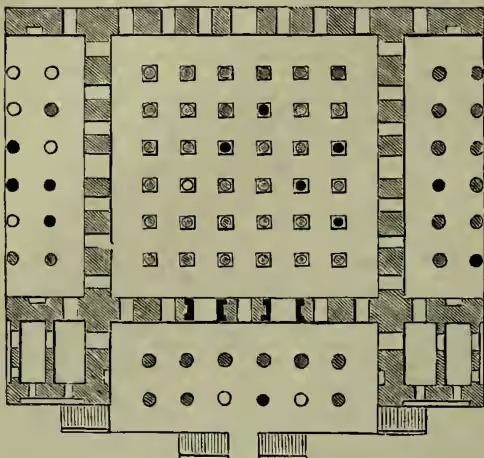
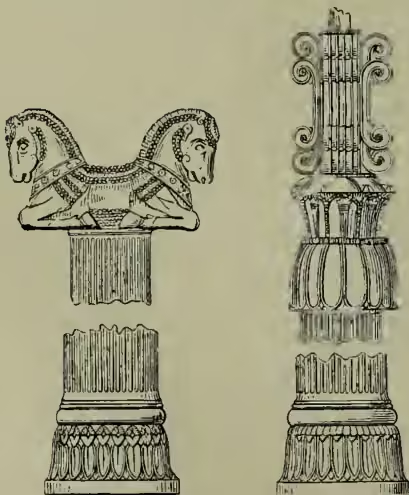
Details of Persian Architecture.
The halls at Persepolis were square in plan, having an equal number of pillars in each direction for the support of the roof, which was flat. In the centre a portion was left open for the admission of light, and sheltered by another roof raised upon pillars. The remains of the seventy-two columns with which it was adorned are still extant (fig. 1). The hall had thirty-six columns, six on each side, and on three sides had an external portico, each with two rows of six columns. These columns had capitals, composed of bulls' heads and shoulders (fig. 2), between which the beams of the roof rested; while others were ornamented with scrolls like the Ionic order (fig. 3). The bases also are suggestive of the origin of that Greek style. This hall was 350 feet by 300, and covered more ground than any similar buildings of antiquity, or any mediaeval cathedral except that of Milan. The palaces of Persepolis stand on lofty platforms, built with walls of cyclopean masonry, and approached by magnificent flights of stairs, adorned, like the palaces, with sculptures somewhat similar to those of Assyria. The interiors were ornamented with paintings. The use of the arch was known in Assyria, as has been shown by the subterranean arched conduits discovered by Layard, and the gates of Khorsabad discovered by M. Place. The arches of the latter spring from the backs of sculptured bulls, and are beautifully ornamented with enamelled bricks.
In 1886 some extremely interesting discoveries were made at Susa (Shushan) in south-western Persia by M. and Madame Dieulafoy, who unearthed and sent to the Louvre a splendid frieze in coloured enamelled bricks with life-sized figures of warriors from the palace of Darius I., and another similar frieze with lions from the palace of Artaxerxes. A fac-simile reproduction of the warrior frieze is in the Edinburgh Museum of Science and Art.
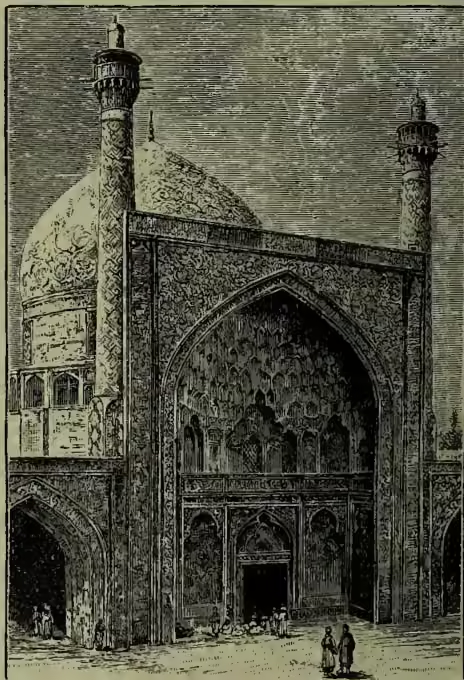
Modern Persian architecture is separated by a wide historic gap from that of ancient Persia, and, all posterior to the Moslem conquest, belongs to the type known as Saracenic or Arabian. But it seems that the old art of Persia has a more direct influence on that of modern Persia than has been sometimes admitted; and even the Egyptian type of Saracenic art (see ARABIAN ARCHITECTURE) may have been moulded by Persian as well as by Byzantine artists, working for the Moslem conquerors. In Persia itself there seems no doubt that architecture of Mohammedan Persia, which in its palmiest days rivalled in splendour that of Egypt, Bagdad vying with Cairo, is in many respects a reproduction of the ancient palaces of Nineveh and Babylon. In the mosques thick walls of imperfectly burnt bricks are covered with brilliantly coloured decorations of glazed and painted tiles and bricks. Fig. 4 is a view of the gateway of the Masjid Shah, or Great Mosque of Ispahan, dating from the reign of Shah Abbas the Great (1585-1628 A.D.).
PERSIAN LANGUAGE AND LITERATURE.—The ancient and modern idioms of Persia, which are in general designated as Iranian or West Aryan, belong to the great class of the Indo-European languages; but the term Persian itself applies more particularly to the language as it is now spoken, with a few exceptions, throughout Persia, and in a few other places formerly under Persian dominion, like Bokhara, &c. The more important and better known of the ancient idioms are (1) the Zend (the East Iranian or Bactrian language, in two dialects—the 'Gátha idiom' and the 'ancient' or 'classical Zend'), which died out in the 3d century B.C.—one of the most highly developed idioms, rich in inflections, in the verbs as well as in the nouns, and in the former almost completely agreeing with Vedic Sanskrit; yet such as we find it in the small remains which have survived it is no longer in the full vigour of life, but almost decaying, and grammatically somewhat neglected. Geographically, this idiom may be placed in northern Persia. Its alphabet is of Semitic origin, and the writing goes from right to left (see ZEND, ZEND-AVESTA). (2) Ancient Persian, the chief remnants of which are found in the cuneiform inscriptions of the time of the Achæmenides, discovered in the ruins of Persepolis, on the rock of Behistun, and some other places of Persia (see CUNEIFORM). Some relics, chiefly consisting of proper names for gods and men, and terms for vessels and garments, have survived in the writings of the classical period, and in the Bible, chiefly in Daniel. This idiom is much nearer to Zend and Sanskrit than to modern Persian. (3) Pehlevi (West Iranian, Median, and Persian), in use during the period of the Sassanides (3d to 7th century A.D.), an idiom largely mixed with Semitic words, and poorer in inflections and terminations than Zend. Its remnants consist of a certain number of books relating to the Zoroastrian religion, of coins and inscriptions; and the language is not quite the same in all cases—according to the larger or smaller infusion of foreign words. The non-Iranian element is known as Huzvaresh, and is simply Chaldee; while the Iranian element is but little different from modern Persian. There are three distinct idioms to be distinguished in Pehlevi, and the writing varies accordingly, yet it is not certain whether the difference arises from their belonging to different districts or periods. When, however, Pehlevi ceased to be a living language, and the restoration of the pure Iranian had begun, people, not daring to change the writings (chiefly of a sacred nature, as having descended to them from the Sassanian times), began to substitute in reading the Persian equivalents for the Huzvaresh words. At last a new form of commentaries to the sacred writings sprang up, in which more distinct and clear Zend characters were used, where each sign had but one phonetic value, and where all the foreign Huzvaresh words were replaced by pure Persian ones; and this new form was called (4) Pâzend. The transition from the ancient to the modern Persian is formed by the Parsee, or, as the Arabs and the modern Persians themselves call it, Farsi, in use from 700 to 1100 A.D., once the language purely of the south-western provinces, and distinguished chiefly by a peculiarity of style, rigid exclusion of Semitic words, and certain now obsolete forms and words retained in liturgical formulas. It is the Persian once written by the Parsees or fire-worshippers, and is in other respects very similar to the present or modern Persian (which also is invariably called Farsi by the modern Persians), the language of Jami, Nizami, and Hâfiz—from 1100 to the present time—with its numerous dialects. The purest dialect is said to be that spoken in Shiraz and Ispahan and their neighbourhood. In general, the language is pronounced by universal consent to be the richest and most elegant of those spoken in modern Asia. It is the most sonorous and muscular, while at the same time it is the most elegant and most flexible of idioms; and it is not to be wondered at that in Moslem and Hindu realms it should have become the language of the court and of the educated world in general, as French used to be in Europe. Its chief characteristic, however, is the enormous intermixture of Arabic words, which, indeed, make up almost half its vocabulary. Respecting its analytical and grammatical structure, it exhibits traces only of that of the ancient dialects of Zend and Achæmenian, of which it is a direct descendant. The elaborate system of forms and inflections characteristic of those dialects has been utterly abandoned for combinations of auxiliary words, which impart fullness and an incredible ease to speech and composition. The grammar of the Persian language has been called 'regular;' but the fact is that there is hardly any grammar worth mentioning. Thus, there is no gender distinguished in declension; the plural is always formed in the same manner, the only distinction consisting in animate beings receiving the affix ân, while the inanimate are terminated in há. Imported Arabic nouns, however, invariably take their Arabic plural. Not even the pronouns have a gender of their own; the distinction between masculine and feminine must be expressed by a special word, denoting male or female. There is no article, either definite or indefinite. The flexion of the verb is equally simple. As to syntax, there is none, or, at all events, none which would not come almost instinctively to any student acquainted with the general laws of speech and composition. The time of its greatest brilliancy may be designated as that in which Firdausi wrote, when Arabic words had not swamped it to the vast degree in which they have since done, and were still, as far as they had crept in, amenable to whatever rules the Persian grammar imposed upon the words of its own language.
In the history of the Persian writing three epochs are to be distinguished. First, we have the Cuneiform (q.v.), by the side of which there seems, however, to have been in use a kind of Semitic alphabet for common purposes. This, in the second period, appears to have split into several alphabets, all related to each other, and pointing to a common Syriac origin (such as the different kinds of Pehlevi characters and the Zend alphabet) cleverly adapted to the use of a non-Semitic language. In the third period we find the Arabic alphabet enlarged for Persian use by an addition of diacritical points and signs for such sounds as are not to be found in Arabic (p, ch, zh, g). The writing is but slightly different from the usual Arabic Neskhi.
Of the literature of the Persians before the Mohammedan conquest we shall not speak here, but refer to the article ZEND. The literary period now under consideration is distinguishable by the above-mentioned infusion of Arabic words into the Persian language, imported together with the Koran and its teachings. The writers are one and all Mohammedans. With the fanaticism peculiar to conquering religions, all the representatives of old Persian literature and science, men and matter, were ruthlessly persecuted by Omar's general, Saad Ibn Abi Wakkas. The consequence was that for the first two or three centuries after the conquest all was silence. The scholars and priests who would not bow to Allah and his Prophet took with them what had not been destroyed of the written monuments of their ancient culture, while those that remained at home were forced to abandon their wonted studies. Yet, by slow degrees, as is invariably the case under such circumstances, the conquered race transformed the culture of the conquerors to such a degree that native influence soon became paramount in Persia, even in the matter of theology. It is readily granted by later Mohammedan writers that it was out of the body of the Persians exclusively that sprang the foremost, if not all, the greatest scholars and authors on religions as well as grammatical subjects, historians and poets, philosophers and men of science; and the only concession they made consisted in their use of the newly-imported Arabic tongue. A further step was taken when the Persians, under upstart native dynasties, returned also to the ancient language of their fathers during the first centuries of Mohammedanism. The revived national feeling, which must have been stirring for a long time previously among the masses, then suddenly burst forth in prose and in verse, from the lips of a thousand singers and writers. The literary life of Persia, the commencement of which is thus to be placed in the 9th century A.D., continued to flourish with unabated healthy vigour for five centuries, and produced a host of writers in every branch of science and belles-lettres, of whom we can only here give the most rapid of surveys, referring for the most important names to special articles.
About 952 Abul Hasan Rudegi, the Blind, rose by the king's favour to such an eminence that he had two hundred slaves to wait upon him; but little has remained of his 1,300,000 distichs, and of his metrical translation of Bidpai's Fables. About 1000 we hear of Kabns, the Dilemite prince, as the author of The Perfection of Rhetoric, and poems. In the time of the Ghaznevids, chiefly under Mahmud, who surrounded himself with no less than four hundred court-poets, we find those stars of Persian song, Ansari (1039), author of Wamik and Asra; Ferruchi, who, besides his own poems, wrote the first work on the laws of the Persian metrical art; Esedi, from Tus; and, above all, Firdausi (q.v.), the author of the Shah-Nameh. Under the Atabek dynasty was the panegyrist Auhad-ed-Din Anwari, who, with his praise, well knew how to handle satire. Nizami (about 1200) is founder of the romantic epos. Conspicuous in Persia is the mystic (Sufistic) poetry, which, under Anacreontic allegories, in glowing songs of wine and love, represented the mystery of divine love and of the union of the soul with God (see SUFISM). In this province we find the famous Omar Khayyam (q.v.; died 1123), and Farid-ed-Din Attar (born 1216), the renowned author of Pend-Nameh ('Book of Counsel'), a work containing the biographies of saints up to his own time; such is the depth and hidden meaning of his mystic poems that for centuries after him the whole Moslem world has busied itself with commentaries on the meaning of his sacred poetry. He died about 1330, more than a hundred years old, as a martyr. Greater still in this field is Jelal-ed-Din Rumi (died 1273), whose poem on Contemplative Life has made him the oracle of oriental mysticism up to this day; he wrote also a great number of lyrical poems. The 13th century cannot better be closed than with Sádi (q.v.), the first and unrivalled Persian didactic poet. But far above all shines Háfiz (q.v.), who sang of wine and love, and nightingales and flowers. After him the full glory of Persian poetry begins to wane. Among those that came after him Jami (1419-92) stands highest, a poet of most varied genius, second only in every one of the manifold branches to its chief master—in lyric and in didactic to Sádi, in romance to Nizami, in mysticism to Jelal-ed-Din; but most brilliant as a romantic poet. Of prose works we have by him a history of the Sufis, and an exceedingly valuable collection of epistolary models. The dramatic poetry of the Persians is not without merit, but is of small extent.
The numerous tales, stories, novels, anecdotes, anthologies, and all the miscellaneous entertaining literature in which Persia abounds form a fit transition from poetry to prose. Able rivals of the great Arabic historiographers sprang up at an early period. For the mythical times Firdausi's gigantic epos remains the only source. Reshid-ed-Din, the vizier of Ghazan (born 1247; executed in 1320), wrote a summary of the history of all Moham- medan countries and times, containing besides a complete history of sects. His contemporary Wassaf is the model of the grand rhetorical style. His most successful imitator in the 15th century is Sherif-ed-Din, who wrote the history of Tamerlane. Up to that period pomposity of diction was considered the principal beauty, if not the chief merit, of a classical Persian history. From the 15th century downwards a healthy reaction set in, and simplicity and a striving after the real representation of facts became the predominant fashion. Foremost among the modern historians is Mirkhond, whose Universal History comprises the period from creation to the reign of Sultan Hasan Beikara. His son Khondemir also wrote history. Among Indian historians who wrote in Persian we have Mohammed Kasim Ferishtah (1640), who wrote the ancient history of India up to the European conquest, Mohammed Hashim, Abul Fadel Mobarreke, and others. The Measiri Sultaniye, which contains the history of the present dynasty of Persia, and was published at Teheran in 1825, was translated by Bridges (Lond. 1833).
Biographies, legends, histories of martyrs, and the like are legion. Most of the biographies of the Prophet, however, are taken from the Arabic. Works on geography—generally treated together with history—are those of Mestafi, Ahmin Ahmed Rasi, Berdshendi, &c. In theology little beyond translations of the Koran, commentaries, and some portions of the Traditions has been produced. Jurisprudence has likewise to show little that is original, and not mere translation, partial commentary, or adaptation in Persian. The Hedad-shah, the Inadshah, the Futawa Alemgiri are the most important legal works. Much has been written on medicine, surgery, pharmacy, and physical sciences by Persians, but nearly all their chief works are in Arabic. Mathematics, astronomy, and philosophy have not been neglected; rhetoric, works on letter-writing, and on metrical and poetical arts are numerous. Grammar and lexicography found their principal cultivators in India. Translations from Greek, Indian, Arabic, Turkish, and other languages into Persian exist in abundance.
There is no good history of Persian literature; but there is much information in the great catalogues of Stewart (1809), Ouseley (1831), Morley (1854), Sprenger (Calcutta, 1854), Rieu (Lond. 1879), and others. See the articles in this work on FIRDAUSI, HÁFIZ, OMAR KHAYYAM, SUFISM, &c. Dictionaries, besides the native ones, are those of Johnson and Richardson, Vullers (1867), Palmer (1876-84), Steingass (1884-92), Wollaston (1889).