Pig, or HOG (Sus), a genus of artiodactyle ungulate mammals, of the family Suina (see BOAR, where the characteristics of the wild species are discussed, with an illustration). The term Swine is commonly applied to the genus in Britain. The body is covered more or less with bristles and hairs; the skin is very thick; the limbs short and stout; the neck, which is carried straight forward from the trunk, is very thick and strong; the face moderately prolonged and truncated, always terminating in a movable cartilaginous disc, furnished, as in the mole, with a special small bone, and employed with wonderful expedition in turning up the soil in search of roots and other food. In most of the improved varieties the face is much shorter than in the wild boar or ancient pig. There are six incisors, two canine teeth, and fourteen molars in each jaw, the lower incisors projecting forwards; the canine teeth long and strong, projecting and curved, becoming formidable tusks in wild boars, and large and powerful even in the females in a wild state. The feet have each four toes, the lateral ones small, and scarcely touching the ground, all separately hooved. The tail is short. The stomach shows mere traces of division. The food is chiefly vegetable, but perhaps no animals may more properly be called omnivorous; and although, even in a wild state, pigs are not to be reckoned among beasts of prey, they not unfrequently, even in domestication, kill and eat small animals that come in their way, as many a housewife has had occasion to observe in respect to chickens. The Common Pig (S. scrofa) appears to be a native in the wild form (see BOAR) of most parts of Europe and Asia; the domestic European breeds are apparently descended from the European wild boar, crossed with domesticated Asiatic breeds. Like the other thick-skinned animals with which it is allied—the elephant, rhinoceros, hippopotamus, and tapir—the pig delights in humid and shadowy places. The pig usually grows until five years old. Its natural life ranges from fifteen to thirty years. Although the use of its flesh was prohibited to the Jews, and the prohibition has been adopted in the Mohammedan law, the pig has been a domesticated animal from a very early period, and its flesh constitutes a large part of the food of many nations. The fecundity of the pig is great; with proper treatment it will produce two litters annually, generally of four to eight pigs each, although sometimes there are as many as fourteen in a litter. Vast quantities of the flesh are consumed in various forms, as pork fresh or salted, bacon, ham, &c. Brawn (q.v.) is an esteemed luxury. The fat of the pig, which is produced in a thick layer under the skin, is an important article of commerce, and of various use under the name of Lard (q.v.). The skin of the pig is made into leather, which is particularly esteemed for saddles. The bristles, especially of the wild boar, are much used for brushmaking. Indeed, there is no food-producing animal which is of greater benefit to mankind than the pig.
There are numerous varieties of the domestic pig. Some have erect and some pendant ears, and those are most esteemed which exhibit the ing of the breeds commonly reared in Britain, giving rise to the improved white and black breeds respectively. The Chinese breed is renowned for its fertility, as well as for the rapidity with which, without materially increasing in offal or bone, it lays on flesh. Its head is short and thick, ears erect, legs very short, chine high and broad, and jowl wide, belly hanging very near to the ground. As a rule it carries a small quantity of hair. The skin is usually dark, but the flesh is delicate and white. These valuable characteristics distinguish the improved Yorkshire pigs which are now so much esteemed all over the British Isles as well as in several foreign countries. The Neapolitan breed is entirely black, with little hair, moderately short in the face, ears small and erect, short in the leg, moderately long and thick in the body, remarkably easy to fatten, but scarcely so robust in constitution or so prolific as the Chinese pig.
Besides many local varieties of recognised merit, there are at least six improved breeds of swine reared extensively in the British Isles. The White Yorkshire are divided into the three sub-varieties known as the Large, Middle, and Small White Breeds. Then there are the black Berkshire, the Suffolk breed (some black and others white), and the red Tamworth. The black Suffolk pigs are sometimes spoken of as the Small Black breed. The Tamworth is a large-sized pig, rather stronger in the bone than the other sorts, with a long face. It is noted for a high proportion of lean meat. The Large White is the most widely distributed variety. It is being used extensively and with excellent results in the improvement of the pigs in Ireland, Scotland, and on the continent of Europe. The pigs of America are descended mainly from the Berkshire, Poland-China (a breed developed in 1816-38), white Suffolk, Chester, Cheshire, Essex, Jersey red, and Victoria (a breed originating at Saratoga about 1855). The first swine seem to have been introduced into Hayti by Columbus in 1493, and into Florida by De Soto in 1538; within a century pigs bred in Virginia, Canada, and Nova Scotia. The extent of the pork-packing business in America may be estimated from the figures given at CHICAGO. See also PORK. It used to be said that pigs were indigenous in the Polynesian area, but most likely they were introduced by the earliest navigators. Allowed to run wild, they multiply rapidly under favourable conditions; thus in New Zealand they became at one time a nuisance, and in Nelson province three men killed 25,000 pigs in twenty months.
Pigs are profitably kept wherever there is much vegetable refuse on which to feed them, as by cottagers having gardens, farmers, millers, brewers, &c. They are often allowed to roam over fallow ground, which they grub up for roots, and over stubble-fields, which they glean very thoroughly. It was an ancient practice to allow pigs to feed in woods, where they consumed acorns, beechmast, and the like. When they are fed, as is sometimes the case, chiefly on animal garbage, their flesh is less palatable and less wholesome. The pig has a reputation, which it does not deserve, of peculiar filthiness of habits. It is true that it wallows in the mire, as the other pachydermata also do, to cool itself and to provide itself with a protection against insects, and it searches for food in any puddle; but its sleeping-place is, if possible, kept scrupulously clean. The too common filthiness of pigsties is rather the fault of their owners than of their occupants; and a clean and dry sleeping-place is of great importance to the profitable keeping of pigs.
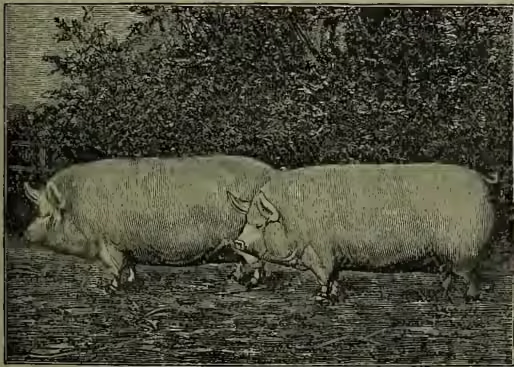
The Hog Cholera or Swine Plague, due to the presence of a bacterium, caused terrible havoc in the United States in 1870-80, though hardly greatest departure from the wild type, notably in shorter and less powerful limbs, less muscular and more rounded forms, wider ribs and greater wealth of flesh. The Chinese breed and the Neapolitan have been of great use in the crossing and improv- known twenty years before. As in the splenic fever of sheep, due also to bacteria, attempts have been made to ward off the more violent form of the disease by inoculating animals with a milder type.
The pig is not inferior to other quadrupeds generally in intelligence, but it excels most of them in obstinacy. It can be easily rendered very tame and familiar. Its acuteness of scent has been turned to account in making it search for truffles; and a tale is told of a pig having been successfully used as a pointer. The pig has sometimes served as a beast of draught.
The Bosch Vark, or Bush Hog of South Africa (Choiroptotamus africanus), is about 2 feet 6 inches high, covered with long bristles; it has projecting tusks, a large callous protuberance on each cheek, and long, sharp, tufted ears. It is gregarious, subsists chiefly on vegetable food, and makes destructive inroads on cultivated fields. The forests of the island of New Guinea produce a species or variety of pig (S. papuensis) more widely different from the common pig than its breeds are from one another. It is 18 or 20 inches high, with short ears, and very short tail. The Baboroussa (q.v.) is another species of pig; see also WART-HOG.
See Coburn, Swine Husbandry (New York, 1877); Gilbert, Pig-keeping for Amateurs (1882); Long, Book of the Pig (2d ed. 1889).