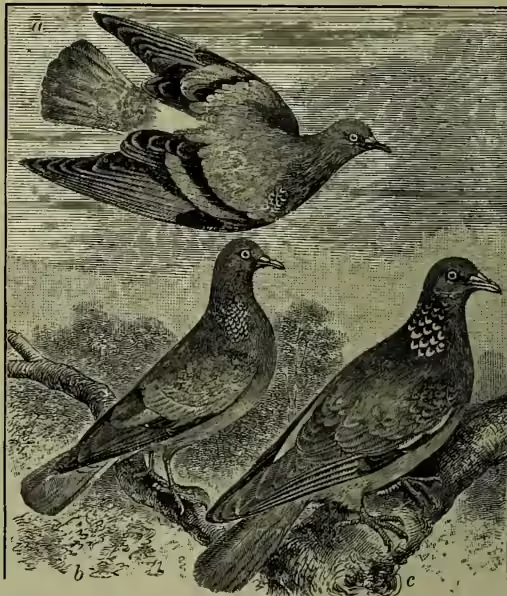
Pigeon (Ital. pigione, piccione, or pipione, from pipiare, Lat. pipire, 'to peep or cheep'), a name sometimes applied, like Dove (q.v.), to all the species of Columbidae, and sometimes almost restricted to those still included by ornithologists in the genus Columba; having a bill of moderate length, hard, and a little arched at the point, the base of the upper mandible covered with a soft thick skin, in which the nostrils are pierced; the feet with toes divided to the base, and fornéd both for walking and perching; the wings rather large and pointed; the tail of moderate length, and generally square at the end. The species of this group are very numerous, there being nearly 150 different kinds, and they are found in all parts of the world. Some of them build their nests in trees, and others in rocks. They invariably lay only two eggs at a time, but breed several times in the year, both the male and the female taking part in the process of incubation, as also in that of feeding the young birds. The origin of all the domesticated varieties of the pigeon is the Blue Rock-pigeon (C. livia), the Biset of the French, a bird of extensive geographical range, being found as far north as the Faroe Islands, and in nearly all parts of the eastern hemisphere. It is found in large numbers on the British coast, particularly on the Orkney Islands and the Hebrides, and also in the Mediterranean. Its food consists partly of molluscs and other small animals, and partly of grain and seeds; and it often pays unwelcome visits to the cornfields within its radius. In a wild state the blue rock-pigeon exhibits great uniformity both of size and plumage; it is not quite 12 inches in length from the tip of the bill to the end of the tail; the prevailing colour is bluish gray, in some parts with green and purple reflections, and having two broad and distinct black bars across the closed wings; the lower part of the back is whitish; the tail is a deep gray with a black bar at the end; the bill is dark brown; the legs and feet reddish orange. There are also the Stock-dove or Smaller Wood-pigeon (C. ænas), found all over southern and mid Europe, a species found in woods; and the Ring-dove, Wood-pigeon, or Cushat (C. palumbus), very common in all parts of Europe and Asia and in northern Africa, and the largest of the British species. These are all the British species of pigeon. In addition we may mention the Ring- tail Pigeon (C. caribbea), a West Indian species; the Bald-pate or White-headed Pigeon (C. leucocephala), also found in the West Indies and Florida; the Double-crested Pigeon (C. dilophia), found in the northern parts of Australia, and having, as its name indicates, a double crest, one half on the back part of the head, and the other springing from the forehead. There are other varieties, too numerous for mention.
As already stated, only the blue rock-pigeon has been domesticated, but this species lends itself very readily to the restrictions of civilised life. The changes brought about in it are very varied and remarkable; and the description of his experiments upon the pigeon by Darwin are of the deepest interest. For many centuries and in all lands pigeon-breeding has been a favourite pursuit with all classes of society. In India several of the native rulers have very extensive establishments for the breeding of pigeons. In Persia and in Asia Minor the pigeon is very largely and carefully bred; and in the latter country especially many of our most beautiful varieties have been produced. From North Africa we have also received at least one fine breed. Throughout Europe this pursuit is followed with a great amount of enthusiasm, more especially in Italy, Germany, France, and Belgium, as well as the United Kingdom. In Belgium the sport of pigeon-flying or racing is the national sport engaged in by all sections of the community; and to that country we owe the variety known as the Homing Pigeon (see CARRIER PIGEON). In the United Kingdom, as in America, there are enormous numbers of breeders who devote themselves to what are known as 'fancy pigeons,' by which term are known those bred for their special points or characteristics. Of these there is a great and ever-increasing variety, which it is impossible to describe in detail, as there are in all some two hundred breeds, many of which have several distinct colours. The following are some of the most prominent: Carrier (q.v.).—This is not, as is commonly supposed, a member of the homing family, though undoubtedly it was at one time used to carry messages. It is much longer in feather than the blue rock, and is specially characterised by having an abnormal development of the beak and eye wattles, the former of which is like a round fleshy ball pierced by the beak. Dragon.—Of a similar type, rather lighter in body, and with less heavy wattles. Barb.—A heavy-wattled pigeon; but in this case the eye-wattle is the chief point, and it is bred so that the head has the appearance of a bobbin or reel. These three varieties make up the Wattled Pigeons; and they are all very valuable when bred to perfection. Pouters.—The Pouting Pigeon is equally high class, the name arising from the great development of the crop, which has a globular form, and stands out from the neck. Of these the best known is the English Pouter; and there is also the Norwich Cropper; the former a large bird, and the latter a smaller one. The smallest of this family is the diminutive Pigmy Pigeon. In these the head, which is at the back of the crop, is often almost buried by it. Jacobin.—A breed in which the head and neck feathers are largely developed, the former in the shape of a hood, so that the head is often buried within it, and the latter falling on to the shoulders, leaving a round space between, known as the rose. Fantail.—In this the characteristic which gives the variety its name is that the tail-feathers spread themselves out transversely to the body in the shape of a fan, and in good specimens evenly so. The head is thrown back, often touching the tail, with a nervous motion, the body poised on short legs, and the bird looking as if it were falling backwards. Tumblers.—In these the name is derived from the tumbling or turning motion when flying in the air, and good well-trained birds have been known to remain on the wing for many hours without cessation. They are divided into two sections—viz. Flying Tumblers—i.e. those which are bred for this quality, and Fancy Tumblers, in which the propensity is lost or suspended through disuse. A very valuable breed is the Short and Long Faced Tumbler, of which there are several varieties, notably the Almond, so called from its rich coloured plumage. The Nun and the Magpie are supposed to be descended from the same family. Allied to the flying tumblers are the Rollers and the Tipplers. Frilled Pigeons.—These include a very large variety, the greater portion of which originated in the Orient. They are thus called because the throat or chest is decorated with a frill of curled feathers, more or less perfect. Some have in addition a crest on the head, and there is an almost endless variety of colour and of markings, the richest—those known as Oriental Frills—being of much later introduction than the Owls and Turbits. One, the White African Owl, is the smallest of all domestic pigeons, and comes from Tunis. Antwerps.—A very massive-built bird in which there is a considerable admixture of homer blood. Of the other prominent varieties the homer has already been referred to; the Russian Trumpeter has a large crest and very profuse leg-feathering; the Runt is the largest of all pigeons, and on the continent of Europe is extensively bred for the table. The system of exhibitions which has grown up of late years has done much to stimulate the breeding of fancy pigeons, and very high prices are paid for the best specimens. On numerous occasions £100 has been given for a single pigeon, and £50 is quite a common price.
For the keeping of pigeons different forms of houses may be adopted. When they are permitted to fly about they may have either small cotes for, say, four pairs, mounted on tall poles—and these can be made very attractive—or they may be accommodated in larger houses. Fancy pigeons are usually restrained by what are called flights or aviaries, which consist of a large space attached to the house, the sides and top made of wire-netting, so that the birds cannot get away. It would be too great a risk to permit valuable birds to fly. Whether in confinement or at liberty each pair of pigeons must be supplied with a nest of their own, which is better if double, as often they are sitting on eggs and feeding young pigeons at the same time. In the nest-boxes pans are placed of the usual construction for this purpose. Pigeons are prolific breeders, and will lay several nests during the year, each time a couple of eggs. The male and female, if permitted to do so, continue faithful to each other from year to year, a circumstance noted by Pliny and others of the ancients.
See DOVECOT, and books on pigeons and pigeon-keeping by Tegetmeier (1868), Piper (1871), Foulton (1876), Brent (1878), Wright (1879), Lucas (1886), Ure (2d ed. 1889), Lyell (1889), and the present writer (1891).