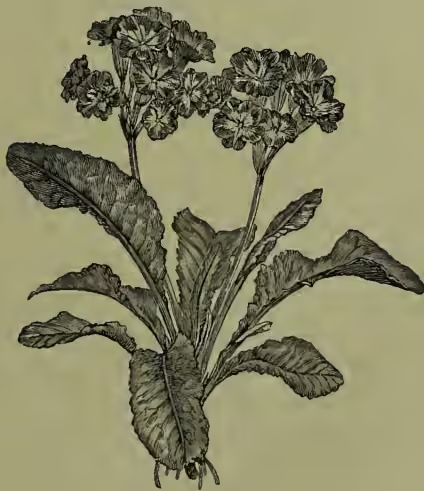
Polyanthus (Gr., 'many-flowered'), a kind of Primrose (q.v.), much prized and cultivated by florists. It is generally believed to be a variety of the Common Primrose (Primula vulgaris), produced by cultivation, in which an umbel of numerous flowers is supported on a common seape (leafless flower-stem), instead of each flower rising on its own stalk from the crown of the root; a modification to which a tendency often appears in the wild plant itself. Thus in its habit it somewhat resembles the cowslip and oxlip, whilst in the size of its flowers it is more like the common primrose; but instead of the pale uniformity of the wild plant it exhibits great variety of delicate and beautiful colours. The subvarieties are innumerable, new ones being continually produced from seed, and of short duration. The seed is sown about mid-summer, and flowers may be expected in abundance next year, if the young plants are properly planted out. A rich free soil is most suitable. The polyanthus loves shade and moisture more than its congeners, the auricula. It is very hardy, and seldom suffers from the most severe winters. Fine kinds are preserved for a time by dividing the root. The cultivation of the polyanthus is prosecuted with particular assiduity and success in England. For the Polyanthus Narcissus, see NARCISSUS.