Projectile is the name given to any mass thrown so as to describe a path in air near the earth's surface. The path described is called the trajectory. The importance of the subject springs from its close connection with Gunnery (q.v.). Any mass projected into the air is under the action of two forces: first, its weight, acting downwards and practically constant; second, the resistance of the air to motion through it, which resistance is a function of the speed, and depends also on the form, size, and mass of the projectile.
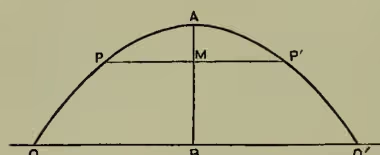
If we consider the action of gravity alone, the problem is a very simple one. Since the force of gravity is always vertical, there can be no change in the value of the horizontal component of the velocity. The projectile, projected from any point O (see fig. 1) at any inclination, will some time or other reach the highest point A. At this point the vertical velocity will be zero; and, if the horizontal velocity were here suddenly reversed, the projectile would travel back along the same trajectory to O. As it is, the projectile proceeds along the path AO', which must be exactly similar to AO. In short, the trajectory is symmetrical about the vertical line drawn through the highest point A. Reckoning from A, let us suppose the projectile to reach P' after seconds. Then, if the horizontal velocity is , the distance of P' from the vertical line AB—PM namely—is measured by the product . But the projectile in falling through the height AM has acquired a vertical velocity , where is the acceleration due to gravity. Thus the space fallen through, being measured by the product of the average speed and the time, is
The trajectory is therefore a Parabola (q.v.) with its axis vertical.
If we suppose the projectile to be projected with a velocity whose vertical and horizontal components are respectively and , then the angle of projection has its trigonometrical tangent equal to . The time taken to reach the highest point is ; and the total range on the horizontal plane is
If we interchange and so that the tangent of the angle of projection becomes , instead of , we get still the same range. Generally, then, a given point, O', can be reached by two trajectories with the same initial speed of projection. It is easy to show that the two corresponding directions of projection are equally inclined to the line that makes with the horizontal; and the range is greater according as the components and of the given initial velocity are less unequal in magnitude. The greatest range is attained when , being the total velocity of projection—i.e. when the angle of projection is . In this case the range is . Thus, to throw a ball to a distance of 100 yards or 300 feet it is necessary to project it with a velocity of at least 100 feet per second (nearly). Practically, however, because of the atmospheric resistance, it would need a distinctly greater speed of projection than that just given to attain the desired range.
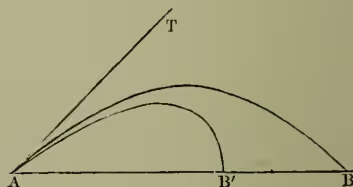
A very simple observation suffices to show that the parabolic trajectory is only approximately realised in air. A well-driven cricket or golf ball will be seen to a spectator suitably placed to describe a trajectory which is distinctly asymmetrical about a vertical line through the highest point. The path will be found to be less curved during the ascent than during the descent; while the highest point is considerably nearer the end than the beginning of the trajectory. In fig. 2 the general character of a real trajectory, AB', is compared with the parabolic trajectory, AB, which would have been described if the air had offered no resistance. AT shows the direction of the initial projection. The same features causing deviation from the parabolic form are still more characteristic of the long flat trajectories of cannon-balls. These, projected with very high speeds, have their approximately horizontal velocities rapidly cut down in the earlier stages by the resistance of the air.
The first approximately accurate ideas of the resistance presented by the air to bodies moving through it at high speeds were obtained by Robins (see BALLISTIC PENDULUM). In our own times Bashforth, by means of his electric chronograph, has elaborately investigated the subject (see his Motion of Projectiles and The Bashforth Chronograph, 1890, the authoritative treatises on this branch of gunnery). Bashforth's results indicate that up to velocities of from 800 to 900 feet per second Newton's theoretic law that the resistance varies as the square of the speed holds practically true. The same law (but with a different coefficient) holds for all measured velocities above 1300 feet per second; but between the limits named the resistance depends on higher powers of the speed. Between the velocities of 1000 and 1100 feet per second—the velocity of sound in air, in fact—the resistance grows very rapidly, varying for a certain interval as the sixth power of the velocity. The resistance also depends on the form of the projectile, a spherical shot being nearly twice as much resisted as an ogival-headed shot of the same diameter and weight. For different sized projectiles of the same form the retardation due to the resistance is directly as the square of the diameter and inversely as the weight. It is usual to express the diameter in inches and the weight in pounds; and the following numbers are for an ogival-headed projectile, whose weight in pounds equals the square of its diameter in inches. The first line gives the velocity and the second the corresponding resistance-acceleration (negative):
| Velocity..... | 1500 | 1200 | 1100 | 1000 | 900 | 800 | 400 |
| Acceleration.... | 318 | 188 | 143 | 79 | 54 | 39 | 10 |
For a sphere of same weight and size, the resistance-acceleration for speeds lower than 850 feet per second is given by the formula , where is the velocity. From this it may be shown that such a sphere falling in air can never attain a velocity of 522 feet per second. If projected downwards with a greater velocity it will be retarded, since the resistance due to the atmosphere is greater than the weight of the body. If projected upwards with a speed of 800 feet per second it will reach a height of only 5112 feet instead of nearly 10,000, and will return to earth again with a velocity of 351 feet. These results show why a meteoric stone never reaches the earth's surface with a velocity of more than a few hundred feet per second. It matters not with what relative speed the meteor may meet the earth. Once it gets into the atmosphere its kinetic energy is rapidly dissipated in heat, and much of its substance volatilised at the high temperature that results. Our atmosphere, in fact, acts as a practically perfect shield to meteoric bombardment.
For projectiles discharged from firearms, see the articles on Bullet, Cannon, Cartridge, Firearms, Gun, Rifle, Shell, Shot.