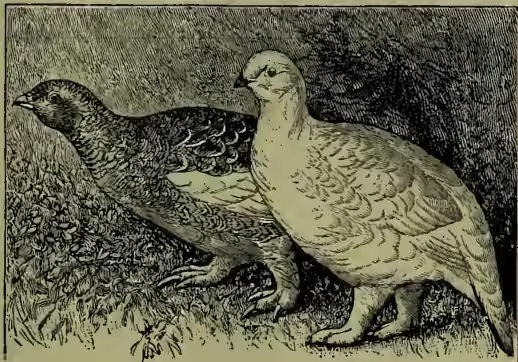
Ptarmigan (Lagopus), a genus nearly allied to the true Grouse (q.v.), differing chiefly in having the toes as well as the legs thickly clothed with short feathers. Hence the name Lagopus, a name used by Pliny, from the resemblance of the foot to that of a hare. The species are natives of the northern parts of the world, of elevated or of arctic regions. With the exception of the 'Red Grouse' (L. scoticus), the species change colour on the approach of winter, assuming a white or nearly white plumage. All are esteemed as food. The Common Ptarmigan (L. mutus) occurs in a few parts of Scotland, but not in England or Ireland. It is resident in the Lofoden Islands, in Scandinavia, on the Ural and the Altai ranges, &c., and occurs on the Alps and the Pyrenees. The winter-plumage is pure white, except a black band above the eyes of the male, and some black on the under feathers of the tail. In both sexes the wings are always white, but have dark shafts to their quills. In summer the males are predominantly grayish brown above, with blackish head, shoulders, and breast, with white belly, with black tail-feathers tipped with white. In the females a tawny colour predominates. In autumn, again, the plumage is different, with numerous streaks of slate-gray on the upper parts. The white winter-plumage is doubtless protective amid the snow, and may be the result of the cold; the summer-plumage is not less harmonious with the surroundings. It seems that some moultng is associated with each of the changes, but precise observations are wanting. A rough nest is scraped in the ground; the eggs (eight to ten) are laid in May, and have a buff colour. Ptarmigans are monogamous, but sometimes gregarious. They feed on tender shoots and berries. Among the related species are the following: L. rupestris (Siberia, Arctic America, &c.), L. scoticus, or Red Grouse, L. leucurus (Rocky Mountains), L. hemileucurus (Spitzbergen), and L. albus, or Willow-grouse (in both hemispheres). Most of the 'ptarmigan' sold in British markets are willow-grouse. See GROUSE, and Howard Saunders, British Birds.