Quagga (Equus—or Asinus—quagga), one of the three species of striped wild horses, or more properly wild asses, peculiar to Africa, of which the zebra is the type. Formerly found in profusion south of the Vaal River, beyond which its range seldom extended, it is believed to be now quite extinct. The illustration represents the last animal of its species owned by the Zoological Society; it
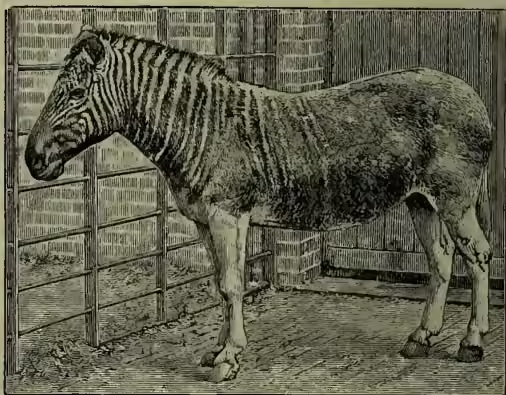
(From a Photograph by Messrs York & Son, London.) was sent from the Cape by Sir George Grey in 1858. The quagga was a handsome animal, more strongly built than the mountain zebra and Burchell's zebra. The upper parts of the body were dark rufous brown, becoming gradually more fulvous, and fading to white at the rump and ventral surface, the dorsal line dark and broad, widening over the crupper. The head, neck, mane, and shoulders were striped with dark brown, gradually waxing fainter till lost behind the shoulder. It was usually found in herds of from ten to a hundred, but often seen in troops of many hundreds on the plains of the Orange Free State and Cape Colony, and often associated with the white-tailed gnu, not seldom with ostriches. The quagga was swift and enduring, but could be run down by a first-rate horse. Its extinction was mainly wrought by the Orange Free State and Transvaal Boers, who slew thousands annually for their skins. In the old days it was tamed with success, was more tractable than the zebra, and even bred in captivity. The term Quagga is a corruption of the old Hottentot name Quacha, bestowed in imitation of the peculiar barking neigh of this quadruped. The quagga is not to be confounded with Burchell's zebra, which is often erroneously called quagga by hunters of the South African interior.