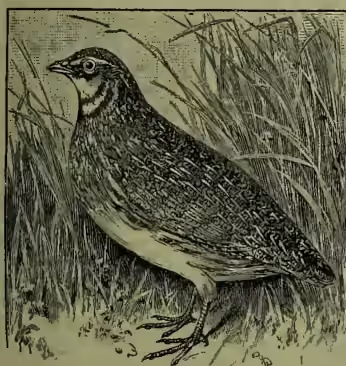
Quail (Coturnix), an Old-World genus of the Partridge family (Perdicidae), ranging over the temperate Palearctic, Ethiopian, and Oriental regions, and in the Australian region to New Zealand. The quails are the smallest of the partridge family. Six species are described in this restricted genus. The best known is the Common Quail (Coturnix communis). In size it is about 7½ inches long; the general colour above is brown, varied with buff, and on the under parts buff. The male is somewhat smaller in size, is brighter, and has a reddish throat and two dark-brown bands descending from the ear-coverts and ending at the throat in a blackish patch acquired at the second year. Quails fly rapidly, and take long and fatiguing journeys. Immense flocks visit the countries bordering the Mediterranean, especially during the spring emigration; and they are caught for food in large numbers—17,000 have been brought to Rome in one day, and in the small island of Capri, in the Bay of Naples, over 160,000 have been netted in a single season. Many remain to breed, but the majority pass northwards. In England quails are spring visitors; they are becoming scarcer, but at times there is a great influx. Northwards the numbers are fewer, but nests have been found in the northernmost mainland of Scotland, and in the Orkneys, Shetlands, and Outer Hebrides, and in summer they reach the Faroe Islands. A few remain on the south-west coast of England and in Ireland during winter, but the majority leave in October; many pass the winter in the south of Europe and in North Africa; and the species is resident in the Canaries, Madeira, and the Azores. It is also found at the Cape, in Madagascar and Mauritius, and in Egypt, while in Palestine, as of old (Exod. xvi. 13), quails come up at night and cover the land. It ranges to India and China, and passes the cold season in those countries. Its flesh is considered a delicacy, and in the countries they commonly visit the arrival of the quails is eagerly expected. Quails feed chiefly on insects and slugs, but also on grain and seeds, and they seek their food in the evening. In habit they are unsociable, unamiable, and pugnacious with their own species. They are partly polygamous, partly monogamous. The female is, however, an excellent and careful mother. She builds her nest of bits of plants, and lays from seven to fourteen eggs, pear-shaped, light brown in colour, with dark shading. The young are full grown in six weeks, and two beves may be reared during the season. The call-note of the male is three-syllabled, and from it the quail is known as 'wet-my-lips,' or 'wet-my-feet,' and the species has also for the same reason been named C. dactylisonans. The other species of this genus are C. delegorguii (named after the discoverer Delegorgue) and C. coronandelica, found in South Africa and India respectively in addition to the common quail; C. pectoralis, found in Australia and Tasmania; C. caineana, found in China; and C. novæzelandice, formerly abundant in New Zealand, but now almost extirpated by the bush fires. The Button-quails, a different group, including twenty species or more ranged under the genus Turnix or Hemipodus, are distributed in Barbary and in the Ethiopian, Indian, and Australian regions. Australia possesses a genus, Synocicus, peculiar to itself, which includes four species. The American Quails, of which there are about fifty or sixty species, are included in the family or sub-family Odontophoridae, and differ in habit from all the Old-World forms in perching upon trees. The Virginian Quail (Ortyx virginianus), known as the Partridge and the Bob-White, from its calling-note, and the Californian Quail (Lophortyx californica) have been introduced into England as game-birds, but they have not yet become resident there.