Rail (Rallus), a genus of birds of the family Rallidae, having a slender bill rather longer than the head, wings of moderate length, long, powerful legs, and very long, completely-divided toes. The only European species is the Common or Water Rail, or Bilcock (R. aquaticus), found in marshy districts throughout England and in many parts of Scotland and Ireland. Many of the birds migrate southwards on the approach of winter. Like most of its relatives, the water-rail is very shy in its habits, and though it does not readily fly, generally escapes detection by threading its way swiftly and quietly through the reeds when its nest is approached. During the breeding season, however, it frequently utters a loud, harsh, groaning cry.
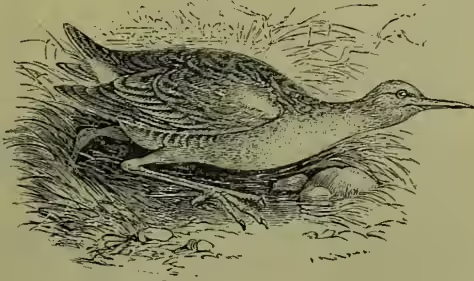
The nest of the rail is made of coarse grass or reeds, usually well hidden among thick aquatic plants. The eggs, numbering seven to eleven, are 'pale creamy-white, sparsely flecked with reddish brown and ash-gray.' Two broods are reared in a season. The food consists of worms, snails, and soft vegetable substances. The adult bird is about a foot in length; the prevailing colours of the plumage are olive-brown on the upper, ash-gray on the under parts. The tints of the female are duller than those of the male, while the young bird has the under parts creamy-white, barred with brown. Nearly allied to the water-rail are the Moor-hen and the Corn-crake (q.v.). Typical of the American rails is the Virginian Rail (R. virginianus).