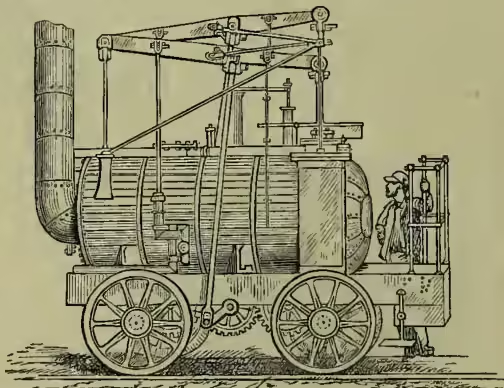
Railways. The addition to tractive power through the diminution of friction to be obtained by the use of rails upon a roadway is so obvious a fact in mechanics that it is not surprising to find records from very early times of the employment of various materials with this object (see TRAMWAYS). Stone or wood was first used, but towards the end of the 18th century the improvements in the production of iron permitted the substitution of that metal on lines laid down in collieries and quarries. The employment of steam-power for locomotion on ordinary roadways was the subject of numerous experiments in various countries during the 18th century, but the credit of producing the first practical working engine is ascribed to Nicolas Joseph Cugnot (1725-1804), a native of Vaud in Lorraine. His carriage, constructed in 1769 at the French National Arsenal at the cost of the Comte de Saxe, ran on three wheels, and had two single-acting cylinders turning the front wheel. In the United States Oliver Evans (1755-1819) in 1804 constructed a steam dredging-machine which propelled itself on wheels to the river, a distance of mile. The improvements of the steam-engine effected by the inventions of James Watt soon led to better forms of locomotives, and comparatively successful models were produced by William Murdock; by William Symington of Dunbarton, the pioneer of steam navigation; and later by Richard Trevithick, whose steam-carriage was exhibited in London in 1803. The development of the high-pressure engine was largely due to Trevithick's numerous experiments and inventions. The first railway locomotive was tried, it is said, on the Merthyr tramroad in 1804, but the experiment was not successful, and to the venerable 'Puffing Billy,' patented in 1813 by William Hedley, and now to be seen in the museum of the Patent Office, must be ascribed the honour of being the progenitor of the enormous stud of iron horses now existing in all quarters of the world. In previous experimental lines rack rails and toothed wheels had been provided under the mistaken notion that the adhesion of a smooth wheel to a smooth rail would not be sufficient. 'Puffing Billy,' after many trials and alterations, commenced regular working at the Wylam Colliery, near Newcastle-upon-Tyne, in 1813, and was kept in constant use until 1872, when it was purchased by the government.
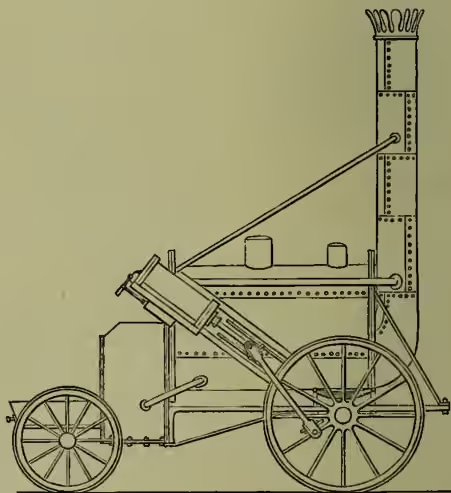
A standing difficulty with the earlier forms of engine was the want of adequate and uniform steam-power, various devices being employed to secure the requisite draught to the furnace. The problem was first solved by George Stephenson. In 1815, after many previous experiments made while acting as colliery engineer, it occurred to him that the waste steam might be utilised as a blast to stimulate combustion, and from this idea, with the subsequent invention of the multitubular boiler (by Booth), securing enormously increased heating surface, the present form of locomotive was evolved. Other improvements made by Stephenson comprised the direct communication between the cylinders and the wheels, and joint adhesion of all the wheels by the use of horizontal connecting-rods. An engine constructed by him was the first to run on the Stockton and Darlington line, opened for public traffic on 27th September 1825. The engine weighed about 8 tons, and could make a speed of nearly 16 miles an hour. The Stockton and Darlington line was constructed for mineral traffic; and it was not until the opening of the Liverpool and Manchester Railway that the vast possibilities of the new form of transport were proved beyond cavil. The directors of that company, with a view to settle the method of traction on the line then approaching completion, offered a £500 prize for the best locomotive engine. Stephenson's 'Rocket,' comprising the improvements above mentioned, was the only one that complied with the conditions laid down, and at the competition which took place at Rainhill in October 1829 its superiority was at once manifest. It drew a coach with thirty passengers along the prescribed course at the rate of 30 miles an hour. The 'Rocket' went into regular service on the opening of the railway in the following year. It weighed, with its supply of water, only tons, and long after it had been superseded by heavier engines, on one occasion ran 4 miles in minutes. All the many changes which have since been effected in the appearance and size of the locomotive have been more matters of detail than of principle. The 75-ton express passenger-engine, which runs at a speed of a mile per minute for miles together, does not differ materially in construction from George Stephenson's pioneer engines.
A modern development, however, of importance for economy of fuel is the adaptation to the locomotive of the 'compounding' principle which has effected such a revolution in steam navigation. By this invention (see STEAM-ENGINE) the steam after doing duty in one cylinder or pair of cylinders is made available through its expansive power in another and larger cylinder. Engines formed on this plan are used extensively on the London and
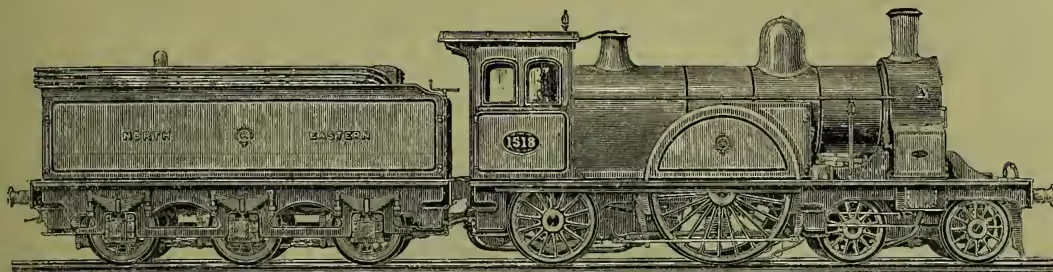
North-Western Railway, the North-Eastern, and the Great Eastern. A saving of from 10 to 15 per cent. in fuel is claimed by advocates of compound locomotives, the objection being a complication of parts.
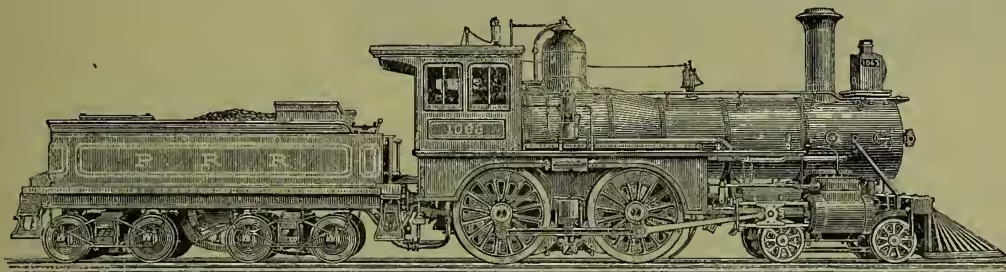
(From The Railways of America.)
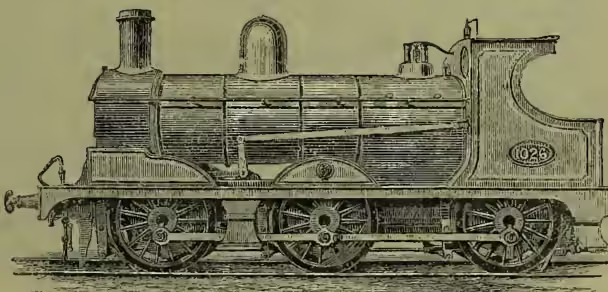
Considerable diversity has hitherto existed in the type of locomotive on various lines; but the policy now adopted by nearly all the leading companies of manufacturing their own rolling-stock, and the obvious advantage of having interchangeable parts, has led of late to the gradual adoption of a more uniform style of construction for the different kinds of service required. As a general rule inside cylinders are in use on the through lines of the United Kingdom, it being contended by many authorities that for high speeds the placing of the weightier parts of the machine close to the centre of gravity minimises oscillation. It is held further that the moving part of the machinery is better protected by being placed within the wheels. On the other hand, the objections to be urged are the increased cost and complication of the driving-axle and the comparative inaccessibility of the valves and pistons for purposes of repair. Outside cylinders have been adopted on the London and South-Western Railway and on other lines; and, supported by the bogie-truck, this form of engine approximates closely to the type in use on American railroads. The bogie-truck consists of a separate frame carried by two or more sets of wheels and attached to the engine or carriage by a central pivot; by this contrivance the wheels adapt themselves more readily to inequalities or to sharp curves. The boiler on English locomotives is invariably carried on a stiff plate frame, while in the comparatively cheaper form in use in the United States the running portion of the machinery is attached directly to the boiler by means of a bar frame, which in Britain is thought to throw undue strain upon the structure. Be that as it may, the types of passenger express engines in England and in the United States are undoubtedly approximating more and more closely (see fig. 4). The large single-driving wheel at one time generally used on express loco- motives is now more rare, except in the case of some of the new compound engines, but for high speeds it possesses some advantages. For goods-engines the six coupled wheel, inside cylinder type, is in most general use, while the forms of tank-engines for local and suburban lines and for shunting purposes vary with the different companies and the different services to be performed. Of acces- sories to working perhaps the most important added in recent years is the Injector (q.v.). A contrivance for picking up water in transit from troughs placed between the rails, the invention of Mr Ramsbottom of the London and North-Western Railway, is in use on some lines where long distances are run without stopping.
In the matter of fuel some very successful experiments have been made on the Great Eastern complement ordinary forms of railway construction the most successful is the electric traction railway. The Central London Railway, opened in 1900 (the popular 'twopenny tube'), is the most important of an extensive series of London electric railways. See ELECTRIC RAILWAYS.
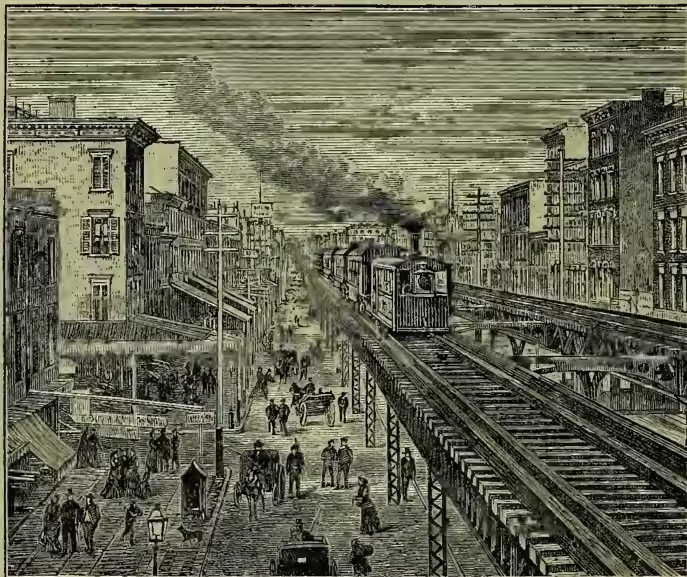
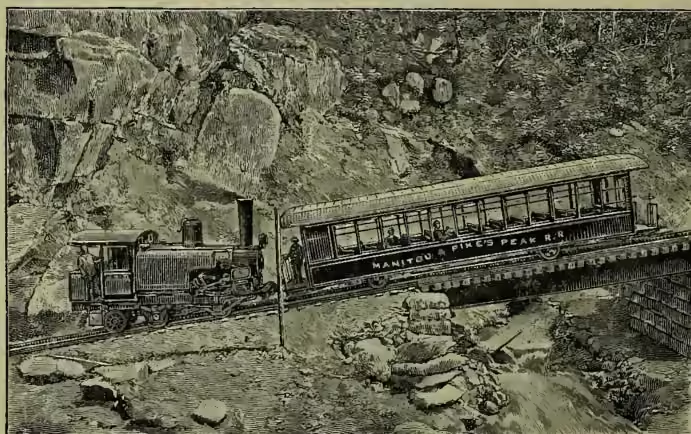
The overhead railways of New York are supported on iron columns, and traverse the principal streets, affording accommodation to an enormous number of passengers. Liverpool has also adopted an overhead railway for communication along the line of docks. The project for the carriage of slips and their cargoes by railway was brought to a practical test by the Chignecto Ship Railway (1889-92), across the narrow neck connecting Nova Scotia with the mainland. Lines have also been surveyed across the Central American isthmus. The rack system of railways, which was the earliest form of iron road, has been since adopted with advantage for the working of lines having steep grades. The Mont Cenis (1865) and Rigi Railway (1871) in Switzerland are among the best-known instances of this form of construction. The Zermatt Railway, 22 miles in length, opened in 1891, is the best example of the 'combined' working. The engine (metre gauge) has four cylinders, the outer pair of which are connected with wheels running on ordinary rails. The inner pair operate a central toothed wheel which runs on a single
Railway in the use of oil refuse in conjunction with coal, and liquid fuel is now employed on several of the company's locomotives and stationary engines (see FUEL). The use of liquid fuel by itself in locomotive work is open of course to some objections, such as the starting of the fires and the sudden reduction of temperature when the fuel is shut off, but these do not apply where the two racked rail laid on such portions of the line as are of steep gradient. The two sets of cylinders can be worked separately or together as required. A similar line has been constructed ascending Pike's Peak in Colorado to a height of 14,134 feet. The highest points reached by the locomotive are Galera, a village in Peru, 15,635 feet, and those touched by a line from Galera rising 215 feet higher. The railway crossing the Andes in South America, from Buenos Ayres to Valparaiso, is to be worked on this system for some 17 miles, and on part of the state railways in Bosnia and Herzegovina it is employed.
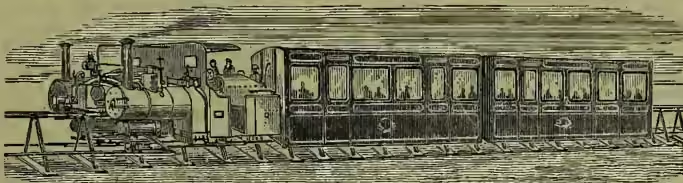
The Lartigue system of light railways, of which several short lines have been constructed—one in Ireland and others in France—comprises only a single rail. The carriages or receptacles for goods are balanced on either side, pannier fashion, on a pyramidal structure of wood or iron, 3 or 4 feet in height, which carries the rail (fig. 8). A 'bicycle' railway has been proposed and an experimental line constructed in the United States, the engine and carriages being retained on the single rail by an overhead support held between small horizontal fuels are interchangeable. The consumption and cost of coal alone per mile passenger express train may be taken at 34 lb. of fuel and 3½d. To do the same work 10½ lb. of liquid fuel and 15 lb. of coal are used, say 25½ lb., at a cost of 2½d. Of various contrivances designed to supersede or sup- wheels. In the French 'gliding railway' (1888) a thin film of water is kept between the rails and the sledge which supports the carriage.
Carriages.—The builders of the earliest railways did not intend them for passenger so much as for goods traffic. On the Stockton and Darlington line ordinary coaches placed on suitable wheels were used for the small passenger business which was encouraged, and until comparatively recent years the coach was the model for railway-carriage builders. Third-class passengers were accommodated in open wagons, with or without seats. So late as 1845 many of these vehicles had no windows, slight ventilation being provided by venetian blinds. On several of the lines no lamps were supplied in third-class carriages even for the night journeys. The first-class passengers booked their tickets as in coaching days, and their luggage was packed on the roof of the carriage to which they were allotted. As the passenger traffic increased the public became more exacting in their demands, and gradually more attention was given to the comfort of travellers, and the tendency of modern management is to add to the luxuriousness of the carriages, especially in long-distance trains. On account of the gradual decrease of second-class passengers, many of the principal companies abolished that class; but, owing to the companies who still retain it lowering the rates nearly to the level of third class, the numbers have considerably increased again in 1896-97. Composite carriages for first and third class in most express trains are fitted with lavatories and every comfort for both classes. Drawing-room, luncheon, and dining cars are also provided for day expresses; and sleeping-cars for night trains are fitted with all the luxury of a first-class hotel. There were in 1897 of locomotives in England 16,600, in Scotland 2092, in Ireland 787—total, 19,479; of carriages: England 51,294, Scotland 7163, Ireland 2954—total, 61,411; of wagons: England 493,428, Scotland 136,017, Ireland 18,030—total, 647,475.
The cost of the passenger express locomotive may be put at from £2500 to £3500; the more powerful engines, if made by locomotive builders, would cost from £4000 to £4500, but, like most of the carriages and wagons, they are usually built by the companies themselves. A goods-engine such as that illustrated would cost £1800 to £2200, and a tank-engine (without tender) £1500 to £2000. The cost of a Pullman carriage is from £2000 to £3500; of an ordinary first-class carriage, £550 to £700; second, £450 to £600; third, £350 to £450; of a coal wagon carrying eight tons, £60 to £70; a wagon carrying ten tons, £70 to £90.
Brakes.—The supply of brake-power has been the subject of many ingenious patents, and is dealt with in a separate article in this work. The use of continuous brakes of some approved form on all passenger-trains in the United Kingdom was made compulsory by the Railway Regulations Act of 1889. See the article BRAKES.
Railway Construction.—The cost of constructing railways is dependent on many conditions, such as cost of labour, the nature of the district traversed, and value of the land required. In England the last-named item has been a very serious one, and heavy parliamentary expenses have also added largely to the cost per mile, which, including equipment, averages £44,710 for the United Kingdom. The most expensive railway system in the world is the underground system known as the 'Inner Circle' line of London. A circular railway of this description was recommended by a parliamentary committee in 1864. The scheme has been carried out by two companies, the Metropolitan and the Metropolitan District, which have since extended their respective systems into the suburbs. This circle, including the purchase of land, which was the heaviest item, has cost from £600,000 to nearly £1,000,000 per mile. The Metropolitan line from Bishop's Road to Farrington Street was opened on 10th January 1863, but the circle, owing to financial and other difficulties, was not completed until October 1884. Another very costly section of railway is that of the South-Eastern between Charing Cross and Cannon Street, London, which includes two large stations with hotels and two bridges over the Thames in its length of two miles. The cost of this short piece of line has been over £1,000,000 per mile. In other countries the land acquired has been of much less value, and in many cases has been given by the government. Moreover, the traffic has not been so heavy, and consequently lighter works have sufficed than those which the Board of Trade require in Great Britain. The average cost of railways in the United States is thus under £12,000 per mile, and in Western Australia the railways have been built and equipped at about £4400 per mile. In flat tracts, such as the prairies, where the traffic is light, the rails can be laid with but little prepared roadway; but this is an exceptionally favourable condition, engineers in most cases having to span rivers (see BRIDGES), pierce hills or mountains (see TUNNELS), cut through elevations, and carry the line over low-lying ground on embankments. In an ordinary clay soil the cost of cutting and embankment may be taken at from 1s. to 1s. 3d. per yard, with about 2d. extra for trimming slopes, &c. In the case of chalk, hard rock, or sand the cost would naturally be much higher; and the length of cartage is also another important item. The roadway having been completed, a substantial bedding of gravel, burned clay, or other suitable material is laid, and in this are imbedded the 'sleepers,' to which the rails are fixed. A good navy will dig and throw out into a barrow in a day of ten hours in common ground from 8 to 10 cubic yards, in stiff clay or firm gravel about 6 cubic yards, and in hard ground, where picking is required, from 3 to 5 cubic yards. The 'steam navy' is now largely employed in railway work, and does in one day the work of from seventy to eighty men (see EXCAVATOR).
In laying out a line it is of great importance that heavy gradients and sharp curves should be avoided, as the former add to the cost of working and the latter interfere with speed. Some of the sharpest railway curves in the United Kingdom are on the narrow gauge Festiniog line, where there are curves as sharp as the sweep of Oxford Circus—of but 116 feet radius—for short lengths. This line runs to a point 700 feet above Portmadoc in less than 12 miles, giving an average gradient of one in 92, and a maximum gradient of one in 80. On the Sleaford and Bourne section of the Great Northern Railway the line, on the other hand, is practically level, the gradients averaging about one in 400. The advantage of an easy gradient will be seen from the following calculation: If an engine and tender, weighing together 56 tons, is capable of drawing a maximum load of, say, 40 loaded wagons, weighing 560 tons, at 25 miles per hour on the level, it will only take the following loads over the gradients named below, and the speed would also be considerably reduced.
| Level..... | 40 wagons weighing 560 tons. | ||
| Incline 1 in 100..... | 20 " | 230 " | |
| " 1 in 50..... | 10 " | 140 " | |
| " 1 in 30..... | 6 " | 84 " |
Before the Board of Trade will sanction the opening of a line it has to be satisfied as to the strength of the bridges, that a minimum distance of 6 feet has been left between the lines, and as to other conditions.
The form of 'permanent way' has altered considerably since the laying of the first railways. The first wrought-iron rails used on the Stockton and Darlington weighed 28 lb. to the yard. The cheapening of steel which followed the invention of the Bessemer process has led to the use of that material for rails throughout the world, and the size of the rails has been successively increased until between 80 and 85 lb. per yard is the usual weight. In British railway practice the rails are supported on cast-iron chairs held by wooden wedges, and the chairs are spiked on to transverse wooden sleepers. On American and colonial lines chairs are dispensed with, and the rails are spiked direct on to the sleepers. The joints are made by 'fish-plates' bolted on each side of the rails, and the bolt-holes are made oblong or elliptical to permit of the expansion and contraction of road under changing temperatures. Blocks of stone were sometimes used in the early history of railways to support the metals, but the rigidity obtained was found to be very destructive of rolling-stock, and wooden sleepers lying on gravel ballast are now almost universally employed. Iron sleepers have been found serviceable in some countries where wood is liable to the attacks of insects.
Light Railways.—In order to benefit the agricultural and other interests in districts too poor to make or support a railway on the usual terms, the Light Railway Act was passed in 1896 to empower the construction of lines of cheaper construction and simpler working than the ordinary. To avoid the heavy parliamentary expenses, the bill gives power to a Light Railway Commission to make inquiry, and if it is satisfied, to issue orders (subject to the approval of the Board of Trade) for the construction of such railway. County, Burgh, and District Councils are also empowered to initiate such railways, or otherwise to advance part of the necessary capital, and the Treasury may also advance a like sum at per cent. not exceeding one-fourth of the whole capital. Several acts have been passed for the construction of light railways in Ireland as a means of relieving distress. Under the act of 1890 government voted £136,200 for this purpose.
Signals.—At a very early stage of railway working a system of signals was found to be necessary. In 1830, when the Liverpool and Manchester line was opened, a flag by day and lamp by night were adopted; but this soon proved inadequate for the traffic, and in 1837 the managers of the Grand Junction Railway erected poles about 12 feet in height, with discs and lamps turned through a quarter circle by the pointsman working a lever at the base. About 1842 a semaphore signal, somewhat similar to those now in use, was introduced. Up to 1846 there were no 'distant' signals, but in that year this extra precaution was adopted. The successful concentration and interlocking of the levers working both points and signals was effected in 1856 at the Bricklayers' Arms Junction, and in 1859 the first interlocking frame was fixed at Willesden Junction. Since that date the interlocking and concentration of signal and point levers has made rapid progress, and of the total signals and points in the United Kingdom over 91 per cent. are thus protected. The signals now in use may be classified as 'home,' 'distant,' 'starting,' 'advanced starting,' and 'disc,' the last named used on goods sidings. By the interlocking of points and signals, if the signalman has for instance moved a lever that opens a pair of points to enable a train to come out of a siding on to the main line, the 'home' and 'distant' signals must be at 'danger' to stop any train from approaching on the main line, and it is impossible for him to lower them.
In the working of a railway the telegraph plays a very important part. By its means trains are started and protected throughout their journey; the signalmen are placed in communication with each other, and are warned if the signals are not acting properly. On the London and North-Western system there are over 11,000 miles of wire used for purely railway purposes, apart from the 6800 miles of Post-office wires. Before the introduction of telegraphy on the railway signals were placed at certain points, and kept fixed at 'danger' for a certain time before another train was allowed to pass. In 1853, however, the absolute block-telegraph system was introduced. Under the absolute block there can be only one train in a given section at the same time, while under the 'permissive' system there may be more than one train in each section. Taking A and B as the stations at each end of the section, the working of the absolute block system is thus arranged: the signalman at station A gives to station B what is called the 'Be Ready' signal, which indicates the nature of the approaching train. The man at station B, if the previous train has passed his cabin, and he knows that the section between A and B is clear, repeats this signal to the next box. The train is then despatched from A, the signalman at that box giving the warning 'Train on Line,' which the man at B acknowledges, and at once gives the 'Be Ready' signal to C, and so on. As soon as the train has passed B, the man in that box telegraphs 'Line clear' to A, who acknowledges the message. Of the double lines in the United Kingdom over 94 per cent. are worked on the absolute block system. On most single lines the 'train-staff and ticket' system is adopted. In this case, supposing there are three trains at the terminus of a line or section to proceed to the other end, the first and second start with a ticket, but the third carries a staff which is the only key for the box in which the tickets are placed. No train is allowed to enter the opposite end of a section until the train staff arrives, so that it is impossible for two trains to meet. The proper distance between trains running in the same direction is maintained by fixed signals, and the block telegraph is the same as on double lines. If necessary, the line is divided into sections with crossing places, each section being worked as a separate line. By the 'train-tablet' system, a circular metal disc is electrically controlled from the other end of the section, forming practically a 'train-staff' and block-telegraph system combined. Mechanical details of signalling have on occasions to be superseded by manual work. In case of fogs a man, generally one of the platelayers, is stationed at the foot of each 'distant' signal, and as the semaphore is raised to 'danger' he places on the rails two detonating signals, which are exploded by the engine as it passes over them. If the engine-driver hears no explosion he knows the line is clear.
Gauge.—In deciding upon the gauge to be adopted the constructors of the first railways naturally adopted that of the tramroads then in existence—viz. 4 feet 8½ inches, that standard having been fixed upon as being in common use for the ordinary vehicles of the country. On all the lines built by George Stephenson, and most of the other leading engineers in the United Kingdom, this 4 feet 8½ inches gauge was adopted; but in 1838 Brunel, in his desire to secure double the attained speed and capacity of the then constructed railways, determined upon a 7-feet gauge for the Great Western Railway. This brought about the now historic battle of the broad and narrow gauges. The Eastern Counties (the present Great Eastern), opened for traffic in 1843, had a 5-feet way, the Caledonian 5 feet 6 inches, and in Ireland there were 5 feet 2 inches and 6-feet gauges. So long as lines of different gauges serving separate districts did not come into contact the inconvenience of breaks of gauge were not felt, but when the broad and narrow gauges met at Gloucester in 1845, and at other points later on, the evil effects were soon felt. Goods and passengers had to be transferred from the one set of carriages to the other, and no through services were possible until at a later period the Great Western laid a third rail to accommodate the narrow-gauge trains. So serious became the difficulties which arose through the breaks of gauge that in 1845 a commission was appointed; it reported in favour of the narrow gauge, and in August 1846 an act was passed enacting that thereafter it should not be lawful to construct any railway for the conveyance of passengers on any gauge other than 4 feet 8½ inches for Great Britain and 5 feet 3 inches for Ireland. It was, however, provided that railways constructed before the passing of the act on any other gauge should be allowed to maintain their independence. The Great Western, therefore, continued to maintain its broad gauge, and as late as 1867 there were 1456 miles of line on this system, having junctions at twenty-six points with the narrow gauge. In 1869, however, the directors of the Great Western realised the disadvantages of their isolation; the narrow gauge has been gradually adopted on the system, and the date fixed for the final disappearance of the broad gauge was the 20th May 1892. Parliamentary sanction has, however, been given to various exceptionally narrow gauge lines. In most European countries the gauge adopted has been about the same as the British standard; with the exception of Spain and Russia, where the gauge is somewhat wider.
Accidents.—The number of persons killed on the railways of the United Kingdom in 1890 was 1076, and injured 4721. Of those killed 118, and of the injured 1361, were passengers; but of the fatal accidents only 18, and of the injuries 496 were due to causes beyond the control of the passengers—viz. accidents to trains—the others arising from various causes, especially want of caution on the part of individuals themselves. Taking the number of passenger journeys, exclusive of those of season-ticket holders, at 817,744,046, the proportion of passengers returned as killed by accidents beyond their own control was one in 45,430,224, and of injured one in 1,648,677. In the case of railway servants 12 were killed and 147 injured by train accidents, and 487 killed and 2975 injured by other accidents. The number of persons employed on the railways of the United Kingdom is estimated at 346,426, so that one in every 694 was killed and one in 111 injured by train and other accidents. These are very high proportions, but it is only fair to the managers to say that every precaution is taken to secure the safety of employés. Too often, however, salutary regulations are broken and mechanical appliances for their protection neglected by the men themselves. The proportion of deaths and injuries has moreover steadily declined of late years. It having been suggested that many accidents were due to men working overtime, railway companies have now to make periodical returns as to the hours of labour on their systems.
Speed.—Mr Worsdell, the locomotive engineer of the North-Eastern Railway, with a powerful engine and a moderately heavy train attained on one occasion a speed of 86 miles an hour. On the Philadelphia and Reading Railroad in the United States in August 1891 a distance of about 3 miles was run at a rate of 90 miles an hour. Mr Stroudley, engineer of the Brighton line, said that a light engine could easily attain 100 miles an hour. The actual running-time of trains is of course considerably below such limits. The fastest speed in ordinary service and the largest proportion of high speed trains are to be found on the railways of Great Britain—the careful finish of the road-beds, the fencing of the track, and the comparative absence of level crossings giving an undoubted advantage in this respect over all foreign systems. The best regular running-time as yet made on railways was in the 'race to the North,' between the East and West Coast routes, commenced in 1888. The London and North-Western in May of that year announced their intention of reducing their time between Euston and Edinburgh from 10 to 9 hours. The East Coast companies accepted the challenge, reducing their time from 9 to 8½ hours, and in August the time by both routes was reduced to 8 hours. The distances to be covered were by the East Coast 393 miles, and by the West Coast 400¼ miles, the gradients on the former being more favourable. The 'race to the north' was resumed between the rival railways in 1895, when on 22d August the west route did the journey from London to Aberdeen, 540 miles, in 8 hours 40 minutes, an average of 63·3 miles per hour, including stoppages. The expense and risk of these high-pressure speeds led to an agreement, and the rivalry was stopped. The fastest train now performs the journey from London (King's Cross) to Edinburgh in 7 hours 45 minutes, to Perth in 9 hours 25 minutes, and to Aberdeen in 11 hours 20 minutes, including stoppages. On the New York Central in 1891 a special run was made from New York to Buffalo, a distance of 437 miles, in 440 minutes, including three stops aggregating 15 minutes. The following may be taken as the best express services now regularly running in different parts of the world in miles per hour, including and excluding stops respectively:
| England—London to Leeds, G.N.R..... | 48·4 | 51 |
| United States—New York to Philadelphia.. | 47·9 | 49·8 |
| France—Paris to Calais..... | 43 | 44 |
| Germany—Berlin to Hamburg..... | 37·3 | 40·5 |
The average rate for express trains may be taken as under, all trains running above 40 miles an hour being taken as 'express' in Great Britain and the United States, and all above 29 miles an hour on the Continent:
| Great Britain..... | with stops | 41·6 | without stops | 44·6 |
|---|---|---|---|---|
| France..... | " | 32·3 | " | 36·2 |
| Holland..... | " | 32·5 | " | 35 |
| Germany..... | " | 31·7 | " | 34·3 |
| Belgium..... | " | 31·7 | " | 33·5 |
| Austria..... | " | 30 | " | 32 |
| Denmark..... | " | 30 | " | 32 |
| Italy..... | " | 29½ | " | 31·2 |
| Sweden..... | " | 29 | " | 31·5 |
| Russia..... | " | 29 | " | 31·6 |
| United States..... | " | 41·4 | " | .. |
On the Canadian Pacific line a special train to convey the Japanese mail in 1891 performed the distance from Vancouver to Brockville, opposite the New York frontier, in 77 hours, at a speed of 36 miles an hour for the whole 2800 miles. On the Grand Trunk line the best service is 36·8 miles including stops, and 38·2 excluding stops. The best service in India is from Bombay to Calcutta, about 25 miles an hour. The distance from Mel- bourne to Sydney is run at 33 miles an hour including stops, and 37 miles excluding stops.
Fares and Rates.—The standard English passenger fares may be taken at about 1½d. per mile first class, 1¼d. per mile second class, and 1d. per mile third class. The experience over a series of years has shown a constant increase in the volume of third-class travel, which in 1890 formed ¾ths of the whole passenger business in the United Kingdom. In 1872 the Midland Company decided on the abolition of the second class, and in 1890 the Manchester, Sheffield, and Lincolnshire Company and the Caledonian Company partly adopted the same policy. The Midland Company, however, by running Pullman drawing-room and sleeping cars at an extra fare, practically re-established the three classes. In the United States the average fare may be taken at 1¼d. per mile, extra charge being made for drawing-room and sleeping cars. The following official statistics as to the comparative fares per kilometre in the different countries of Europe were published by the French government :
| First Class. | Second Class. | Third Class. | Free Baggage. | |
|---|---|---|---|---|
| England..... | 12.5 centimes. | 9.5 | 6.5 | 27 to 54 kilos. |
| France..... | 12.3 | 9.2 | 6.7 | 30 |
| Germany..... | 11.2 | 8.7 | 6.2 | 25 |
| Italy..... | 12.4 | 8.7 | 5.6 | none |
| Belgium..... | 9.5 | 7.5 | 5.0 | none |
With regard to goods, the charges on British railways are higher on the whole, but the speed of the goods-trains and the character of the service is superior. With long hauls in some foreign countries of course lower mileage rates can be charged. The grain rates in America have been reduced to about ¾d. per ton per mile, and on Indian railways, with cheap labour and fuel, a standard of ¼d. per ton per mile has been reached.
Capital, Revenue, &c.—The act of parliament authorising the construction of the Stockton and Darlington Railway, the first used for passenger traffic, received the Royal assent on 19th April 1821. The first rail was laid on 23d May 1822, and on 27th September 1825 the railway was opened with great ceremony. Four hundred and fifty passengers were conveyed in the first train. The train arrived at Darlington, a distance of 8¾ miles, in 65 minutes. When fifty years later the jubilee of the railway system was celebrated there were 16,449 miles of railway working in the United Kingdom, representing a capital cost of £600,895,000, and producing from traffic a revenue of £56,898,000, of which £24,893,000 was received from passenger fares and £32,005,000 from the conveyance of goods and minerals.
At the close of 1897 there were 21,433 miles of railway open for traffic. The authorised capital for the construction of railways was £1,089,765,095, of which English railways had £896,411,043, Scottish railways £153,887,595, and Irish railways £39,466,457. The total receipts of these railways were £93,737,054, of which £79,759,776 was taken in England, £10,438,957 in Scotland, and £3,538,321 in Ireland. Of the total capital stock of the railways in the United Kingdom, £103,061,275 is guaranteed, £279,321,045 debentures, £269,373,440 preferential, £425,501,582 ordinary stocks and shares, and £12,507,753 loans. The gross receipts of all the companies is derived from—passengers, £40,518,064; goods, £47,857,172; mails and parcels conveyed by passenger trains, £6,482,164; and miscellaneous items. The number of passengers carried was 1,030,420,201, of whom 935,159,878 were third-class. The total working expenditure was £53,083,804, equal to 57 per cent. of the gross receipts; the net receipts were £40,653,250, giving a percentage of 3.73 on the total capital. Of the working expenditure, £13,712,718 was for locomotive power; £4,371,121 for repairs and renewals of carriages, &c.; £8,610,686 for maintenance of permanent way, &c.; and £16,505,464 for traffic expenses. The railway companies paid £116,329 as compensation for personal injuries sustained in 1897, and £315,088 as compensation for damage and loss to goods traffic.
The railway system of the United Kingdom has not been developed according to any plan previously marked out, nor does it owe any of the position which it now holds to support or assistance given to it by the state. It is the outcome of private enterprise carried on in very many instances under great difficulties, in spite of much national and local prejudice, and at an expenditure of capital greatly in excess of that which would have been required under more favourable conditions. In 1830 the Duke of Wellington, then at the head of the government, was asked to appoint some engineers to lay out four or more main lines which would form the great highways for the locomotive. The duke's reply was that he did not like railways; and Mr Goulburn, the Chancellor of the Exchequer, declined to take any action in the matter, on the ground that interference with vested interests would create an amount of opposition which the government could not withstand. Private enterprise speedily supplied the impetus to railway development which the national government refused to give. The Liverpool and Manchester Railway was opened for traffic in 1830, and in 1838 there was a completed line between London and Birmingham. During the interval of the opening of these two lines—now absorbed in the London and North-Western system—fifty-six acts of parliament were passed authorising the construction of 1800 miles at a total estimated cost of 45 millions.
The Railway Mania.—A later period marked with greatly increased activity on the part of promoters and engineers culminated in the 'Railway Mania,' followed by a great financial collapse. Parliament had required as a condition precedent of considering any new railway bills that a deposit of ten per cent. of the estimated cost should be lodged with the accountant-general by the promoters, and five per cent. for parliamentary expenses. On the 30th of November in 1845, the latest date at which the Board of Trade would receive plans of new railways, there had been lodged 1263 bills, with plans and sections for new railways, representing a capital of 563 millions, and requiring the deposit of a total sum of 59 millions. The amount required for payment of the deposit exceeded by more than 20 millions the whole amount of gold and coin in the Bank of England and notes in circulation. The publication of these figures created alarm, and a panic ensued, the stocks of existing railways were greatly depreciated, and the premiums on the shares of the newly-promoted companies, which had been created by a wild spirit of speculation, disappeared, and wide-spread ruin and commercial disaster ensued. The result was that, of the 1263 companies which were promoted, 120 only survived the ordeal of parliament.
Railway Administration.—Up to 1891 there had been passed over 4000 separate acts of parliament authorising the construction of new or dealing with the constitution and working of existing companies. In order to compensate to some extent for the lack of original design and system in connection with the railways, the companies have resorted to numerous plans for amalgamation, fusion, purchase, or working agreements between themselves. There were in 1891, after numerous changes and dissolutions, 516 railway companies in the United Kingdom. Of the railways owned by these companies 266 are worked or leased by other companies. The
Great Western, for instance, has thirty-six railways of which it is the lessee, and has joint-ownership of nine other lines. The movement of the traffic over the separate systems of railways is provided for under the Clearing-house Association (see CLEARING-HOUSE); and in 1888 an act was passed giving to the Board of Trade authority to call for returns, and deal with the schedules of rates and classifications of the companies.
The earliest railways were authorised on the supposition that they would, like canals, be highways for the use of carriers. A scale of maximum tolls was prescribed in each act, and the canal classification of goods adopted. Later on the railway companies prepared a new classification. Each railway act also contained a clause authorising the railway company to charge a reasonable sum in addition to the maximum tolls, in order to cover carriers' services, risks, and profit; and from about the year 1845 each railway act prescribed a scale of maximum charges for conveyance. To these maximum rates most of the companies were allowed to add a terminal charge for the services of loading, unloading, covering, collection, and delivery, &c. Although the companies had thus power to charge certain rates, the maxima were seldom enforced; but even with the lower level of actual charges the traders were dissatisfied, and demanded frequent inquiries into the working of railways. Three such inquiries were held between 1866 and 1884, but the companies were on the whole acquitted of the charges brought against them. As the result of the inquiry of 1872 the Railway Commission was appointed to specially deal with disputes between traders and the railways. In 1885 the government made an attempt to deal with the whole subject of railway rates, but it was not until 1888 that an act was passed. The later part of 1889 and the whole of 1890 were occupied with inquiries before the Board of Trade and a joint committee of both Houses of Parliament, as to the rates and classifications of the railways, and the result has been acts which come into force on 1st August 1892, amending the powers and classifications of nine of the leading lines.
Zone System.—In 1889 a new departure was inaugurated on the Hungarian state railways by the introduction of the Zone system for passengers, under which each station, taken as a point of departure, is considered as the centre of certain zones, which increase in a regular ratio, and in which the fares are arranged on a simple plan. This was followed by the introduction on the Austrian railway system of the Kreuzer tariff, which is a combination of the Zone and the Kilometre systems; and in 1891 the Zone system was also applied in Hungary to the goods traffic.
Results of Railway Working.—At the time when the Liverpool and Manchester Railway was completed, ten miles an hour travelled by the fast stage and mail coaches was about the limit of speed attainable. At that time the population of the United Kingdom was about 25 millions; in 1891 it was nearly 38 millions. At the opening of the London and Birmingham Railway there were 3026 stage-coaches, 54 four-horse and 49 pair-horse mail-coaches in use. The full seating capacity of these vehicles, each being licensed to carry fifteen passengers, would represent 16,500,000 individual journeys in the course of the year, and it may be safely assumed that not more than 10 millions of such journeys were made. The extent of correspondence among the population was officially stated at 82 millions of letters. In 1890 the number of passengers carried on the railways was 817 millions. On the basis of work done by stage-coaches in 1837, we should require over a quarter of a million of these vehicles to move the passengers now conveyed over the 20,000 miles of railway. On 30th November 1830 the first of Her Majesty's mails was transferred from the mail-coach to the railway. The increased facilities thus afforded converted a uniform penny post from a theory into a reality when that system came into operation on 5th December 1839. In 1890 the Post-office celebrated the jubilee of the penny postage, and in that year carried 1650 millions of letters, 207 millions of post-cards, 442 millions of book-packets, and 159 millions of newspapers. To have conveyed this would have required more than thirty times the number of coaches which carried the mails half a century since. The news in those days was carried at an average speed of 8 miles per hour. The railways carry the mails at an average speed of over 40 miles per hour.
The total traffic in coal on the railways of the United Kingdom amounted to over 126 millions of tons in 1890. Of the total meat supply of London the railway companies convey about 64 per cent.; whilst of milk four companies alone import about 22 millions of gallons each year. The supply of vegetables, fruits, and flowers for London and other large towns is also mainly dependent on the railways. The fish trade of the country also owes its development mainly to the railway facilities of recent years—in 1890, 383,000 tons of this valuable item of our food supplies were conveyed by rail from the ports to inland markets.
State Ownership of Railways.—It may be assumed in general that railway construction and development has been less hampered by state interference in the British Islands and in the United States and Canada than in any other parts of the world, and it is precisely in these countries that railways have attained their highest development. In other British colonies the government has either built or subsequently purchased the lines. Railway construction in France was undertaken in a much more methodical manner than in Great Britain. The country is partitioned out among six great companies, and competition has thus been entirely avoided. The government owns about one-third of the capital invested, and will ultimately about the middle of the 20th century become the absolute proprietor of the various systems. The state has the right to fix fares and charges, and to determine the amount of new mileage to be constructed from time to time. So far as technical skill is concerned, the railways of the country are well managed, but the accommodation provided is far inferior to that in Great Britain or the United States; passenger-trains are comparatively few and crowded, and the freight service is very slow. The main lines are very remunerative in their operations, but the local roads are mostly worked at a loss. In Germany the roads are owned and managed by the government, and political and military considerations are paramount in the working of the system. The lines have been cheaply constructed, the cost being less than half per mile that in Great Britain. The tendency in most other European countries is towards state ownership or control of railways. The Russian government since 1880 has been actively engaged in buying up private railways and building new lines, and at the present time some 40 per cent. of the system is owned by the state. In Belgium the whole of the lines have been so purchased by the government. In Austria only one line is a state railway.
Railways in the United States.—By far the greatest and most rapid development of railway construction in proportion to population has taken place in the United States, and the working of railways in all parts of the world owes much to the characteristic inventive genius of Americans. The building of railways has not been hampered on the
American continent by undue legislative restrictions. State ownership has never been seriously discussed; land has been cheap or free for occupation; the distances to be traversed are great, and it is small wonder, therefore, that the iron road has in most districts preceded or superseded the ordinary highway. Before the date of the celebrated locomotive trial which evolved the 'Rocket,' an engine was run in America called the 'Stourbridge Lion,' a machine made in England, and imported by the Delaware and Hudson Canal Railroad Company. The first railroad in the United States was, however, begun in 1828 by the Baltimore and Ohio Company, a section of 15 miles from Baltimore to Ellicott's Mills being opened in May 1830. Horse-traction was first used on this line. American engines are now found competing with English-built machines in many parts of the world, including the British-Australian colonies.
It is, however, in the matter of carriage construction that the American railroad engineer has marked out an independent path and obtained the most striking results. For many years European railway carriages adhered closely to the model of the old stage-coach. The longer distances travelled on the American continent, and the republican spirit which objected to the division of classes, led to the adoption across the Atlantic of the long railroad car, with a central passage between the seats. The great size and weight of these structures necessitated increased attention to such details as springs, couplings, and brakes, and in the provision of such accessories for comfort and safety American railroad practice has long been in advance of that in any other part of the world. Republican simplicity notwithstanding, the demand for improved accommodation gave rise to drawing-room, sleeping, and dining-room cars, and the stock turned out for these purposes by the Pullman and Wagner companies challenges comparison with the provision made for the travel of royalty in the Old World. The 'Vestibule' trains running on most of the trunk-lines for long distances—say between New York and Chicago—represent the highest ideal yet obtained of luxurious travelling. Railway stock of this character is mostly owned by independent companies, whose officials collect the extra fares for the accommodation.
In the United States, between 1830 and 1890, a total length of 167,000 miles has been constructed, or an average of nearly 2800 miles a year. Previous to 1850 the greater portion of the railroads made were in the states bordering on the Atlantic, and were for the most part isolated lines employed for local traffic. A great development to this form of enterprise was given by the discovery of gold in California, and lines were rapidly pushed towards the centre of the continent. The great civil war at the commencement of the next decade emphasised the necessity of direct communication with the growing Pacific states to cement the Union, and government assistance was freely given both in land-grants and money to the two companies, the Union Pacific and Central Pacific, which, building respectively from the east and the west, met near Salt Lake City in May 1869, the total length from the Missouri River to San Francisco being 1700 miles. Since that date five transcontinental lines have been completed, including the Canadian Pacific Railway on British territory. The rate of general railroad construction has varied considerably, but the most active period was that between 1880 and 1890. In 1882 11,569 miles were built, and in 1887 no less than 12,878. A large extent of this mileage was built in advance of the necessities of the districts traversed, and in other cases existing lines were paralleled to the heavy loss of the interests concerned. These periods of over-construction and resulting competition, combined with a necessary reduction of mileage rates as the centre of agricultural production moved westward across the continent, caused at times much depression in railroad securities. The system of finance under which the companies borrow money on mortgages with foreclosure powers (not possessed by owners of British railway debentures) has also been the cause of heavy loss to investors in American railroads, many of which have passed through the ordeal of reorganisation with the accompanying 'assessment' or 'wiping out' of junior securities.
To remedy the effects of over-competition, a system of 'pooling' receipts was adopted by the various trunk-lines. Under this plan the receipts from any given description of traffic were made into a common purse, and divided among the companies concerned in an agreed ratio. The state railroad commissions were powerless to deal with traffic originating or passing out of their respective territories; but in 1888 the Interstate Commerce Commission was appointed with federal authority to deal with questions affecting railway traffic. Under the law appointing the commission, 'pooling' receipts was made illegal, and the well-known 'long and short haul' clause, establishing uniform mileage rates, was, contrary to the result, expected to produce disastrous results to railway revenues.
The total railway capital in the United States in 1890 was 10,122,000,000, of which rather less than half, or 4,640,000,000, consisted of capital stock, and the remainder of different forms of indebtedness. The cost per mile of completed road was 59,638. The gross earnings were 1,097,847,000, equal to 10.8 per cent. on the investment, and the net earnings $346,921,000, or 3.4 per cent. on the outstanding capital. Of this amount 4.18 per cent. represents interest on indebtedness, while the average return in the way of dividend to stock-holders was 1.80 per cent. The work done was represented in 1890 by 793,925,000 train miles run. Passengers were carried to the number of 520,439,000, and an average distance of 24.06 miles, while 701,344,000 tons of freight were carried an average distance of 112.91 miles. The average earnings per passenger per mile were 2.185 cents, and per ton of goods per mile 0.935 cents, the latter a lower average than in most other countries, the distances hauled being unusually great.
Colonial and Foreign Railways.—Canadian railways follow closely in their characteristics the construction and methods of working of the lines across the boundary. The return of 1890 gives a total of about 14,000 miles completed, the greater proportion of the mileage being divided between two companies, the Grand Trunk and the Canadian Pacific. The nominal capital, including advances made and aid granted by the Dominion government, was 786,447,000, or 56,174 per mile. The earnings were returned at 46,844,000, and the net profits at 13,930,000. Passengers were carried to the number of 12,827,000, and 20,787,000 tons of freight.
In Mexico for many years the line from Vera Cruz to the capital, constructed in 1850 at a heavy cost to British capital, was the only railway in existence; but routes connecting with the systems of the United States were subsequently constructed under American auspices.
Of railways in other Central American states the Panamá line constructed by American capital, as the first transcontinental route, claims chief attention. Other routes between the Atlantic and Pacific are under construction, and a great scheme, traversing the Isthmus from north to south, was discussed and steps taken for the necessary surveys at a meeting of representatives of the various republics held in 1890 at Washington. The project vies in magnitude with the Trans-Siberian railway scheme in the Old World. The Argentine Confederation represents the chief railway development in the southern half of the continent.
In the early days of railway enterprise in India the agency of private companies guaranteed by the state was exclusively employed, and nearly all the great trunk-lines of the country were made under this system. The government gave the land for the lines free of charge, and guaranteed interest generally at five per cent. on the share capital and a lower rate upon the debentures for ninety-nine years. Any surplus earnings after the guaranteed rates were paid were divided equally between the government and the companies. Moreover, the government retained the right of buying the undertakings at specified dates on payment of the value of the stock calculated at its market price on the average of the three preceding years. In this way the East Indian Railway was acquired in 1880, the Eastern Bengal in 1884, the Sind, Punjab, and Delhi in 1885-86, the Oudh and Rohilkund at the end of 1888, and the South Indian in 1890. In 1870 a new policy of railway development by the direct agency of the state was inaugurated; and in 1880-81 the system of encouraging private enterprise by state assistance was again adopted. Both agencies are now employed. In some instances—notably the Bengal and North-Western line—railways have been constructed without any direct pecuniary assistance; in others a subsidy or limited guarantee has been granted. The agency of private companies has also been employed by the government both in the construction and working of state lines. In all cases the government has the power of taking over the railways at specified periods on stated terms. In 1884 a select committee reported in favour of a more rapid extension of railways than had been taking place, and recommended the broad gauge—i.e. 5 feet 6 inches—except in tracts where the metre or smaller gauge was already in successful operation, and for local lines where the traffic could only be light. The first railway opened in India was that of the Great Indian Peninsular Company from Bombay to Tannah, traffic being commenced on 4th May 1853, and at the close of 1890 there were 16,996 miles in working. Of this total 8077 miles were state lines worked by companies, 4680 miles state lines worked by the state, 258½ miles were worked by guaranteed companies, 381 by assisted companies, 539½ miles were owned by native states and worked by companies, 124 miles were owned by native states and worked by state railway agency, 547½ were owned and worked by native states, and 58½ miles were in Portuguese and French territory.
The first railway in Australasia was projected in 1850 in New South Wales by private enterprise, but was completed by the government. With a few small exceptions the railways of the Australasian colonies are owned and worked by the governments. The dates of opening of the first lines and latest mileage returns of each colony are: Victoria (13th September 1854), 2762 miles; New South Wales (29th May 1855), 2182 miles; Queensland (31st July 1865), 2113 miles; South Australia (26th April 1856), 1810 miles; Western Australia (21st January 1864), 569 miles; New Zealand (1st December 1863), 1965 miles; Tasmania (10th February 1871), 374 miles. In Australasia in 1870 there were but 948 miles of railway, but in 1890 there were about 12,000 miles. The distribution of this total is shown above. It is unfortunate that in Australia different gauges have been adopted, so that where the systems join transhipment of goods and passengers is necessary. The Victorian lines are built on the 5 feet 3 inches gauge, which is also the national standard in South Australia, but this colony has also 700 miles on the 3 feet 6 inches gauge. In New South Wales a 4 feet 8½ inches gauge is the standard, but there is also a 5 feet 3 inches line. In Queensland, Western Australia, Tasmania, and New Zealand all the railways are on a 3 feet 6 inches gauge. The capital cost per mile of the Australasian lines has been: Victoria, £13,612; New South Wales, £12,532; Tasmania, £8436; New Zealand, £7582; Queensland, £6766; South Australia, £6444; and Western Australia, £4374 per mile. In Cape Colony the first railway was opened 26th June 1860, and when the government took over the railways in 1873 there were only 63½ miles; in 1890 there were 1890 miles.
In China the first short railway at Woosung was torn up after a few months' working, but the line to the Kaeiping collieries was not disturbed. Some 100 miles of the Tien-tsin line has since been constructed, and plans are under discussion for the construction of a trunk route. See the articles on the several countries.
Railway Mileage.—The dates of the opening of the first railways, and the mileage in 1891, of the principal countries are as under:
| Austria-Hungary ..... | 20th September 1828 | 16,467 |
| Belgium ..... | 5th May 1835 | 3215 |
| Denmark ..... | 18th September 1844 | 1223 |
| France ..... | 1st October 1828 | 22,536 |
| Germany ..... | 7th December 1835 | 25,969 |
| Great Britain and Ireland | 27th September 1825 | 20,073 |
| Greece ..... | 18th February 1869 | 239 |
| Italy ..... | 3d October 1839 | 8117 |
| Netherlands ..... | 13th September 1839 | 1887 |
| Norway ..... | 14th July 1853 | 970 |
| Portugal ..... | 9th July 1854 | 1280 |
| Russia ..... | 4th April 1838 | 19,027 |
| Spain ..... | 30th October 1848 | 6127 |
| Sweden ..... | 9th February 1851 | 1623 |
| Switzerland ..... | 15th June 1844 | 1929 |
| Turkey ..... | 4th October 1860 | 1096 |
| Egypt ..... | 26th January 1856 | 1494 |
| India ..... | 18th April 1853 | 16,996 |
| United States ..... | 17th April 1827 | 167,000 |
| Canada ..... | 19th March 1847 | 14,000 |
| Mexico ..... | 8th October 1850 | 5827 |
| Argentine Republic ..... | 14th December 1864 | 5798 |
| Brazil ..... | 30th April 1854 | 5779 |
| Chili ..... | January 1852 | 1926 |
| Colombia ..... | January 1880 | 230 |
| Paraguay ..... | 1st October 1863 | 149 |
| Peru ..... | 29th May 1851 | 994 |
| Uruguay ..... | 1st January 1869 | 537 |
| Venezuela ..... | 9th February 1866 | 441 |
See Francis, History of the English Railway (1851); W. Galt, Railway Reform (1865); Smiles, Lives of George and Robert Stephenson (1868); Colburn, Locomotive Engineering (1871); Arthur Helps, Life of T. Brassey (1872); Francis Trevithick, Life of Trevithick (1872); Adams, Railroad and Railway Questions (1878); Redman, Law of Railway Companies as Carriers (1880); Burdett's Official Intelligence (1891); Barry and Bramwell, Railways and Locomotives (1881); Bigg, Railway Acts, 1830-66 (1867), and Supplement to, 1875-83 (1883); Minot, Railway Travel in Europe and America (1882); Clifford, Private Bill Legislation (2 vols. 1885-87); Ivatt's Railway Management of Stations (1885); Waring, State Purchase of Railways (1887); Professor Marshall on State Ownership, in Trans. Brit. Assoc. (1890); Jeans, Railway Problems of Working in Different Countries (1887); McDermott, Life of Firbank (1887), and The Railway Clearing-house (1887); Williams, Our Iron Roads (1888), and The Midland Railway (1883; new ed. 1888); H. Grierson, Railway Rates, English and Foreign (1886); Findlay, Working and Management of an English Railway (1889); Acworth, Railways of England (1889), and Railways of Scotland (1890); Hodges, Law of Railways, by Lely (7th ed. 1889); Hyde, The Royal Mail (3d ed. 1889); Foxwell and Farrer, Express Trains, English and Foreign (1889); Fisher, Railway Accounts and Finance (1891); Railways of America (1890); Bradshaw's Railway Manual; Board of Trade Railway Returns (of capital, revenue, accidents, brakes, signals); Poor's Manual of the Railroads of the United States (annual); Reports of Interstate Commission of the United States; and for foreign works on railways, see the Catalogue of M. Dunod, Paris.