Réaumur, RENÉ ANTOINE FERCHAULT DE, physicist, was born at La Rochelle, 28th February 1683, and studied in the Jesuits' College at Poitiers, and afterwards at Bouges. In 1703 he went to Paris, where he attracted general attention by the publication of three geometrical Memoirs; and in 1708 he was elected a member of the Academy of Sciences, and was charged with the supervision of the work Description des Divers Arts et Métiers, published under the auspices of the government.
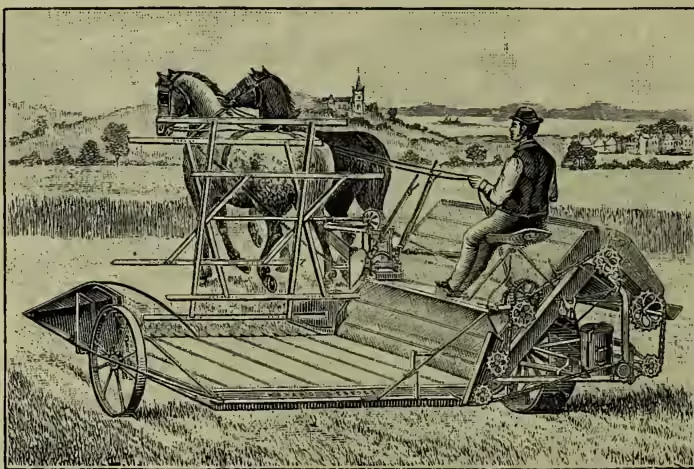
Réaumur lightened his labours with occasional researches into various subjects of natural history. These researches occupied him from 1708 to 1715, and were followed by a series of investigations into the condition of the woods, auriferous rivers, and turquoise mines of France. The collections of Memoirs of the Academy of Sciences from 1722 till 1725 contain a number of papers by Réaumur, in sheaves. Samuelson's sheaf-deliverer will be made plain by fig. 2. The machinery consists of a series of four rakes—two toothed and two plain—attached to an upright shaft in such a manner as to admit of a free ascending, descending, and horizontal motion. The two toothless rakes or 'dummies' are shorter in the arms by six inches than the other two, and are merely employed to incline in which he details his discoveries of the mode of producing steel from iron, and of the mode of tinning iron. For these and other researches he received from the French government a sum of 12,000 livres, which he spent in promoting and encouraging the industrial arts in his native country. In 1739 he succeeded in producing an opaque glass which was equal to the porcelain of Saxony and Japan. His invention of the Thermometer (q.v.) which bears his name need not be more than mentioned here. He died of a fall from a horse, 17th October 1757, leaving behind him a voluminous collection of works on all the subjects above stated, also a treatise on 'the silk of spiders,' a number of Memoirs (1731-40), containing his thermometric researches on air, and on mixtures of fluids with fluids or solids, and his Mémoires pour servir à l'Histoire des Insectes (Amsterdam, 12 vols. 1737-48).