Reflection. A surface on which a beam of light falls may be either rough or smooth. If it be rough, the greater part of the incident light is irregularly scattered by the innumerable surface-facets, so as to be reflected or dispersed in all directions; if it be smooth, a proportion (but never the whole) of the incident light is regularly reflected or turned back in definite paths. A smooth, dustless mirror is not visible to an eye outside the track of rays reflected from it. If the polished surface be that of a transparent substance (e.g. glass) optically denser than the medium conveying the light to it, comparatively little light is reflected; but the more oblique the incidence, the smoother the polish, and the greater the difference between the optical density of the glass and that of the medium in which it is immersed, the greater the proportion reflected. Thus less light is reflected from glass under water than from glass in air; and conversely, if the light travel in the denser medium and strike the bounding surface between it and a rarer medium—as where light ascending through water strikes its upper free surface—it will, if its obliquity of incidence exceed a certain limit, be almost totally reflected; the small loss that ensues arising wholly from absorption, while no light is transmitted into the air above. This may be shown by holding a clear tumbler of water above the head: the image of objects beneath is seen reflected in a bright mirror surface; and a phenomenon of the same order is seen on thrusting a test-tube containing air below the surface of water, when it will appear to have a lustre like quicksilver. If the reflecting surface be that of an opaque body the bulk of the incident light is reflected, a percentage being lost by absorption. What has been said about light applies equally to ether-undulations of all kinds, and therefore the theory of reflection has general reference to radiant heat, light, actinic radiation, and electro-magnetic undulations (see MAGNETISM). Reflection arises in all cases from a difference in the transmissibility of ether-disturbances on the two sides of the bounding surface.
On reflection from polished surfaces we have, so far as regards the directions of the reflected rays, the following laws observed: (1) The incident 'ray,' the normal (i.e. a line drawn perpendicular) to the surface at the point of incidence, and the reflected 'ray' all lie in one plane, the 'plane of incidence;' and (2) the angle of incidence (the angle which the incident 'ray' makes with the normal to the reflecting surface) is equal to the angle of reflection (the corresponding angle between the normal and the reflected 'ray'). These laws apply equally to ether-waves of all lengths, and therefore to light of all colours; and they also hold good whatever be the shape of the surface. If the surface be plane their application is simple; and if the surface be curved we have, in effect, to consider the curved surface as made up of indefinitely small facets, to each of which the above laws can be applied. The geometrical consequences of these laws make up what used to be called Catoptrics, that part of geometrical optics which deals with reflection; and this coincides in its propositions with that part of kinematics which gives an account of the reflection of waves. Here the ether-waves (using the term 'waves' in its most general sense) are assumed to travel through optically homogeneous media, and can consequently be traced out by imaginary lines drawn at right angles to the wave fronts or along the directions pursued by the waves, these imaginary lines being called 'rays.'
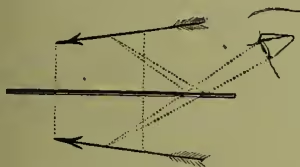
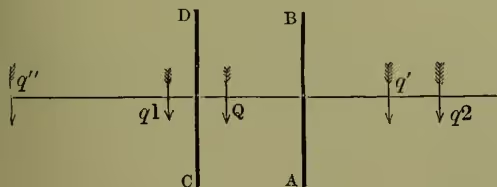
Plane Reflecting Surfaces.—(1) Rays which are parallel to one another before striking a plane reflecting surface are parallel after reflection. (2) If light diverging from or converging towards a point, Q, be reflected from a plane mirror, it will appear after reflection to diverge from or converge towards a point, , situated on the opposite side of the mirror and at an equal distance from it. In fig. 1, the rays diverge from Q; after reflection they appear to diverge from . If, on the other hand, the course of the light is such that the rays appear before reflection to converge upon , they will after reflection actually pass through Q. (3) A consequence of the preceding proposition is that when an object is placed before a plane mirror the virtual image is of the same form and magnitude as the object, and at an equal distance from the mirror on the other side of it. The right hand of the image, taken as looking towards the mirror, is necessarily opposite to the left hand of the object; so that no one ever sees himself in a single plane mirror as others see him or as a photograph shows him, but he sees all his features reversed. (4) When two mirrors are placed parallel to one another, light from an object between them is reflected back and forth, so as to appear on each occasion of reflection as if it came from images more and more remote from the mirrors. On each occasion the course of the rays of light is the same as if the virtual image behind the mirror had been a real object; and a new virtual image is produced, apparently as far behind the reflecting mirror as the virtual object had been in front of it. Thus, in fig. 3, where AB and CD are mirrors, the distance ; ; and so on indefinitely; and also ; ; and so on indefinitely; so that if the mirrors were perfectly plane and parallel, and if they reflected all the light which fell on them, an observer between the mirrors would see in this experiment (which is called the endless gallery) an indefinite number of images. A variation of this experiment, carried out with mirrors not parallel to one another, but inclined at an angle which is some aliquot part of , gives the principle of the Kaleidoscope (q.v.). (5) When a beam of light is reflected from a mirror and the mirror is turned through a given angle the reflected beam is swept through an angle twice as great. This principle is utilised in the construction of many scientific instruments, in which the reflected beam of light serves as a weightless pointer, and enables us to measure the deflection of the object which carries the mirror. (6) When a beam of light is reflected at each of two mirrors inclined at a given angle the ultimate deviation of the beam is (if the whole path of the light be within one plane) equal to twice the angle between the mirrors; for example, in fig. 4, the angle SDB, which measures the ultimate deviation of the original beam SA, is easily proved equal to twice the angle BCA between the two mirrors. This proposition is applied in the
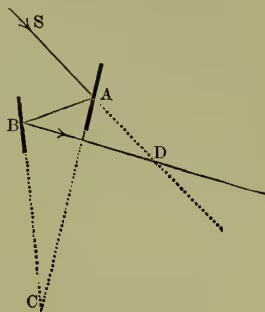
Quadrant (q.v.) and Sextant (q.v.). (7) When a wave of any form is reflected at a plane surface it retains after reflection the form which it would have assumed but for the reflection, this form being, however, guided by reflection into a different direction.
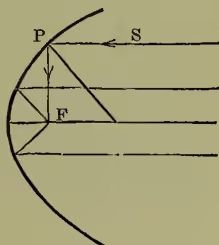
Curved Reflecting Surfaces.—In these we have to trace out the mode of reflection of incident rays from each 'element' or little bit of the reflecting surface; and this leads, through geometrical working, to such propositions as the following: (1) Parallel rays, SP, travelling parallel to the axis of a concave paraboloid mirror (fig. 5) are made to converge so as all actually to pass accurately through F, the geometrical focus of the paraboloid; and, conversely, if the source of light be at F, the rays reflected from the mirror emerge parallel to one another—a proposition of great utility in lighthouse work, search-lights, &c.
(2) If the paraboloid mirror be convex, parallel incident rays have, after reflection, the same course as if they had come from the geometrical focus of the paraboloid. (3) In a concave ellipsoid mirror, light diverging from one 'focus' of the ellipsoid is reflected so as to converge upon the other 'foci' of the curved surface; and by a convex ellipsoidal mirror light converging towards the one focus is made to diverge as if it had come directly from the other focus. (4) In a hyperboloid reflector the two geometrical foci have properties corresponding to those of the ellipsoid.
(5) In spherical reflectors, which are those most easily made, there is no accurate focus except for rays proceeding from the centre and returning to it. When parallel rays are incident on a
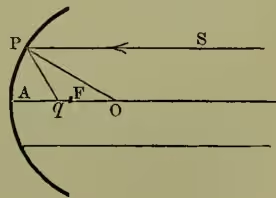
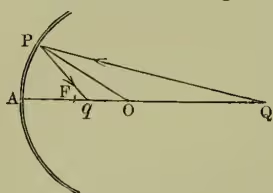
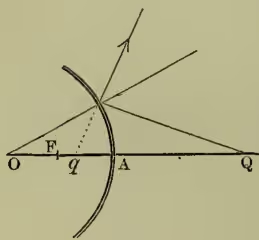
concave spherical mirror we see from fig. 6 that if they be parallel to the axis of the mirror each ray is made to pass after reflection through a point, , which is nearer to (a point midway between the mirror and its centre, ) the narrower is the pencil of rays. If, therefore, the pencil of rays be very narrow in comparison with the radius, , the rays will after reflection approximately converge upon , which is called the principal focus of the mirror; and the principal focal distance, , where is the radius of the spherical mirror. The farther any ray is from the axis , the farther from is the point, , to which that ray is reflected; and the difference, , is called the longitudinal aberration for that ray. The reflected rays from the various parts of the mirror form by their intersection a Caustic (q.v.), the apex or cusp of which is at . If, instead of using a parallel beam of incident light, we have light coming from a point at a definite distance along the axis, we find (see fig. 7) first that any ray from to travels back along , whence the focus of reflection is somewhere in the line ; and that any ray, , is reflected to a point, , such that the angle ; and therefore (since by Euclid, vi. 3, ) if the pencil be relatively very narrow, so that comes to be equal to , and to , we have . This proportion reduces to the equation ; whence we can readily find when and are known. Thus, if, for example, the radius of curvature be 12 inches (the principal length being then 6 inches), and if be 30 inches from , we have ; whence and inches. The same formula may be written , where and are the distances from of the two 'conjugate' foci, and , and is the principal focal length. The two 'conjugate' foci are reciprocal; if light start from it will be reflected to . As , the source of light, approaches , also approaches ; when is at , also is at ; as continues to move towards , moves out more and more rapidly beyond ; when is at , is at an infinite distance, or the reflected rays are parallel; when is between and the reflected rays are divergent, as if from a virtual focus on the opposite side of . If the mirror be convex, fig. 8 shows that and have, with respect to the reflecting surface, opposite signs; so also have and ; so the equation above becomes ; whence, taking the same numbers as before, is equal to inches; a virtual image, seeming to come from a point 5 inches on the other side of the reflecting surface.
As to the quality of the light reflected there are some peculiarities to be observed. From the surface of a transparent body, of greater optical density than the surrounding medium, light polarised in the plane of incidence and reflection is more largely reflected at oblique incidences than light polarised at right angles to that plane; when the angle of incidence is such that the reflected and refracted rays tend to be at right angles to one another, the whole of the light reflected is polarised in the plane of incidence and reflection; and if light polarised at right angles to that plane be made to fall upon glass at the particular angle of incidence just referred to, it will not be reflected at all, but will wholly enter the glass. Plane-polarised light polarised in any other plane than that of incidence or one at right angles to it, is, after total reflection in glass, found to be elliptically polarised (see POLARISATION); and this phenomenon is always presented in reflection from metals. In the case of electro-magnetic radiation (see MAGNETISM) theory and practice concur in indicating that conductors are good while non-conductors are bad reflectors; and the same general proposition holds good with reference to those more frequent but otherwise similar ether-oscillations to which the phenomena of Radiant Heat, Light, and Actinism are due.