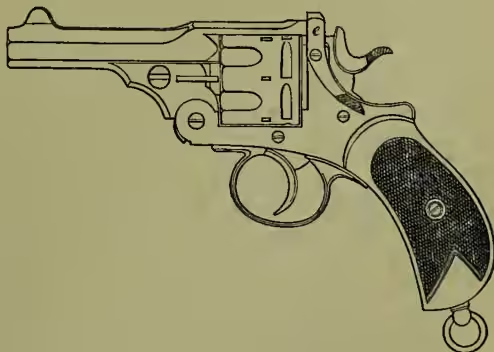
Revolver, in Firearms, is a weapon having barrels or chambers which revolve upon a common centre, and are fired in turn by one lock mechanism. Revolving firearms date from the commencement of the 17th century, when hand-guns having two or more barrels were mounted to turn upon an axis, and so arranged that the powder-pans came successively under the action of the lock; the barrels were not rotated by pulling the trigger, but were turned by the hand. The celebrated Marquis of Worcester invented several such. In 1815 Le Norman, a Parisian gunsmith, produced a pistol with five barrels, Devisme one with seven, but neither proved successful. The 'Mariette,' made with from four to twenty-four barrels, was the first to become popular, although from its weight, cumbersome mechanism, and short range, it could have been of little use except at close quarters. This pistol was the precursor of the 'pepper-box' pistol, to which it was closely allied; the barrels of both were bored in a solid mass of metal, and made to revolve as the hammer was raised to full cock. Not so old as the principle of revolving barrels, but still an invention of past generations, is that of a revolving chamber or breech-piece, pierced with cylindrical apertures to contain the charges, and so arranged that each chamber came successively into line with the barrel and lock common to all. E. H. Collier in 1818 patented an improved carbine with three revolving chambers, which appears to have been an efficient weapon. Colonel Samuel Colt produced his world-renowned revolver in 1835. This consists of a rifle barrel, a revolving cylinder with six or seven chambers, each furnished with its own nipple and cap, and a lever trigger, which operates the mechanism required to turn the chambers and fire the weapon. The double-action revolver is one in which by simply pulling the trigger the hammer is raised and released, and the chambers turned; whilst in the single-action revolver the hammer is raised by the thumb of the firer and released by the trigger. Breech-loading revolvers are of two kinds—the solid frame revolver, which requires the empty cases to be forced out by a diminutive ramrod (generally attached to the pistol by a swivel), and the self-extracting revolver, of which there are many kinds. The regulation pistol of the British army is that illustrated here. By pressing the lever, e, the bolt securing the top of the hinged frame is released, and the barrel turning upon the hinge raises the chambers, whilst the extractor-rod coming into contact with a spur-lever, flips out the fired cases and returns into position; the chambers are thus exposed for loading, and upon the barrel being raised the breech-bolts snap home, and the pistol is ready for firing by pulling the trigger. This principle is the most popular of any employed for self-extracting revolvers, and it has proved efficient. There are many types of revolvers, self-extracting and other, but, with the exception of cheap weapons and some single-action solid-frame revolvers popular in America, the principle adopted by the British and other governments is that most generally used. Messrs Smith & Wesson of Worcester, Massachusetts, were the first to popularise the hinged self-extracting revolver, and amongst many other models they now make one in which the hammer is covered, and the pistol can only be fired when firmly grasped by the hand; as a safety bolt, which effectually and automatically bolts the firing mechanism, projects through the haft, and has to be pressed in before the trigger can be drawn back to raise the hammer and fire the weapon. This pistol is perfectly safe, and insures immunity from such accidents as arise from careless handling. For military purposes the revolver is generally made of half-inch calibre, and such a weapon has a range of from 100 to 300 yards, whilst at 50 yards ten consecutive shots have been placed in a 4-inch bull's-eye. At shorter ranges its precision is equal to that of the finest duelling pistol. Revolving arms of large size are used as Cannon (q.v.) and Machine Guns (q.v.); and for further particulars of revolving firearms consult Galand, Le Revolver de Guerre (2d ed. 1873); Gould's Modern American Pistol and Revolver (Boston, 1888); and British service publications.