Rice (Oryza), a genus of grasses, having panicles of one-flowered spikelets, with two very small pointed glumes, the florets compressed, the paleæ strongly nerved, awned or awnless, six stamens, one germin, and two feathery stigmas. The Greek name oryza is, according to Skeat, from an old Persian word akin to the Sanskrit vrihi, a word which passed into Arabic as uruz or aruzz, whence the Spanish form arroz. The only important species is the Common Rice (O. sativa), one of the most useful and extensively cultivated of all grains, supplying the principal food of nearly one-third of the human race. It seems to be originally a native of the East Indies, but is now cultivated in all quarters of the globe, and almost wherever the conditions of warmth and moisture are suitable. It is adapted to tropical and subtropical climates, rather to the latter than the former; and requires much moisture, rather, however, in the soil than in the air. Rice is an annual, varying from 1 to 6 feet in height. There are many other distinguishing characters of the varieties in cultivation, some having long awns and some being awnless, some having the chaff (paleæ), when ripe, yellow, white, red, black, &c. The seed or grain of rice grows on little separate stalks springing from the main stalk; and the whole appearance of the plant, when the grain is ripe, may be said to be intermediate between that of barley and of oats. Rice requires a moist soil, sometimes flooded; and the cultivation has in many places been attended with an increase of intermittent fevers and of general unhealthiness, the rice-fields being artificially flooded at certain seasons. In some parts of the East canals are carried along the sides of hills for the irrigation of land for the cultivation of rice. In South Carolina rice is sown in rows in the bottom of trenches, which are about 18 inches apart; the trenches are filled with water to the depth of several inches, till the seeds germinate; then the water is drawn off, and afterwards the fields are again flooded for rather more than a fortnight to kill weeds. They are flooded again when the grain is near ripening. In Europe the cultivation of rice is most extensively carried on in the plains of
Lombardy and in Valencia in Spain. Marshy situations, where there is always the same abundance of water, are not so suitable for rice as those in which the supply of water is regulated according to the season and the growth of the plant. The best of all rice known in the market for size and quality is that of Carolina, yet the introduction of rice into the United States took place only about the middle or close of the 17th century; for the date has been disputed, 1694 being the earliest year in which it is known to have been grown. Rice in the husk is called Paddy in India.
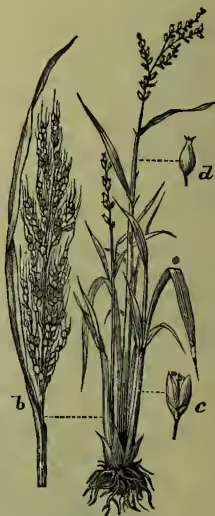
b, a panicle in seed; c, a flower; d, a seed.
The wild rice, plentiful in the marshy tropical countries of southern Asia as well as in northern Australia, is without doubt the plant from which all our forms of cultivated rice have been derived. Most modern authorities regard India as the first home of rice, though some say it was originally derived from China. It has been cultivated in India from time immemorial. At the Calcutta Exhibition of 1884, 4000 apparently distinct forms of Bengal rice were shown, arising from differences of climate and varieties of soil. There are 1400 different specimens of rice in the Calcutta Museum. There are as many as 1300 names of rice, and though very many of these are merely local synonyms, a large number unquestionably correspond to intrinsic and seasonal distinctions. The obvious differences in the grain itself are indeed very remarkable. In colour the specimens range from a bright golden hue through almost every gradation of tint to black; and in regard to size also they vary greatly. But all these forms of rice are referable to a very few well-marked and constant varieties of O. sativa, the result of seminal variation commonly observed in plants that have been long brought under cultivation. The rice exported from India is divided broadly into three qualities—(1) table rice; (2) ballam, named after the boats in which it is carried; and (3) moonghy, common or inferior rice. Cargo rice is that in which only one part in five is husked. In British India there are more than 60 million acres under rice; in Ceylon, 605,000 acres; and in Cochin-China, 2 million acres. It is also extensively grown in Siam, China, Japan, Java, Egypt, and Brazil. In 1890 India exported 34,500,000 cwt.; China, 9,500,000 cwt.; Japan, 4,000,000 cwt. The produce in the United States has fluctuated much. In 1860 it was 187,140,173 lb.; in 1870, 73,635,071; in 1880, 110,131,173. In 1890, 388,912 lb. were exported, and 113,308,571 lb. were imported. After South Carolina the principal rice-growing states are Georgia and Louisiana. Great Britain imports about 6,000,000 tons annually, mainly from Burma; of this half is re-exported.
In China rice is generally sown pretty thickly on very wet land, and afterwards transplanted to the land which it is finally to occupy. The plants tiller or spread at the root very much, so that each sends up several or many stalks. The rice-grounds are carefully kept clear of weeds, although often so wet that a man cannot walk in them without sinking to the knees. In many parts of China and in other warm countries it is common to obtain two crops of rice in a year.
Rice is husked and quickly dried before being brought to market. Special milling machinery is required for removing the inner skin of the rice grain, and a large quantity of the grain is badly broken in the process, being saleable only as broken rice or rice flour. Good Indian rice has the following composition: Moisture, 13.50 per cent.; nitrogenous matter, 7.41; starch, 78.10; fatty or oily matter, 0.40; ash, 0.59. Rice contains a smaller amount of nitrogenous elements than any other grain (wheat having as much as 22 per cent.); it is also deficient in fatty matter, and if taken by itself is less nutritious than other grain-food (see FOOD, Vol. IV. p. 719); but combined with fatty nitrogenous substances it is a valuable food-stuff. It is believed to furnish more food for man than any other grain, especially in Chinese regions; but it is not, as is commonly supposed, the chief food-supply of India, where, save in certain favoured areas, millet is the principal food-stuff. Ground rice is in great demand for puddings; and preparations of rice flour under such names as razine, &c., are familiar. Owing to the small quantity of gluten which it contains, it is capable by itself only of an imperfect fermentation, and is unfit for being baked into bread. It is, however, subjected to fermentation, by help of added fermentations of various kinds, in many countries. The beer made from rice by the Japanese is called Saki, and is in general use among them. Several kinds of Rice wine are made by the Chinese and Japanese, some of them highly esteemed and very intoxicating; spirit is distilled from the lees. Some of the common Arrack (q.v.) of the East is made from rice; and rice is also largely employed by distillers in Britain.
Rice Starch is made in considerable quantity in Britain, and is used in laundries and muslin manufactories. It has one-fourth more starch in its composition than wheat, hence the preference given to it by starch makers, both from its cheapness and larger yield. The straw of rice is used to make straw-plait for bonnets and the straw shoes of Japan. The refuse of rice, which remains when it is cleaned for the market, and consists of the husk, broken grains, and dust, is valuable as food for cattle. It is known as Rice-meal and Ric-dust.
Canada Rice (Zizania aquatica), the Wild Rice or Indian Rice of North America, is a species of grass quite different from the true rice, and of a different genus. It is common in North America, and particularly abundant in the north-western parts, growing in miry places or shallow water, often on the margins of lakes. It has a culm 7 to 8 feet high, with broad diffuse leaves, and a large terminal panicle of male flowers, with a spike of female flowers at the summit. The flowers have six stamens. The seeds are about half an inch long, slender, farinaceous, affording very good meal, and are much used by the Indians where the plant abounds.