Rome, the capital of the modern kingdom of Italy, stands on the Tiber, about 15 miles from its mouth. Roman legend ascribed the foundation of the city to Romulus, at a date corresponding to 753 B.C. But recent explorations have proved that the site was inhabited in the neolithic and early bronze period. The existence of a town with a considerable population at a time long before the date ascribed by tradition to the foundation of the city has been established by the discovery in 1874 of a cemetery on the Esquiline, near the railway station, which contained pottery of the type usually assigned to the 9th or 10th century B.C. In the time of the kings (753-510 B.C.) the city occupied seven hills, whose summits rise from 80 to 120 feet above the river and the intervening valleys. These hills are believed to have been formed by subaerial erosion of beds of soft tufa previously erupted by submarine volcanoes. Of these seven hills five—the Palatine, the Capitoline, the Aventine, the Cælian, and the Esquiline—being more or less isolated, were termed Montes; and two, the Quirinal and Viminal, being mere spurs jutting out from the tableland to the east, were called Colles. The Esquiline, however, is properly rather a Collis than a Mons, being connected with the tableland by a narrow neck. The Palatine and the Capitoline, being the most defensible sites, were doubtless the first to be occupied, and this accords with the Roman legend, which makes the Palatine the site of the primitive city founded by Romulus, the Capitoline being occupied by a rival Sabine
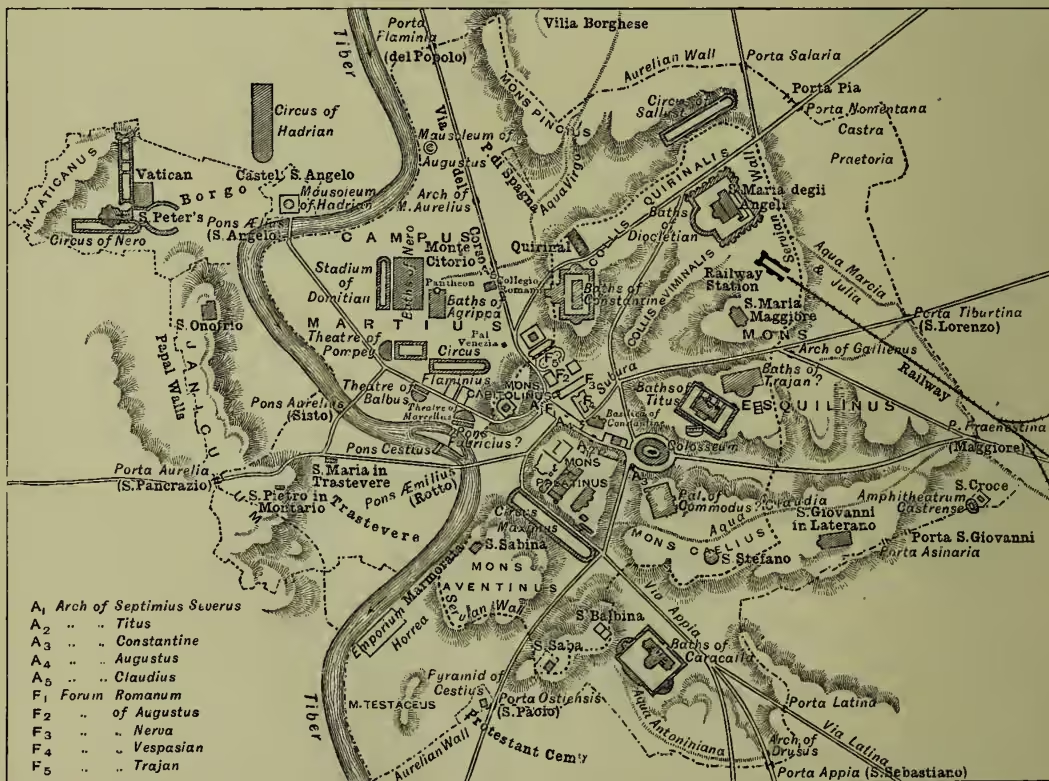
The positions of a few of the more important modern places of interest are also indicated; the ancient names being given in Italic and the modern in Roman letters. settlement which, under Tatius the Sabine king, soon extended to the Quirinal, a contiguous spur of the tableland, separated only by a narrow valley from the Capitoline. We are also told that the Aventine, which after the Palatine and the Capitoline was plainly the most desirable site, was occupied by a colony of Latins in the time of
Ancus Martius, the fourth king. Under Servius Tullius, the sixth king, the Esquiline, together with the Viminal, which is a mere spur of the Esquiline, is said to have been added to the city. These legends conform to the probabilities of the case.
The settlement on the Palatine attributed to Romulus was fortified at a very early period, possibly about the date assigned to the foundation of the city. Remains of this earliest wall have been discovered in the course of recent excavations. The steep slopes were scarped, and a retaining wall, consisting of large stones fitted together without mortar, was built up from the base of the slope, rendering the hill almost impregnable. The Palatine was thus made into a sort of artificial platform, rising some 100 feet above the surrounding valleys, and was called the 'square city' (Roma quadrata). In the time of the later or Etruscan kings at least five of the settlements on the seven hills had been surrounded by separate defences. These fortified hills, with the marshy hollows between them, were then enclosed by a huge rampart or agger of earth, faced with an exterior wall of unmortared masonry, which is still in one place 50 feet in height, with an inner retaining wall of similar construction. Outside the rampart was an enormous fosse, which from recent excavations appears to have been in some places 30 feet in depth and 100 feet in breadth, from which the materials for the agger were obtained. In the construction of this rampart the older walls, which ran along the crests of the Palatine and Capitoline hills, were utilised, as is indicated by the fact that the agger can only be traced where it crossed the intervening valleys, or where it protected the spurs where they joined the tableland. The agger, begun probably by Tarquinius Priscus, has received the name of Servius Tullius, by whom probably the portion which included the Quirinal and the Esquiline was completed. A considerable fragment of this part of the agger may be conveniently examined in the goods yard of the railway station. An excellent cross section is exposed on the northern crest of the Quirinal in the Via di S. Nicola di Tolentino, and a further extension may be traced in the gardens of the Barberini and Colonna palaces. A very perfect fragment may also be seen in the valley below the southern slope of the Aventine.
For 800 years, till the reign of the Emperor Aurelian, the Servian agger formed the only defence of the city. The wall which bears the name of Aurclian is to a great extent identical with the present walls. It enclosed the suburbs which had grown up beyond the Cælian, the Esquiline, and the Quirinal, and included two additional hills, the Pincian, and part of the Janiculum, as well as the low-lying ground near the Tiber called the Campus Martius, which now forms the busiest and most densely populated part of the modern city. The Aurelian Wall, as it is called, was begun by Aurelian in 271 A.D., and completed by the Emperor Probus in 280. It was restored and partially rebuilt by Honorius, and repaired by Belisarius. It is 12 miles in circuit. The Leonine Wall, enclosing the Vatican Hill and the remainder of the Janiculum, was built by Leo IV. in 848. In 1527 some additional space on the Vatican was enclosed, and bastions to strengthen the weak parts of the old wall were added. At the present time populous suburbs have arisen to the east and north beyond the walls, while to the south extensive spaces within the wall are uninhabited. In 1888 no less than 1465 acres, chiefly on the Cælian and the Aventine, were occupied by vineyards, fields, and gardens, while public gardens and squares occupied 106 acres.
To the period of the kings belongs the Cloaca Maxima, a huge arched sewer of Etruscan masonry, which drained the marshy hollow between the Capitoline, Palatine, and Esquiline hills. A portion of this valley became the Forum Romanum, at once the market and the place of political meeting for the Roman, Sabine, and Latin tribes, who occupied the surrounding hills. The Cloaca
Maxima (q.v.), though the oldest and best known of the sewers, is rivalled in magnitude by two other ancient sewers which enter the Tiber nearly at the same point. The so-called Mamertine prison at the foot of the Capitol, now consecrated as the subterranean church of S. Pietro in Carcere, was a deep vaulted well from which, and from the Tiber, the water-supply must have been obtained during the regal period. When Rome was supplied with water by aqueducts from the Alban hills and the Apennines this well, perhaps the most ancient structure in Rome, was converted into a dungeon, in which state-prisoners, among them Jugurtha and the Catiline conspirators, were confined. That St Peter, by whose name the well is known, was ever confined here is a mere legend, of no authority or probability.
In the great aqueducts we have the most notable remains of the Republican period. The oldest was the Aqua Appia, constructed by Appius Claudius Cæcus in 312 B.C., which brought water from springs upwards of seven miles distant from the city. The Anio Vetus, 43 miles long, was commenced in 273 B.C., and brought water from the river Anio. The Aqua Marcia, 62 miles in length, was constructed in 144 B.C., and brought water from the Alban hills at a level sufficiently high to supply the Capitol. The Aqua Julia, the Aqua Claudia, and the Anio Novus, constructions even more gigantic, date from the imperial age. Altogether there were fourteen of these aqueducts, with an aggregate length of 351 miles. These vast structures, striding on their huge arches across the Campagna, and still bringing copious supplies of water from the Apennines and the Alban hills, are among the most striking features of modern Rome. A portion of one of these aqueducts was utilised in the construction of the Aurelian Wall, the arches being simply built up with masonry. The remains of the enormous arches by which the water of the Aqua Claudia was brought across the deep valley between the Cælian and the Palatine also exhibit the vast scale of these erections (see AQUEDUCT).
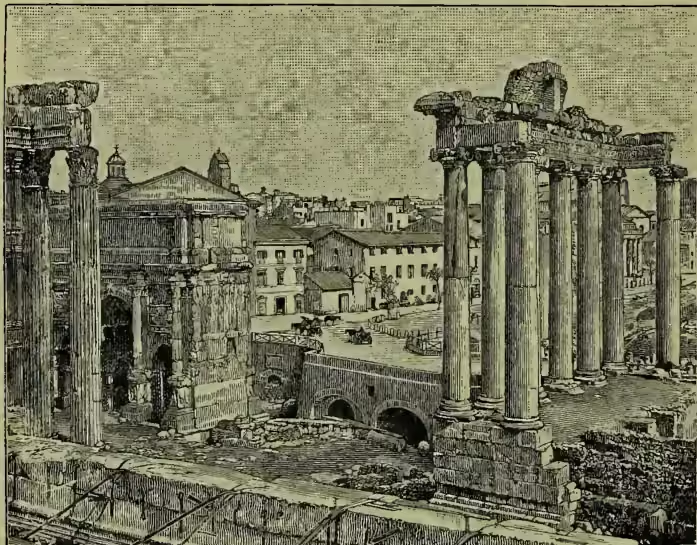
In the time of the Republic the centre of the public life of the city was the Forum Romanum, an oblong space, containing about 2½ acres, surrounded by shops (tabernæ). It was traversed by the Via Sacra, a winding road, along which triumphal processions passed to the Capitol. The great blocks of lava with which this road was paved still, for the most part, remain in situ. The Temple of Vesta and the House of the Vestal Virgins stood on one side of the Forum beneath the Palatine, and on the other side was the Regia, or House of the Pontifex Maximus. Close by were the rostra, the beaks of captured Carthaginian ships, between which was the platform from which orators harangued the people. Farther to the north-east was the Senate House, whose walls are preserved in those of the church of S. Adriano; the neighbouring church of SS. Luca e Martina being constructed out of the offices of the Senate House. Beyond the Senate House stood the Treasury and the Tabularium. In course of time the open space of the Forum became surrounded and occupied with stately public edifices, of which the most conspicuous remains are the eight columns of the Temple of Saturn, built in 491 B.C., the Colonnade of the Twelve Great Gods (deorum consentium), the Temples of Concord, of Castor and Pollux, built in 496 B.C., of Vesta, of Julius Cæsar, of Vespasian, and of Faustina. We see also the foundations of the Triumphal Arch of Augustus, the vast ruins of the Basilica Julia, the base of the column of Phocas, and the milestone from which all Roman roads were measured. To the north of the Forum stands the Triumphal Arch of Septimius Severus, to the south the Arch of Titus (see ARCH). So much of the open space of the Forum became occupied by great public monuments and edifices that in the time of the emperors additional fora were required. These were erected on the eastern side of the Forum Romanum. Of the Forum Julium only three arches of the outer wall remain. Of the Forum of Augustus a portion of the enclosing wall, a massive archway, and three columns of the Temple of Mars Ultor, which stood within the Forum, now cleared of rubbish, are among the most imposing and accessible remains of the architecture of the early empire. Of the Forum of Nerva two columns may be seen in the Via della Croce
Stadium the most perfect in existence, imperial reception-halls, several temples, with gardens, baths, barracks for soldiers, and a basilica or hall of justice, in which St Paul must have pleaded before the emperor. The Golden House of Nero, built on the opposite side of the Forum, and occupying the greater portion of the Oppian Hill, was demolished to make room for the Colosseum and the Baths of Titus, so that practically nothing is left save some substructures, the cisterns known as the Sette Sale, and the base of the colossal statue of Nero, which stood in front of the Golden House.
Of the numerous temples in Rome, of which there are said to have been three hundred, the names, and in many cases the sites, of 153 are known. The foundations of the great Temple of Jupiter Capitolinus may be traced in the gardens of the Caffarelli Palace, now the German embassy. Of the temples which remain the preservation is due in several cases to their having been converted into churches. The columns in front of the church of S. Lorenzo in Miranda, which faces the Forum, formed part of the Temple of Antoninus and Faustina. Ten columns of the Temple of Ceres are built into the walls of S. Maria in Cosmedin. S. Maria del Sole is a round temple formerly called the Temple of Vesta, but now believed to be the Temple of Hercules Victor. Another temple, supposed to be the Temple of Fortuna Virilis, is now the church of S. Maria Egiziaca. The church of SS. Cosmo e Daniano is the Temple of Sacra Urbs, erected by the Emperor Maxentius. The cella of the
Bianca. Of the Forum Pacis, built by Vespasian, nothing remains except one massive fragment of a wall. The most magnificent of the imperial fora was the Forum of Trajan, which was reckoned one of the wonders of the world. Within its walls stood the Basilica Ulpia, which has been partly excavated, so as to expose the bases of many of the columns.
Beyond it stands the great Column of Trajan, 124 feet in height, with spiral bas-reliefs representing scenes from Trajan's campaigns against the Dacians, forming the most instructive historical monument in Rome. We are shown the march of a Roman army, the construction of bridges, assaults on forts, and all the varied incidents of a campaign, constituting a pictorial record containing some 2500 figures of men and horses, which may compare with the Bayeux tapestry, or the pictorial narratives of Egyptian campaigns which are represented on the walls of Theban temples. In the same style, but of inferior art, is the Column of Marcus Aurelius in the Piazza Colonna on the Corso, usually called the Antonine Column. It bears reliefs representing scenes in the wars with the Marcomanni.
On the western side of the Forum Romanum rises the Palatine Hill, its summit covered with the substructures of the Palaces of the Emperors, the Houses of Augustus, of Tiberius, of Livia, of Caligula, of Domitian, and of Hadrian. Most magnificent of all is the Septizonium or Palace of Septimius Severus, rising in seven stages of massive masonry, which form a southern extension of the Palatine Hill. Besides these imperial palaces, the Palatine included a magnificent
Temple of Venus and Rome, built by Hadrian, is preserved in the church of S. Francesca Romana. It is believed that the church of SS. Sergio e Bacco was the Temple of Concord, that the church of S. Stefano Rotondo was the Temple of Mater Matuta, and that of S. Nicola was the Temple of Piety; while Santa Maria sopra Minerva stands on the ruins of a Temple of Minerva, S. Maria Liberatrice probably occupies the site of a Temple of Vesta, and the round church of S. Teodoro was a temple of unknown attribution. In 27 B.C. Agrippa built a vast dome in front of the Thermæ which he erected in the Campus Martius. It is called by Pliny and other writers the Pantheon, and may have served as a sort of entrance-hall to the Thermæ. In 608 it was consecrated as the church of S. Maria ad Martyres, and now goes by the name of S. Maria Rotonda. Of all the buildings of ancient Rome none is more perfectly preserved. The diameter of the dome, which is lighted only by a central aperture in the roof, is larger than the dome of St Peter's; the walls, 19 feet in thickness, have deep niches which were filled with statues of deities; and the floor is of Phrygian and Numidian marbles, with porphyry and granite slabs.
The Thermæ of Agrippa, of which the Pantheon is the only portion that remains, were the earliest of the eleven great public baths which formed so characteristic a feature of imperial Rome. The Thermæ of Trajan, and the adjacent Thermæ of Titus, built on the site of the Golden House of Nero, occupied almost the whole of the Oppian Hill; but of these baths little is left save the foundations. On the slope of the Quirinal stood the Thermæ of Constantine. In the Piazza del
Quirinale stand two colossal horses from the thermæ which occupied the site. In the formation of the steps which lead down from the piazza, and of the Via Nazionale, substructures belonging to these thermæ were discovered, and portions of their massive walls may be seen in the gardens of the Colonna and Rospigliosi palaces. At the other end of Rome, on the low ground south of the Cælian, are the ruins of the Thermæ Antoninianæ, usually called the Baths of Caracalla, by whom they were begun in 212 A.D., and completed by Alexander Severus. They were built to accommodate 1600 bathers, and, after serving for centuries as a quarry, are still the vastest, and in their desolation perhaps the most impressive, of all the ruins in Rome. The lofty walls are still standing, and, as the halls have been cleared of rubbish, the arrangements of Roman thermæ (see BATHS) can here best be studied. We see the Calidarium, the Tepidarium, and a Frigidarium, with an Exedra and a Stadium or racecourse. The outer wall encloses a space of nearly 27 acres, of which the baths themselves occupy more than 6 acres. Even more magnificent were the Thermæ of Diocletian, on the summit of the Quirinal, designed to accommodate 3600 bathers. The semicircular curve which forms such a conspicuous feature in the Piazza delle Terme was the exedra of these baths. One of the smaller circular halls forms the church of S. Bernardo, while a portion of one of the great vaulted central halls, with its columns of Egyptian granite, serving probably as the Tepidarium, was converted by Michael Angelo into the magnificent church of S. Maria degli Angeli. Another hall is used as a prison, another as a fencing-school, others now serve as barracks, stables, coach-houses, and warehouses for timber, while the cloisters of a Carthusian convent built out of the ruins are now converted into a museum.
A large marshy plain, which now forms the most densely populated part of Rome, lay outside the Servian Walls, extending from the foot of the Capitoline and Quirinal hills to the Tiber. This, being used for military exercises, was called the Campus Martius. Towards the close of the republican era this suburban plain began to be utilised for the erection of places of public recreation, such as baths, theatres, and racecourses. These were connected by the Porticoes, a network of colonnades forming covered walks, serving as a protection alike from the sunshine and the rain, along which the citizens could stroll to the various places of recreation and amusement. The Campus Martius was traversed by the Flaminian Way, approximately represented by the modern street called the Corso, which was bordered on either side by the stately tombs of Roman nobles, and spanned by the triumphal arch of Claudius and by that of Marcus Anrelins, demolished in 1662. On these fields were built the Baths of Agrippa and the Baths of Nero. Here was erected the Theatre of Balbus and the vast Theatre of Pompey, said to have contained seats for 40,000 spectators. Some of its substructures may be seen behind the church of S. Andrea della Valle. Somewhat nearer to the Capitol was the Theatre of Marcellus, of which a considerable portion still stands, forming one of the most characteristic examples of Roman architecture of the best period. This theatre was begun by Julius Cæsar, and finished in the year 11 B.C. by Augustus, who named it after his nephew Marcellus, the son of Octavia. In the 11th century, like the Colosseum and the Mausoleum of Hadrian, it was turned into a fortress by the turbulent Roman nobles of the Orsini family. The interior is now occupied by the Palazzo Orsini-Savelli, while the outer arches are used as rag-shops and smithies.
In the same characteristic Roman style as the Theatre of Marcellus, but of a more debased type, is the great Flavian Amphitheatre, built for gladiatorial exhibitions and for the combats of wild beasts, which goes by the name of the Colosseum. Commenced by Vespasian, it was dedicated by Titus 80 A.D., and finished by Domitian. It is built in the form of an ellipse, the longer diameter measuring 613 feet and the shorter 510 feet. It rises to a height of 160 feet, covering five acres of ground. In the middle ages it was used as a fortress and afterwards as a quarry; but, though so large a portion has been demolished, it constitutes perhaps the most imposing monument of Roman magnificence which is left (see AMPHITHEATRE). The earlier amphitheatres were mostly of wood, and have perished. The Piazza di Monte Citorio on the Corso is believed to occupy the site of the Amphitheatre of Statilius Taurus, erected in 31 B.C., the foundations having been found 88 feet below the present surface of the street. At the side of the church of S. Croce in Gerusalemme are considerable remains of the Amphitheatrum Castrense, which was utilised in the construction of the Aurelian Wall, from which it projects, forming a sort of semicircular bastion. Below was the Circus of Elagabalus, from which came the Egyptian obelisk now in the Pincian Gardens.
The oldest circus was the Circus Maximus, in the valley between the Palatine and the Aventine. It is supposed to date from the regal period, but was enlarged by Julius Cæsar. It was about three furlongs in length and one in breadth, nearly the size and shape of Eaton Square, and is said to have been capable of seating 250,000 spectators. The site is now occupied by the Jewish cemetery and the gas-works. The arrangements of a Roman circus can best be studied in the well-preserved circus on the Appian Way, near the tomb of Cæcilia Metella, built in 311 A.D., which usually bears the name of the Emperor Maxentius, but is more correctly assigned to his son Romulus. It is 350 yards long and 86 broad. The metæ, the spina, the carceres, and the seats for the emperor and the spectators may still be traced. An Egyptian obelisk from this circus now adorns the Piazza Navona (see CIRCUS).
Of the Circus of Flaminius, built in 220 B.C. on the Campus Martius immediately below the northern slope of the Capitoline Hill, no vestiges remain. The same is the case with the Circus of Nero on the Vatican, which occupied the hollow between S. Peter's Church and the Sacristy through which the visitor now drives to the Vatican Museum. While the circus was designed for chariot-races, the stadium was used for foot-races. Of these there were several, but the Imperial Stadium on the Palatine, between the house of Augustus and the buildings of Septimius Severus is the only one which remains in a tolerable state of preservation. The Stadium of Domitian on the Campus Martius is believed to be represented by the present Piazza Navona, recently renamed the Circo Agonale. Both of these stadia are about the size and shape of St George's Square, Pimlico, or the site of the Houses of Parliament.
The roads leading out of Rome beyond the Servian Walls were bordered by tombs, many of which, on the erection of the Aurelian Wall, were included within the city. On the Appian Way (q.v.) are the tombs of the Scipios, the inscriptions on which, forming the earliest contemporary records of Roman history, are among the treasures of the Vatican. Farther on four ancient columbaria have been excavated. Outside the Aurelian Wall is the Tomb of Cæcilia Metella (see ROMAN ARCHITECTURE), wife of the triumvir Crassus, which in the 13th century was converted into a fortress by the Gaetani family. It is a cylindrical block of masonry, 65 feet in diameter, resembling the keep of a feudal castle. Another remarkable tomb is the Pyramid of Caius Cestius in the Via Ostiensis. The most magnificent of Roman tombs was the Mausoleum of Hadrian, now the castle of S. Angelo. It was a cylindrical tower of masonry, 240 feet in diameter and 165 feet in height, surmounted by a colossal statue of the emperor. When the Goths besieged Rome the tomb was converted into a fortress by Belisarius. It afterwards became the castle of the popes, and citadel of Rome, and in 1527 was defended against the French by Beuvenuto Cellini. Of similar construction and hardly inferior in magnitude was the Mausoleum of Augustus, which stood behind the great church of S. Carlo al Corso. In the middle ages it formed the castle of the Colonna family, and is now occupied as the Teatro Corea. Two obelisks of Egyptian granite faced the entrance, one of which now stands in the Piazza of S. Maria Maggiore, and the other fronts the Palace of the Quirinal. In all there are eleven Egyptian obelisks which ornament the gardens and piazzas of Rome. Two stand near the Pantheon close to the sites of the Temples of Isis and Serapis, before which they were originally erected. Another, now in the Piazza del Popolo, was brought from Heliopolis by Augustus, and placed in the Circus Maximus. That in the Piazza di Monte Citorio was also brought to Rome by Augustus. That in the Piazza of S. John Lateran, 104 feet in height, is the largest in existence. It was erected at Thebes by Thothmes III., and removed by Constantine to the Circus Maximus. The obelisk in the Piazza di S. Pietro was brought from Heliopolis by Caligula, and placed in the Circus of Nero, near its present site. On the Pincian is an obelisk of Hadrian; and there is another in the gardens of the Villa Mattei.
Of the triumphal arches those of Augustus, Tiberius, Claudius, Marcus Aurelius, and Trajan have disappeared. The Arch of Septimius Severus, which spanned the Sacred Way just as it began to climb the Capitol, remains in a fair state of preservation. At the other end of the Forum, also spanning the Sacred Way, is the Arch of Titus, with the well-known reliefs representing the spoils from the Temple at Jerusalem (see ARCH). A little farther south, where the Sacred Way joins the Appian Road, stands the Arch of Constantine, fronting the Colosseum and the three huge arches of the Constantine Basilica. The so-called Arch of Drusus crosses the Appian Way where it passes through the Aurelian Wall. The Arch of Dolabella, built in 10 A.D., is almost hidden in the brickwork of the Aqueduct of Nero, called the Aqua Claudia; and the Arch of Gallienus on the Esquiline, erected in 262 A.D., is in the degraded style of the time (see ARCHES).
Of the twelve bridges over the Tiber three are survivals of the eight or nine ancient bridges. The oldest is the Pons Fabricius, built in 62 B.C. by L. Fabricius, leading from the city to the island in the Tiber. The Pons Cestius, believed to have been built by the Emperor Gratian, leads from the island to the right bank of the river. The Pons Ælius, now called the Ponte S. Angelo, was built by Hadrian in 135 A.D. in front of his Mausoleum, and now serves as the approach to St Peter's and the Vatican. The Ponte Rotto, or 'broken bridge,' was part of the Pons Æmius, built in 181 B.C. Two picturesque arches remained till the recent 'improvements.' It is now replaced by a suspension bridge. The Ponte Sisto was built by Pope Sixtus IV. to replace the Pons Æmius.
Modern Rome.—It is impossible within moderate limits to give an adequate account of Rome, which contains more objects of interest than any other city in the world. A bare enumeration of facts must therefore suffice. The Observatory in the Collegio Romano is situated in N. lat. and E. long. The population was 226,022 in 1870; 272,560 in 1876; 300,467 in 1881; 401,044 in 1888; and 512,423 in 1899. The walls, which enclose 3880 acres, are 14 miles in circuit, with fifteen gates, two of which are closed. Since 1870 more than 3000 new houses have been built, 82 miles of new streets have been formed, and millions sterling have been spent by the municipality on the improvement of the city. During the progress of these improvements 1824 inscriptions, 2360 lamps, 191 marble statues, 266 busts, and 36,679 coins have been found. There are twelve bridges, five of which are old, and the rest comparatively new. The chief gates are the Porta del Popolo and the Porta Pia on the north, the Porta S. Lorenzo and the Porta Maggiore on the east, the Porta S. Sebastiano and the Porta S. Paolo on the south. Old Rome stands on the left bank of the Tiber; on the right bank, occupying the Vatican and Janiculum hills and the low ground between these hills and the river, are St Peter's, the Vatican Palace, the Borgo, and the Trastevere. The business part of the city occupies the plain on the left bank between the hills and the river, traversed by the Corso, the principal thoroughfare of Rome, about a mile in length, leading from the Porta del Popolo to the foot of the Capitoline Hill. From the Piazza del Popolo two great streets diverge on either side of the Corso, the Via di Ripetta to the right, skirting the Tiber, and to the left the Via del Babuino, leading to the Piazza di Spagna, whence the Scala di Spagna, the resort of artists' models, ascends to the Pincian Gardens, on the site of the gardens of Lucullus, which command a splendid view of the city, and form the fashionable drive and promenade of the Romans.
Before Rome became in 1870 the capital of Italy, the greater part of the Pincian, Quirinal, and Esquiline hills was occupied by villas of the Roman nobles, with extensive gardens planted with ilexes and vines. With two exceptions these have been destroyed, and their sites have been covered with modern houses, and too often by blocks of ugly barrack-like buildings, many stories in height, let out in tenements. The dirty but picturesque mediæval city is assuming the aspect of a modern capital, broad, straight thoroughfares having been driven through quarters formerly occupied by narrow streets and mean, crowded houses. Of the new streets the most important are the Via Venti Settembre, from the Porta Pia to the Quirinal, and the Via Cavour and the Via Nazionale, which lead from the railway station, the first to the Forum, and the second to the lower end of the Corso. This is continued to the west by the Corso Vittorio Emanuele as far as the Borgo, crossing the Tiber by a new bridge. The older foreign quarter lay at the foot of the Pincian, around the Piazza di Spagna, but the healthier sites on the slopes and summits of the Quirinal and Esquiline are now more frequented.
Of the palaces the largest are the Vatican, the residence of the pope, and the Quirinal, now the residence of the king, but formerly a papal palace, in which the conclaves were held for the election of the popes. Many of the palaces of the Roman nobles contain collections of pictures and statuary. Chief among them are the Palazzo Borghese, containing, next to the Vatican, the best collection of pictures in Rome, the Palazzi Colonna, Doria, Barberini, Rospigliosi, Chigi, Torlonia, Farnese, Corsini, and di Venezia, now the Austrian embassy. Among the notable villas are the Villa Borghese, standing in a great park below the
Pincian; the Villa Ludovisi, on the Pincian; the Villa Albani, outside the Porta Salara; and the Villa Medici, on the Pincian, now the Académie Française, with a splendid collection of casts. The gardens of the Villa Mattei, on the Cælian, command one of the best views in Rome. The picturesque arches of the Aqua Claudia traverse the gardens of the Villa Wolkonsky.
Besides the private collections Rome abounds in libraries and museums. The Collegio Romano, formerly a great Jesuit college, is now occupied by a public library of modern books called the Biblioteca Vittorio Emmanuele, by the Kircherian Museum of Antiquities, and by a well-arranged prehistoric and ethnological museum. The Palazzo dei Conservatori, on the Capitol, contains many of the best ancient statues. In the cloisters of the Carthusian convent in the Thermæ of Diocletian are stored the antiquities brought to light during the recent excavations. Others from the excavations at Falerii are collected in the Villa di Papa Giulio, outside the Porta del Popolo. The Villa Medici contains a good collection of casts from ancient statues. The Lateran Palace contains an unrivalled collection of inscriptions and sculptures from the Catacombs, and a few good statues and mosaics. The Lateran is extraterritorial, and the Museum is the property of the popes.
The chief papal collections are contained in the galleries attached to the Vatican, probably the largest palace in the world. In addition to the private gardens and apartments of the pope, the Vatican Palace comprises immense reception-halls with a series of chapels, libraries, picture-galleries, and vast museums of sculptures, antiquities, and inscriptions, which can here be only enumerated in the briefest manner. The Sistine Chapel, built in 1473 by Sixtus IV., is covered with magnificent frescoes by Michael Angelo and the great Florentine masters. The Capella Nicolina, built by Nicolas V., and the Pauline Chapel, built by Paul III. in 1590, are also painted in fresco; the first by Fra Angelico, and the second by Michael Angelo. Raphael's Stanze and Loggie are halls and solaris covered with inimitable frescoes executed by Raphael, Perugino, Giulio Romano, and other masters of their school. Beyond the Loggie is the picture-gallery, containing the best collection of oil-paintings in Rome. The world-famous Vatican Library, with its priceless MSS., its collections of early printed books, of Christian antiquities, ancient maps and jewellery, is contained in two immense halls. The vast sculpture-galleries, with their unrivalled collections, comprise the Museo Chiaramonte, the Braccio Nuovo, and the Museo Pio-Clemente, which includes the Cortile di Belvedere, containing the Laocoön, the Apollo Belvedere, and the so-called Antinous, perhaps the most beautiful statue in the world. The inscriptions are contained in the Galleria Lapidaria, the Etruscan antiquities in the Museo Gregoriano, below which is the Egyptian Museum.
The churches, said to be upwards of 300 in number, are among the most conspicuous features of modern Rome. Many of them are rather what we should call mortuary or memorial churches, opened only once a year on the festival of the saint to whom they are dedicated. There are also the churches of the great religious orders, twenty-eight parish churches, and the titular churches of the cardinals. The most noteworthy are the five patriarchal churches, the seven pilgrimage churches, and the eight basilican churches. Others are interesting either from their early date, their historical associations, from the archaeological or artistic treasures they contain, or from the fragments of earlier structures which they enclose.
First in rank are the five patriarchal churches. S. Giovanni in Laterano (see LATERAN), between the Cælian and the Esquiline hills, ranks as the first church in Christendom. It dates from the time of Constantine. It was, till the rebuilding of S. Peter's, the metropolitan cathedral of Rome and of the western patriarchate. It retains its 5th-century baptistery and the 13th-century cloisters, the most beautiful in Rome. The Santa Scala, brought by the Empress Helena from Jerusalem, has for centuries been the chief object of veneration among pilgrims. The church itself was burned down and rebuilt in the 14th century, and has been repeatedly altered and modernised. The adjoining palace of the popes is now converted into a museum, chiefly of Christian antiquities. The Basilica of St Peter (S. Pietro in Vaticano), the largest church in the world, was rebuilt in the 16th century from the designs of Bramante, Michael Angelo, and Bernini. It was begun in 1506, and consecrated in 1626. It is in the form of a Latin cross, with a vast central dome. The interior length is 615 feet, the height of the nave 150 feet, and of the cross which surmounts the dome 435 feet. S. Paolo fuori le Mura, a vast 4th-century church, was before the fire of 1823 the most interesting church in Rome. It has been rebuilt in a style of great magnificence. S. Lorenzo fuori le Mura, occupying the site of a church founded by Constantine, was rebuilt in 578, and remodelled in the 13th century, but still retains the ancient marble and granite columns. The Basilica Liberiana, on the Esquiline, is commonly called S. Maria Maggiore, being the largest of the eighty churches in Rome dedicated to the Virgin Mary. It is one of the oldest churches in Rome, the nave dating from the 5th century.
These five patriarchal churches, together with S. Croce and S. Sebastiano, constitute the seven ancient pilgrimage churches. The five patriarchal churches, together with S. Agnese, S. Croce, and S. Clemente, are the eight basilican churches. S. Agnese fuori le Mura was founded by Constantine, and rebuilt in the 7th century. It contains many early Christian inscriptions. S. Croce is a 5th-century basilica, and is said to have been erected by the Empress Helena. S. Clemente is the most archaic church in Rome. The upper church dates from the 12th century; the lower, which is entirely underground, from the 4th; and below it there are far older substructions dating from the imperial and republican periods. In addition to the eight basilican churches, others already mentioned conserve the remains of earlier buildings. S. Maria in Cosmedin, one of the most interesting churches in Rome, preserves ten columns of the Temple of Ceres, out of which it was constructed, and twenty ancient columns taken from other buildings. It has also a beautiful tessellated pavement of ancient marbles. S. Maria degli Angeli and S. Bernardo were constructed out of the Thermæ of Diocletian, and S. Pietro in Carcere out of the Mamertine prison. S. Giorgio in Velabro, a 4th-century church, was rebuilt in the 7th century, but preserves sixteen of the ancient columns. S. Costanza, outside the Porta Pia, was erected by Constantine, and contains interesting 4th-century mosaics. The granite columns in S. Maria in Araceli, on the Capitol, have been taken from some earlier building. On the Cælian we have SS. Giovanni e Paolo, founded in the 5th century and rebuilt in the 12th; S. Stefano Rotondo, a 5th-century church, containing the episcopal throne of Gregory the Great; and the interesting church of S. Gregorio, built in 575 on the site of his father's house. On the Aventine are S. Balbina and S. Sabina, both of the 5th century. On the Esquiline are S. Pudenziana, a very ancient church, with 4th-century mosaics, probably constructed out of a private house; S. Prassede, a 9th-century church, with ancient granite columns and 9th-century mosaics; and S. Pietro in Vincoli, a 5th-century basilica, with twenty ancient Doric columns, and containing Michael Angelo's statue of Moses, and the supposed chains of St Peter, which were undoubtedly presented by Pope Leo I. to the Empress Eudoxia in 442. On the right bank of the Tiber are S. Crisogono, a 12th-century church, with ancient porphyry columns and a fine mosaic pavement; S. Maria in Trastevere, a 5th-century church, rebuilt in the 12th century, with twenty-two ancient columns, some fine mosaics, a splendid marble pavement, with numerous interesting early inscriptions in the portico; S. Cecilia has 9th-century mosaics; while the Piazza of S. Pietro in Montorio commands the finest view of Rome. S. Maria sopra Minerva, near the Pantheon, the chief Dominican church, is the only Gothic church in Rome. Among the vast modern churches are the Gesù, the gorgeous church of the Jesuits, containing the tomb of S. Ignatius Loyola; S. Carlo al Corso, now the fashionable church of Rome; S. Andrea della Valle; SS. Apostoli; S. Maria Vallicella, commonly called Chiesa Nuova; and the Cappuccini, with its catacombs and Guido's picture of St Michael.
One of the greatest improvements which has been effected is the embankment of the Tiber, and the straightening and deepening of its channel. This has put a stop to the disastrous floods by which the lower parts of the city were formerly inundated. But the municipality being now practically bankrupt, the grandiose schemes for the further reconstruction of the city, and for making Rome a port by the canalisation of the Tiber, are for the present suspended.
In addition to the objects of interest which have been briefly enumerated are the vast Catacombs (q.v.) extending underground for many miles, the Ghetto, the Sapienza, the Propaganda, and the Protestant cemetery with the tombs of Keats and Shelley. The best panoramic views of Rome are from the Pincio, the Villa Mattei, S. Pietro in Montorio, the Janiculum, the garden of the Priorato di Malta, and from outside the Porta S. Giovanni. Rome is now a fairly healthy city, except in the late summer months; the water-supply is unrivalled both for quality and quantity, and the streets are well cleansed. No city excels Rome in its public fountains.
There are practically no manufactures in Rome. Hats, gloves, neckties, false pearls, and trinkets are made, and there are cabinet-makers, and a few foundries on a small scale, but compared with other great cities the absence of factory chimneys is very notable. There are printing-offices, but the Italian book-trade is centred at Milan. The chief industry is the manufacture of small mosaics, small bronzes, of statuary, casts, and pictures, either original or copies of the works of the great masters.
All the necessaries of life have to be imported from a distance, the Campagna which extends for many miles around Rome being uninhabitable on account of the malaria. It is an unenclosed and untilled waste, roamed over by herds of half-wild cattle. Corn and wine are brought from Tuscany, and from the fertile Terra di Lavoro near Naples. The prosperity of the city depends on the expenditure of the courts of the Quirinal and the Vatican, of the army of functionaries in the public offices, of the garrison, and of the foreign visitors who crowd the hotels during the winter months. The railways from all parts of Italy converge outside the city, which they enter near the Porta Maggiore on the Esquiline, and have a common terminus on the summit of the Quirinal close to the Baths of Diocletian. The omnibus service is good, and well-managed tramways traverse several of the broad new streets.
See R. Burn, Rome and the Campagna (1870); J. H. Parker, Archæology of Rome (1872-80); T. H. Dyer, City of Rome, its Vicissitudes and Monuments (2d ed. 1883); F. Wey, Rome (trans. from Fr., new ed. 1886); R. Lanciani, Ancient Rome in the Light of Recent Discoveries (1888); with other works by Gell, Nibby, Hare, Professor Middleton, &c., and those cited on p. 794.
ROMAN HISTORY.—Rome, the 'Mistress of the World,' the 'Eternal City,' gives name to a political empire which lasted eleven centuries, till its transfer to Byzantium, where it lasted eleven centuries more; also to a religious empire which since 42 A.D. has acquired spiritual sway over a yet larger domain than its pagan predecessor, and which, in accord with imperial Germany, formed the twin-factor of the Holy Roman Empire, dissolved in 1806.
Colonised in the bronze age by Alban shepherds who migrated from their hills in fear of volcanic disturbance, Rome, according to her officially adopted legend, dates from 21st April 753 B.C., when Romulus, first of her seven kings, settled on the Palatine mount. From his quadrilateral stronghold—Roma quadrata—he made conquest of the Capitoline and Quirinal. After his successor Numa, the Cælian was annexed by Tullus Hostilius and the Aventine by Ancus Marcius. To the hills, now five under Tarquinius Priscus the fifth king, were added the Esquiline and Viminal by Servius Tullius, who walled in the seven with a stone fortification. So that under her seventh and last king, Tarquinius Superbus, the City of the Seven Hills was already 'built for empire,' on marshy soil made habitable by drainage, and connecting with the seaboard by the Tiber—a waterway so clearly the 'outlet of her supremacy' as to warrant the derivation of 'Rome' and 'Romulus' from the Rumon or river.
Latin in population, with a Sabine infusion, Rome was divided into three tribes—the Ramnes, the Tities, and the Luceres, and again into thirty curiæ. The tribal division disappeared early; that into curiæ lasted well into republican times. Out of the curiæ, originating in common religious observances, grew the populus Romanus, including all freeborn Romans. Its king (rex) was not always hereditary either in his regal or his religious capacity, nor merely elective. When a king died, his successor was chosen by the heads (patres) of families (gentes). These patres—the guardians of religious observance, of popular right, of state interests—had power to choose a provisional king (inter-rex), who, with the patres for assessors, decided on the new king, who was then proposed to the curiæ in assembly (comitia curiata) and, if approved, confirmed by the patres. The king had now absolute authority, civil, religious, and military. The patres were his councillors—the senate—having the above indicated powers, always subject to the king, who consulted them at pleasure, and filled up vacancies. In solemn assembly the Romans met in the Forum under the king or inter-rex, who put questions to the vote, when each curia voted in turn, its vote being determined by the majority within itself, and the preponderance of these votes deciding the result.
Romulus, Numa, Tullus Hostilius, and Ancus Marcius—the first and third Latin, the second and fourth Sabine—are little more than legendary names; the warrior chief Romulus typified by his Roma quadrata and Comitium or place of assembly in the Forum; the priestly Numa by his Temple of Vesta and his Regia close to it; the statesman
Tullus Hostilius by his Senate House (Curia Hostilia); and the administrator Ancus Marcius by his state-prison, his bridge across the Tiber, his fortification of the Janiculum, and his founding of the seaport Ostia. In Tarquinius Priscus (616–578 B.C.) we have an Etruscan and less shadowy Romulus, admitting into the senate a hundred new patres from conquered Latin states, and laying out the Circus Maximus for the entertainment of the people. Servius Tullus, on Tarquin's initiative, distributed all freeholders (for military purposes primarily) into tribes, classes, and centuries. Drawn up in order of battle, the centuries (bodies of one hundred) in front were composed of the wealthier citizens as better able to equip themselves for attack; behind them came the centuries of the second and third classes, poorer and less fully appointed—the three forming the heavy-armed infantry; while centuries of the fourth and fifth classes, poorer still and correspondingly equipped, held the rear. The full strength of the freeholders was divided into two equal parts—the seniores and the juniores, the latter engaged in active duty, the former as reserves. Each corps consisted of 85 centuries or 8500 men—i.e. of two legions, each about 4200 strong, auxiliary to which were the sappers and trumpeters. Finally, the six centuries of cavalry were supplemented, from the wealthiest citizens, by twelve more. For the army thus organised Servius drew levies from his four regions, corresponding to his four tribes, the Suburan, the Palatine, the Esquiline, and the Colline. These tribes included freeholders outside the gates, also entitled to meet and vote with the centuries at their comitia (comitia centuriata). Under her seventh and last king Rome became formidable throughout Central Italy, and owed to him the Temple of Jupiter Capitolinus, and the Cloaca Maxima—the drainage system tapping the hills around the Forum and carrying the waste into the Tiber. But Tarquin's rule was so masterful as to drive the people to revolt, the last provocation being his son's outrage on the noble Lucretia. When engaged at a siege near the coast he was dethroned; he and his race were exiled in perpetuity, and regal government replaced by the Republic. Three great efforts to reinstate him were defeated, and he died at Cumæ.
The Republic.—The regal check on them withdrawn, the patricians made their power so felt by the plebeians as to start a conflict between them lasting two hundred years. The king was now represented by two consuls, elected annually, and from the patrician order. The plebeians, freeborn citizens as they were, retained their votes by classes at the comitia curiata and by centuries at the centuriata, but many of them were attached as clients to patricians who commanded their votes, and all of them were excluded from the higher offices of state. Unable to elect one of themselves consul, the plebeians had not even the power to carry the patrician candidate they favoured, being in a minority in the comitia centuriata, and, again, in a greater minority in the ultimate and decisive assembly, the comitia curiata. The absolute authority wielded by the consuls they felt to be still more oppressive when, in state crises, it was merged in a dictator; so their first attempt to safeguard their liberties and lives was directed at the consular power. The first advantage they gained was the 'right of appeal,' by which no magistrate (the dictator excepted) could subject a Roman citizen to capital punishment unless with approval of the comitia centuriata. Power to extort such rights the plebeians possessed in their military capacity, refusing, as soldiers, to serve unless their demands were conceded. The secession of their legionaries to the Mons Sacer, on the
Anio three miles off, secured them annually elected magistrates of their own, tribuni plebis, with power to protect them against the consuls. From two the tribunes were increased to five, and by 449 B.C. to ten. In no sense a magistrate, the tribune was a check on authority, and his power developed gradually till the tribunate, formidable at the close of the Republic, became still more so under the empire. By the Publilian law (471 B.C.) the assemblies convened by the tribune (concilia plebis) were made legal; not yet their decisions (plebiscita). At these the voting was by tribes, not by curiæ or centuries, whence the object of the tribunes was to add as many to the tribes as possible. To become member of a tribe it was necessary to be a freeholder, and so the tribunes, to multiply freeholders, agitated to secure for the plebeians their share of the agri publici or state-lands. Having partially succeeded in this, they won another advantage from the ever-resisting patricians—the appointment for one year of a commission of ten patricians (decemviri) to make public a code of law binding on patrician equally with plebeian. This code—the famous Twelve Tables—substituted written and published law for that unwritten code which, confined to the patrician few, was always interpreted in their interests. An attempt to reappoint, possibly to perpetuate, the decemvirate caused another secession; the consuls were again created; and from the growing vantage-ground of their concilia, increased by accessions to the plebeian order from without, the tribunes extorted the recognition of the plebiscita as legally binding on patricians. The concilia, now become comitia tributa, could henceforth carry reforms which, if sanctioned by the patres, had the validity of state-law. Another concession gained was intermarriage between plebeian and patrician, and thereafter the consulate—still the patrician stronghold—was attacked. The two consuls were replaced by six military tribunes drawn from either order. Of these consular tribunes the plebeians generally had the majority until, obstacles and delays notwithstanding, the Licinian and Sextian laws were passed (367) replacing the consular tribunes by consuls, two in number, of whom one at least should be a plebeian; enlarging the priestly college from two to ten functionaries, of whom plebeians were to constitute half; relieving the poorer plebeians from debt; and promoting their interests by advantageous reforms in the ownership and cultivation of land. Patrician monopolies shrunk rapidly. In 356 the dictatorship, in 350 the censorship, in 337 the pratorship, and in 300 the colleges of pontiffs and augurs were thrown open to plebeians. The patrum auctoritas, or control by patricians of the decrees (plebiscita) of the people in assembly, became a dead letter; and the two hundred years' conflict issued in the recognised validity of all measures carried in the comitia tributa—a conflict memorable not only for the ability displayed by either order, but for the respect for law observed equally by both.
For her first fifty years of republican life Rome expanded little. Nearest her were the Latins, the Volscians to the south-east, the Æquians to the east, and the Hernicans between the two last. Allying herself with the Latins and Hernicans, she kept the Volscians and Æquians in check till her policy became triumphantly aggressive in the sixty years between 449 and 390. Having razed the south Etruscan stronghold, Veii, she pushed northward to the Ciminian forest, whence she drew down on her the Celtic conquerors of north Etruria, who, defeating her on the Allia, took and sacked the city, all but the Capitol. Recovering rapidly from this disaster, she riveted her hold on south Etruria, gradually subjugated her old enemies and allies, the Volscians, Æquians, Latins, and Hernicans, and dominated Central Italy from the Ciminian forest to the Latin shore. The Sabellian tribes of the Apennines now gave her trouble. The most powerful of these, the Samnites, had overrun Campania; but from this she dislodged them, and, in spite of a formidable revolt extending from the Sabine Hills to the Latin shore and Campania itself, she made good her command of plain and seaboard, lying compact and firm between north Etruria with its detached cities, the Apennines with their miscellaneous tribes, and Southern Italy with its enervated Greek population. The Samnites, in a second war lasting twenty-two years, failed to get the better of her; in a third, with the northern Etruscans and the Celts as allies, they made a last attempt to crush the growing giantess. This too she defeated after desperate conflicts, in which she purchased victory dearly: the Celts were shattered; the Etruscans bought peace by heavy indemnities; and the Samnites on honourable terms became her allies. In characteristic fashion she proceeded to consolidate what she had won, planting 'colonies'—i.e. agricultural garrisons—of Roman citizens wherever their presence was required, and in this way controlling Central Italy from Adriatic to Mediterranean. At the invitation of Greek Tarentum, beset with marauding hordes, she successfully intervened in the south, till in turn Tarentum, incurring her hostility (281–280), brought King Pyrrhus of Epirus to repel her. At first the Epirotes prevailed, but their two victories were as costly as defeats, and in a third great battle at Beneventum (275) they were so punished that Pyrrhus returned to Greece. The fall of Tarentum shortly after left Rome dominant in the peninsula from the extreme south to the Ligurian and Celtic frontier. Divide et impera was her policy—detaching the subject states or tribes from each other to draw them more closely to herself, leaving them 'home rule,' but reserving the safeguard of coast and frontier and power to make peace or war with the outside world. Among her outlying communities the colonies of cives Romani above mentioned ranked first; next came those Latin towns which enjoyed the full franchise, this being sparingly conceded to other communities, of which the lowest received civil but not political rights, their members excluded from the tribes, and, as soldiers, serving not in Roman legions, but in contingents apart. To the urban communities within her pale Rome gave self-government liberally, with assemblies, senates, and magistrates, always, however, subject to the central authorities—the Roman consuls, prætors, and censors. For the administration of justice these colonies and enfranchised towns were annually visited by the prætor's representatives, called prefects, who also assumed control of such communities as were without local government. The military system was modified till the old citizen army, with its order in battle determined by civic rank, became the professional institution in which superior fighting power and experience were primary considerations to be paid for accordiugly. On distant campaigns the consul in command received extension of his imperium, out of which grew the 'proconsul,' empowered to hold the field till the war was at an end.
Eleven years after her victory over Pyrrhus Rome engaged with Carthage in her mighty struggle for the empire of the Mediterranean. To secure her expansion westwards she had first to expel the Carthaginians from Sicily. Having gained to her side the Syracusan king Hiero, she took Agrigentum, and in 260, with her first naval armament under the consul Duilius, she signally defeated Carthage on Carthage's own element.
Following up this advantage, she transferred the war to Africa, and was at first so successful as to recall a considerable part of her forces. But her consul Regulus, whom she left behind, was worsted and made prisoner, a series of naval disasters ensued, and Carthage seemed about to regain more than she had lost of Sicily, when the consul Catulus (241), in command of a splendid fleet, gained a decisive victory over the Carthaginians, who thereupon undertook to evacuate Sicily and the adjacent islands. This ended the first Punic war, twenty-two years in duration, the result to Rome being her acquisition, not only of Sicily, which she henceforth governed as a 'province,' but (a few years later) of Sardinia and Corsica, also governed like Sicily by magistrates sent every year from the capital. Finding Rome her match at sea, Carthage resumed hostilities by acquiring a foothold in Spain, which was to become her military basis for further operations against her rival. Under Hamilcar, the great general who conceived this plan, she occupied the peninsula as far as the Tagus; Hasdrubal continued the work of subjugation till his death (221); and finally Hamilcar's son Hannibal, who, with more than his father's genius, shared all his father's antipathy to Rome, pushed the conquests of Carthage up to the Ebro.
Meanwhile Rome herself was engaged in subduing the Celts in the valley of the Po, and having planted three colonies—Placentia, Cremona, and Mutina—to safeguard her new possessions, she turned her attention on Spain, and got Carthage to make the Ebro her northern boundary in the peninsula. But such engagements could not long be respected. Saguntum, a Greek colony in alliance with Rome, on the east coast of Spain, was besieged and taken by Hannibal, though a Roman embassy to Carthage had protested against the operation. The second Punic war was declared in 218, and Rome sent one army under P. Cornelius Scipio to Spain, and another under T. Sempronius Gracchus through Sicily to Africa. But Hannibal's plans, long matured in secret, were carried out with unexampled celerity. Scipio had got no farther than Massilia when Hannibal, having crossed the Pyrenees, was already at the Rhone; and after fighting his way over the Alps against every obstacle—the hostility of the tribes included—descended on Cisalpine Gaul with but 26,000 surviving of his army of 59,000 men. Defeating the Romans on the Ticino and the Trebia, he realised his expectation of getting the Celts to join him, and in the spring of 217 he pushed on to the city through east Etruria. He annihilated the consul Flaminius at Lake Trasimene; and from Spolegium within a few days of Rome he turned eastward, plundering as he went, and paused for supplies in north Apulia. The Romans, now gravely alarmed, elected a dictator, Quintus Fabius Maximus; but his masterly inactivity did not satisfy them, and they sent two consuls with a numerous army to hurl back the invader. In the great battle of Cannæ Hannibal's victory was complete—the Romans losing 70,000 men to Hannibal's 6000, and Southern Italy—all but the Latin colonies and the Greek coast-towns—came to his side. Macedonia and part of Sicily declared for the conqueror, and the Greek communities one by one were surrendering to him. The Romans tried to recover Campania and laid siege to Capua, and this brought Hannibal up from Tarentum. He even marched directly on Rome herself and rode up to the Colline gate; but he retired unable to make any impression on the city and its defenders; he conciliated no allies; and fell back on South Italy, leaving Capua an easy prey to its besiegers. Five years had done little to encourage the Romans, till Hasdrubal, defeated in Spain, crossed the Alps and skirted the east coast of Italy, to reinforce Hannibal in the south. But he was beaten and killed on the Metaurus by Nero, who, turning southwards, marched up to Hannibal's camp and threw Hasdrubal's head into it. The war in Italy was virtually at an end. Hannibal's attempt on Rome had failed. Meanwhile young Publius Scipio, having driven the Carthaginians from Spain, returned to the city with the proposal to descend on Carthage herself. The senate, not without misgiving, consented. Scipio's successes in Africa compelled Hannibal to leave his vantage ground in Southern Italy and come to the aid of his hard-pressed compatriots. The great battle at Zama left Scipio the victor, Hannibal a fugitive, and Carthage suing for peace. Her request was granted, and she retained her territory, but bound herself to undertake no wars outside Africa and (without the consent of Rome) no wars inside. She surrendered nearly all her navy and had to pay an indemnity of 10,000 talents in fifty years. Rome was now (202) mistress of the Mediterranean, but she had to consolidate her acquisitions. Sicily, easily ruled under a prætor, became her granary and the provision store for her legions. Spain, however, required prætors invested with consular power and a permanent garrison of four legions to keep her in order. The insurrection of Viriathus lasted till the fall of Numantia after a memorable resistance; and not before Scipio Africanus the younger took it in hand could the country really be called pacified and its rich resources made available. Meanwhile Rome had a secret dread of the resuscitation of Carthage, and she courted every pretext for renewing war with her and razing her to the ground. That came in 151 when Carthage, goaded by Masinissa's forays, broke her treaty obligations to punish him. In 149 Rome laid siege to her, and by 146 she was stamped out from the roll of great cities. Her territory was now the Roman province of Africa, protected by Masinissa's three sons, who ruled Numidia. In Italy herself the cities that had declared for Hannibal were severely punished. In the north the Celts forfeited their separate political existence. In the south Roman settlers occupied confiscated lands—nearly everywhere but in Apulia and Lucania; and even the Latins soon felt the preponderance of the Roman element, which tended more and more to assert itself.
Fifty years after she became mistress of the west, Rome had also become the mightiest state in the east, first by conquering Philip of Macedon, who had been the ally of Hannibal, and whose ambition to dominate the Ægean drew Rome into the second Macedonian war (200), which ended in Philip's defeat at Cynoscephalæ and the reduction of Macedon to a minor power. Next came the 'liberation of Greece,' which, with the alliance that followed, enabled Rome to proceed against Antiochus, king of Syria, who in 197-196 had overrun Asia Minor and penetrated into Thrace. Beaten by land and sea, Antiochus sustained a decisive defeat at Magnesia in Asia Minor, and fell back behind the Halys and Taurus range, to the west of which all the kingdoms and communities were now under Rome's protection. Western Greece, however, began to give trouble, and Philip of Macedon's successor, Perseus, incurred a final encounter with the Romans in a third Macedonic war, terminating in his utter rout and capture at Pydna (168). So that, twenty-two years thereafter, Macedonia had sunk into a Roman province, whose governor came gradually to control the Greek states till the whole peninsula was subservient to Rome. Steadily strengthening her hold on Asia Minor, Rome further assumed the guardianship of the king of Syria; while in Egypt, which in 168 had acknowledged her suzerainty, she restored a protégé of hers to the throne, at the same time, true to her policy, dividing and weakening his power. From Syria to Spain the Mediterranean was now a Roman lake, but her authority was better established in the west than in the east. In the former her provincial government was fairly established; not so in the latter, which, besides its more elastic frontier, possessed a civilisation in some respects superior to her own.
With the establishment of her supremacy without began Rome's troubles within. The ennobled plebeians (nobiles) combined with the old patrician families (optimates) to exclude all but themselves from high office or the senate. The constitution had become an oligarchy in which the comitia, nominally supreme in electing magistrates and passing laws, were practically superseded. The prestige of having saved Rome from Hannibal and raised her to undisputed empire belonged to the aristocratic senate, while the graver disasters (at Trasimene and Cannæ) were due to the people's favourites. But that prestige was getting gradually impaired by economic failure at home and confusion abroad, and the people were awaking to a sense of the power the senate had taken from them. The small holders, particularly in Etruria and South Italy, burdened with military service and competing vainly with foreign importations of corn and labour, deserted the farms on which they could neither thrive nor live, and the multiplication of colonies throughout the peninsula gave but temporary relief. To arrest the imminent annihilation of these freeholders—Rome's main-stay—Tiberius Gracchus, the tribune (133), proposed his reform, which was practically the first of a series of attacks on senate-rule. Occupiers not recognised by the Licinian law were to be evicted; occupation was not to extend beyond 1000 acres; public grazing-lands were to be reclaimed for tillage. The senate opposed him strenuously, and he was killed in an incidental collision; but his struggle was renewed on a larger scale by his brother Gaius, who curtailed the senatorial power by getting the comitia to deprive it of privilege after privilege. He, too, fell in a brawl, and by 111 his reforms had already been frustrated and a quite new aspect given to the agrarian question. But the popular party had been taught its lesson by means of the tribunate to reassert its power in the comitia to work out its salvation. Gaius Gracchus had been dead ten years when the client-state Numidia was seized by Jugurtha, who had supplanted its legitimate governors and insulted the Roman name. The popular leaders insisted on his chastisement; but the war, mismanaged under patrician officers, was carried to a triumphant close by the people's favourite, the low-born, illiterate, but efficient Marius, who in January 104 brought Jugurtha in chains to Rome. Still greater successes awaited their hero. Having annihilated the Cimbri and Teutones, who had inflicted four defeats on the patrician generals, and been made consul for the sixth time, he aided the popular vindicators, Saturninus and Glaucia, to harass the senate. But the advantages they secured were small, their violence had to be curbed by Marius himself, and at last the populace turned upon and killed them. The rise of Marius, however, was fraught with far-reaching results. His six consulships, his intervention as a soldier in politics, his military reforms, by which all classes, irrespective of rank or means, were admitted to the legion, and the compulsory levy replaced by volunteer service under a popular leader were epoch-making in the revolution.
The commercial class—soon to develop into the equestrian order—had by their power in the courts and their increasing exactions as farmers-general (publicani) been at feud with their controllers, the magisterial class in the provinces, and fiscal reform became urgent. The Italian communities—the allies of Rome—had long felt their burdens increase as their privileges waned, and they demanded their share of the conquests they had helped to achieve. Promises of relief and expectation of securing the Roman citizenship had brought them in crowds to the capital, to be driven back again by an exclusive senate and people. The tribune Drusus strove to bring about fiscal reform and the redress of the Italians, but though he carried his laws he could not make them valid, and finally he was assassinated. The equestrians remained supreme in the courts, while the murder of Drusus roused the irritated Italians to rebellion (90–89) in the central highlands and the south especially. The Social War began, the insurgents aiming at the erection of a new Italian state governed on the lines of the Roman constitution. To suppress them the two consuls of the year, each with five legates, including Marius and his future rival Sulla, headed the legions, but were disastrously beaten. In the north, however, Marius and Sulla, and in Campania the consul Cæsar, were partially victorious, but so partially that reform after reform had to be conceded, till the Italians could obtain the franchise merely for the asking. The war at length died out by the absorption of the insurgents into the Roman citizenship; but the internal troubles continued. The new citizens enlarged their political claims, the senate was distracted by personal feuds, economic distress prevailed among all, and a war with Mithridates threw Marius and Sulla into rivalry as to which should command the expeditionary force. The action of the tribune Sulpicius in dealing with this complicated crisis intensified it the more. He introduced laws to entrust Marius with the Mithridatic campaign, to allow the new citizens to vote in all, not in a restricted, number of tribes, to confine the freedmen to the four urban tribes no longer, to unseat any senator more than 2000 denarii in debt, to recall from exile those suspected of complicity with the Italian insurgents. Every one of these proposals, bitterly contested, would yet have become law but for the consul Sulla, who, heading in Campania the legions assigned him in the Social War, marched on Rome—the first consul who ever invaded her with her own troops. The flight of Marius and Sulpicius left him free to impose arbitrary measures, among them that by which the sanction of the senate was required before any bill could be entertained by the comitia; and, having seen the consular elections safely through, he set out against Mithridates (87).
In his absence Cinna attempted as consul to carry the reforms of Sulpicius, but was driven from Rome amid the massacre of the new citizens in voting assembly. He in turn rallied round him the legions in Campania, and joined by the veteran Marius, who reappeared from Africa, he entered Rome and was recognised as consul, as was Marius himself (for the seventh time). After a brutally vindictive massacre Marius died (86), and Cinna remained supreme, securing the consulship to himself and a confederate, and getting the newly-enfranchised Italians enrolled in all the tribes. In 84 he died, and next year Sulla, having concluded a peace with Mithridates and left Asia tranquil, landed at Brundisium with a powerful army, including many of the nobiles who had fled from Cinna. Resistance, nowhere formidable, he quickly overcame and (82) entered Rome, to find his lieutenants triumphant in North Italy and to annihilate the remnants of the Marian party just outside the city. But he failed to use his power, absolute as it was, for the abatement of long-standing evils and the prevention of coming disasters. Triumphant everywhere, he instituted a reign of terror—slaying, proscribing, and confiscating through revenge or suspicion. For nine years his rule as dictator, in spite of much salutary administration, was marred by a remorseless partisanship which left the future to take care of itself—creating in the sons and heirs of the proscribed and dispossessed the handy tools of agitation, justified as this increasingly became by ruined agriculture, by the multiplying of latifundia with their necessary evictions, and by the rapid disappearance from nearly all Italy of her substantial freeholders. Life and property, already widely forfeited at his bidding, were still further endangered by brigandage, which culminated in the formidable rising of Spartacus, who held out for two years (73–71). Still fortifying the senate, Sulla left the tribunes with no power of interdict save in protecting individual plebeians, and he excluded them from ever holding high office; he took from the equestrians the control of the courts, giving it back to the senate, to which he also restored its exclusive rights in the colleges of pontiffs and augurs. He extended the application of the criminal law—a wise measure; but he did more than any Roman before him to facilitate the rise to supreme power of any ambitious governor of a province or leader of a provincial army. He forged in fact the weapon by which his system fell (70).
In Spain Cneius Pompey, one of Sulla's favourites, held a commission from the senate to crush the Marian governor Sertorius, who had defeated successive proconsuls sent to humble him. With the submission of the natives following the murder of Sertorius he returned to Rome, and found the opposition to Sulla looking out for a leader to effect a change of government. His ambition to have a triumph, to be made consul for next year (70), and by consequence to receive command in the east, was gratified for the sake of his name and influence. He was elected consul with Crassus, the victor over Spartacus, their troops being just outside the gates, and on the triumph and ovation granted to the two generals ensued Pompey's fulfilment of the bargain—the reinstatement of the tribunes in their authority and of the equestrians in the courts, and the weeding out from the senate of Sulla's notorious tools. The example set by Sulla was improved upon, and henceforth the republican constitution was at the mercy of the strongest leader supported by the strongest battalions. Pompey's next move was to obtain command abroad, and after some delay this was found in a mission to clear the Mediterranean of pirates. For this formidable undertaking the tribune Gabinus secured him large powers, tenable for three years, including authority over all Roman magistrates in the Mediterranean provinces for fifty miles inland. These, backed by a splendid fleet and army, were yet further enhanced by the tribune Manilius, who got Pompey entrusted with the campaign against Mithridates and with the charge of Roman interests in the east. The wiser senators gave ominous warning against these measures, but were powerless against tribunes and people, seconded by equestrians, who as the commercial class drew much of their wealth from Asia. So Pompey set out in 67. Meanwhile Cæsar had come to the front—a patrician, who was also the nephew of Marius and son-in-law of Cinna, and whose consummate ability, shown in the vindication of the tribunate and the carrying of the measures in support of Pompey, had full scope now that Pompey's back was turned. He deepened his hold on the people by avenging the injured names of Marius, Cinna, and Saturninus, pleading for the children of the proscribed, and bringing Sulla's headsmen to justice.
Rising in popular favour by his efforts to enfranchise the Transpadane Latins and his munificent promotion of public works and entertainments, he spared no means, constitutional or the reverse, to put himself on even terms with Pompey before that magnate's return. Crassus, the millionaire, he found a tractable auxiliary, in concert with whom he was rapidly gaining powers hardly inferior to Pompey's, when the Catilinarian conspiracy (63), exposed and defeated by Cicero as consul, involved Cæsar in the ill-will in which the middle classes held popular adventurers. Pompey had now returned to importune the senate for the ratification of his measures in Asia and the bestowal of land on his legionaries. His demands met with determined opposition, till Cæsar, posing as his friend, formed with him and Crassus the coalition—the first, if irregular, triumvirate—of which Pompey was the head, Cæsar engaging to see Pompey satisfied, and Pompey in return promoting Cæsar's candidature for the consulship. Cicero strove to undo a coalition he knew to be fatal to his ideal of a conservative republic, but in vain; he saw the senate weakened by a quarrel with the equestrians and its authority impugned by the friends of Catiline, who arraigned him for having, with the senate's approval, violated the law in putting to death the conspirator's lieutenants. The triumvirate in 59 fulfilled its compact. Cæsar obtained the consulship and the satisfaction of Pompey's demands, conciliated the equestrians at the expense of the senate, and carried an agrarian law enabling him one day to reward his faithful troops. But his crowning success was his obtaining for five years the military command of Cisalpine Gaul, Illyricum, and later of Transalpine Gaul, from which he could scan every political move in Italy. Next year (58) Clodius, the tribune, proceeded against Cicero, who, thrown over by Pompey and with Cæsar out of reach, fled from Rome and was outlawed—to be recalled (57), and his outlawry annulled by senate and people, in the reaction induced by Clodius's misdeeds. Cicero, to fortify the constitution, renewed his efforts, only to fail and retire from public life. The triumvirs tightened their alliance. Cæsar secured his command for five years more; Pompey and Crassus were elected consuls, and Pompey received as province the two Spains, with Africa, and Crassus, Syria—the Roman empire being at the mercy of all three, not, however, for long. Crassus was defeated and killed by the Parthians (53), and Pompey was slowly but surely drawn into antagonism with Cæsar. Rome, in the absence of efficient government, was in ceaseless turmoil, till the senate in despair induced Pompey to remain in Italy, electing him sole consul (52), giving him, with fresh legions, five years' more command, and, in fact, pitting him as its champion against Cæsar. It tried to reduce Cæsar to impotence, either by keeping him at his post, and so baulking his candidature for the consulship, which required his presence in the capital, or, by terminating his command at its legal expiry, to detach him from his troops and make him pursue his candidature in Rome as a private individual. Negotiations between him and the senate only left the latter more uncompromising; and with well-inspired audacity he crossed the Rubicon (49) and advanced on the city. Unprepared for such a move, Pompey and most of the senatorial party, including the consuls and many nobles, withdrew to Greece, leaving Cæsar to enter Rome in triumph. The mighty duel between the two chiefs had begun. After a brief pause Cæsar hurried to Spain, and, victorious over the powerful armies of Pompey's legates, returned to Rome, where, appointed dictator in his absence, he almost immediately renounced the post, and as consul for 48 crossed over into Greece and dealt Pompey a crushing blow at Pharsalia. The Pompeian cause struggled on till 45, when it collapsed at Munda, and Cæsar was made by the senate dictator for life. Unlike Sulla, he used his power with a clemency, a statesman-like wisdom, and a patriotism that made men almost forgive, if not forget, how he came by it. The roll of his salutary reforms and innovations is indicated elsewhere (see CÆSAR); but here our interest centres in the significance of the empire he initiated. That meant the merely nominal retention of the old constitution with its senate, its comitia, its consuls, and its tribunes, under the fiction that the supreme power was held at the people's will. Really it meant an autocracy reaching to the remotest province, resting in the last resort on the military arm—an autocracy whose founder took the title 'imperator,' as expressing his arbitrary and uncontrolled imperium, in token of which he appeared with the laurel wreath and the triumphal garb and sceptre. From the senate which he summoned and presided at to the assembly where he carried laws, and the court where he dispensed justice, he was everywhere the chief magistrate. The empire he designed to bequeath was to be bounded by the ocean on the west, by the Rhine and Danube on the north, by the Caucasus and the Euphrates on the east, and by the African desert on the south, and within these limits he wanted to extend the Roman citizenship, and admit their communities to share the government. This scheme of consolidation he did not live to carry out; but he reduced fiscal burdens in the provinces and curbed the authority of their governors.
His assassination, March 15, 44, was followed by an attempt, powerfully aided by Cicero, to win back the old republican constitution; but Cæsar's representative, Antony, at the head of seventeen legions, combined with Lepidus and Octavian, just made consul, in spite of his youth, to form the second triumvirate, which began operations by proscribing and assassinating its opponents—Cicero among the number. A stand made at Philippi by Brutus and Cassius was crushed by Octavian and Antony, after which the triumvirs divided the empire between them—Octavian taking Italy and the west, Antony the east, and Lepidus Africa. Antony contemplated with Cleopatra an eastern empire, while Lepidus, having lost Africa, was exiled, and the death of Sextus Pompeius, after the destruction of his fleet in the Mediterranean, left Octavian, who had been sagaciously strengthening his position in the west, with only Antony for rival. The inevitable collision took place off Actium (31), and the victorious Octavian, after the suicide of Cleopatra and her paramour, remained master of the east (29). Two years more saw him in Rome, the grand-nephew and heir of Cæsar, armed with authority to mould a government out of republican and imperial institutions. For this he had every qualification.
The Empire.—Augustus began (28–27 B.C.) by a restoration of the republic, with himself as princeps, the republican constitution being retained, while the princeps held the real power. By decrees of the senate he assumed, in token of supreme dignity, the cognomen 'Augustus,' and also the proconsulare imperium, which far exceeded the old proconsular command in width of area and length of tenure, the provinces being governed by legates appointed and controlled by him alone. Of army and navy he was commander-in-chief, raising or dissolving both, and declaring or concluding war at pleasure. His imperium, contrary to precedent, he was allowed to retain within the pomerium, the city's consecrated boundary, giving him there the power wielded by a proconsul in his province. Augustus refrained from exercising this in Rome, but as tribune of the people he controlled the entire administrative machine, so that, what with proconsular command and the tribunicia potestas, he possessed powers which made all others of minor importance. Head of the state, he was also head of religion as pontifex maximus, and from time to time he had privileges and exemptions decreed him by the senate. Anxious as he was to retain the outward show of republican institutions, they declined under the weight of his personal influence. The comitia were 'transferred from the Campus to the senate,' which in the succeeding reign nominated and voted for candidates to all magistracies except the consulship, these magistracies being in request for the social distinction they carried, not for any power they conferred. The emperor as princeps virtually appointed them, and his subordinates transacted their work. The consulship itself, the highest ambition of the private citizen, and a prerequisite for provincial command, was shorn of its duties, excepting those of presiding in the senate and regulating its proceedings. Prætor, ædile, tribune ceased to be what they were under the republic—the last named swallowed up in the tribunicia potestas. Only the quæstor retained something of the old significance. But the senate, in theory at least, continued to represent the republican system. To it, in the absence of a princeps, the real power reverted, and from it the new princeps received the authority and the privileges still derived by a fiction only from the people. But the princeps was really nominated by the army, and though the senate was formally deferred to as beyond his jurisdiction, he could in his capacity as censor man it as he chose, till it survived but in name, like the comitia and the magistracies. These innovations had their compensating side. The provinces, previously at the mercy of nominees of the Roman people, now under the control of the princeps or emperor, gradually gained equality with the Italians as Roman citizens, and made corresponding advances in civilisation and prosperity.
With the establishment of the imperial system the fortunes of Rome are reflected in those of her emperors, to narrate which would be to repeat the biographies given elsewhere. Henceforth we have but to deal with epoch-making events. Tiberius (14–27 A.D.) had little of his predecessor's esteem, genuine or assumed, for republican institutions. The senate became more of an imperial tool, all power more and more embodied in the princeps. The simple mode of life affected by Augustus was replaced by a splendour conspicuous in multiplying palatial residences, in the bodyguards, the courtiers, the aulic etiquette subsequently carried to unheard-of lengths. The population of Rome, from the highest to the humblest, deteriorated—a wealthy, indolent, luxurious upper class maintaining mobs of dependents, below whom was the proletariat, which the emperor from time to time provisioned and amused. Secure against public opinion, Tiberius relied on the military arm, and in Rome herself had his prætorian guard, some 6000 strong, within ready call. These troops acquired a power which overshadowed all others as the emperors became more and more dependent on them. Caligula (37–41) did much to show with what depravity the imperial system was compatible, and in the succeeding reigns of Claudius (41–54) and of Nero (54–68) the evils it could generate had further illustration. The former, made emperor by the prætorians in defiance of the senate, was the creature of profligate and scheming wives, the second of whom poisoned him; the latter perpetrated every crime or excess within his power, till, at the age of thirty, he committed suicide, to the joy of Romans, provincials, and of the army itself. Like his two predecessors he had first been hailed by the soldiers as imperator, and thereafter invested with power by the senate; but with him the succession from Augustus expired; and whom to replace him by was the question. Galba (69), the nominee of senate and soldiers alike, incurred the enmity of the prætorians, who killed him in the interests of Otho (69), now proclaimed emperor. But the legions on the German frontier preferred their own general, Vitellius (69). Otho, defeated at the head of his prætorians, committed suicide, and Vitellius succeeded him, in turn to be murdered after being disavowed by the army in Syria, who proclaimed their commander, Vespasian. With him began the Flavians (69–96), strong and beneficent emperors, save one. Vespasian (69–79) disclaimed the divine attributes associated with the Cæsar-worship of his Julian predecessors, and not only returned to the simpler life and more modest court of early imperial days, but tried to resuscitate the authority of the senate, and even ostentatiously to keep himself within the law and to promote the welfare of the people. Titus (79–81) improved on this sound policy, while providing public baths and the amusements of the Colosseum; but his brother Domitian (81–96) became infamous for profligacy and cruelty, popular only with the worst of his prætorians. Nerva (96–98) was restoring the best traditions of the Flavii, when, after sixteen months' reign, he was murdered by the prætorians, impatient of his austerities—not, however, before he had adopted as son and successor Trajan (98–117), commanding on the Rhine. The assumption of empire by a born provincial illustrates the gradual weakening of Rome's connection with her rulers, whose seat of government became really the military headquarters for the time being. He and the following three emperors gave Rome a century of beneficent rule—the happiest hundred years yet known to her. Living like a plain soldier, he conciliated the senate by the deference he paid it, and the people, whose good he consulted, while keeping the Roman name respected abroad. His adopted successor, Hadrian (117–138), gave up to travel the time spent by Trajan in war, visiting the provinces from the east to Britain, providing them with public buildings, improving the discipline of the army, and indeed the whole administrative organisation. A provincial himself, he adopted a provincial to succeed him—Aurelius Antoninus, a native of Gaul (138–161). He too earned the love of the Roman world, and on his death an adopted son of his, Marcus Aurelius, became emperor (161–180). He was a thinker and moralist, whom necessity made also a man of action, called away to defend the Danube and Upper Rhine. Unhappy in his wife, he was still more so in his son Commodus, and died at headquarters, closing the line of the good emperors. The profligate reign of Commodus (182–192) accentuated still more the ascendancy of the soldiers, who killed his upright and austere successor, Pertinax (193), and became for nearly a century the makers and unmakers of emperors. The Augustan system was gone; except on a few insignificant occasions, the senate did not assert its right to nominate; the soldiers, often serving on the frontiers, were the arbiters of empire. The prætorians next sold it to the highest bidder, the rich senator Didius Julianus; but this was resented by the provincial armies, who started their own nominees.
The ensuing conflicts between these 'pretenders' resulted in the triumph of Septimius Severus (193–211), an able, unscrupulous African soldier, who, ignoring the senate, till then the formal ratifiers of imperial authority, set the further precedent of posing as proconsul in the city itself, made the palace, not the forum, the justice-seat, and raised the prefect of the prætorians to power only inferior to his own. Caracalla (211–217), that he might impose on the provinces the taxes