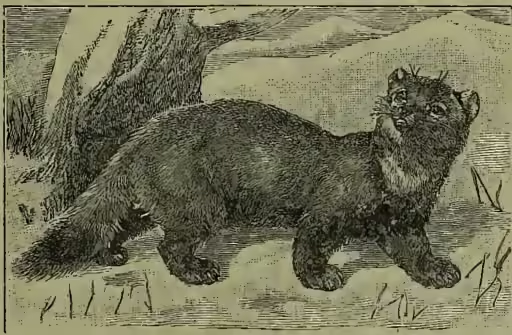
Sable (Martes zibellina), a species of Marten (q.v.), so nearly allied to the Common Marten and Pine Marten that it is difficult to state satisfactory specific distinctions. The feet are covered with fur, even on the soles, and the tail is perhaps more bushy than in the British martens. The length, exclusive of the tail, is about 18 inches. The fur is brown, grayish yellow on the throat, and small grayish-yellow spots are scattered on the sides of the neck. The whole fur is extremely lustrous, and hence of the very highest value, an ordinary sable skin being worth £2 to £4, 10s., and one of the finest quality £28. The fur attains its highest perfection in the beginning of winter, and the pursuit of the sable at that season is one of the most difficult and adventurous of enterprises (see FURS). The sable is a native of Siberia, widely distributed over that country, and found in its coldest regions, at least wherever forests extend. The progress of geographical discovery in the eastern parts of Siberia has been much indebted to the expeditions of the hardy and daring sable-hunters, exploring new regions at the worst seasons of the year, and spending dreary months at a great distance from all human abodes. The sable is taken by traps, which are a kind of pitfall, it being necessary to avoid injury to the fur; or by tracking it through the snow to its hole, and placing a net over the mouth of the hole. It is a very wary animal, and not easily captured. It makes its nest in a hollow tree, or sometimes, it is said, by burrowing in the ground, and lines it with moss, leaves, and grass. From this it issues to prey on hares and smaller animals of almost any kind, its agility enabling it even to catch birds among the branches of trees. It is ready, when food is scarce, to eat the remains of an animal on which a larger beast of prey has feasted, and is said even to satisfy its hunger with berries in winter, when animal food is not to be had. The sable, although it inhabits high northern latitudes, does not, as so many arctic animals do, change to white in the winter. This is accounted for by its habit of hunting among the branches of trees, against the dark colour of which white would be conspicuous, and therefore disadvantageous.