Salisbury (New Sarum) and Old Sarum. Old Sarum (Sorbiendum) stood about a mile north of the present city of Salisbury. It now consists of a bare conical hill encircled with entrenchments, with a central mound—from Roman times a castle and a place of much importance. Here Canute died, and here William the Conqueror assembled the barons to renew their oath of fealty. In 1075 Bishop Herman removed the bishopric of the united sees of Ramsbury and Sherborne to Old Sarum, and began a cathedral, which was finished by his successor St Osmund, who established a chapter of secular canons and compiled the Use of Sarum, which was adopted throughout the greater part of England. The foundations of Old Sarum Cathedral are still to be traced in very dry seasons. It was in the form of a cross, 270 feet long by 70 feet wide, with a transept of 150 feet. Old Sarum returned two members to parliament until the passing of the Reform Bill, although at that time there had for many years been no inhabitants. Service was daily performed in a chapel until the Reformation, after which the place was entirely deserted. The desertion of Old Sarum and the foundation of Salisbury or New Sarum were due to the removal of the cathedral from the former place to the latter. The reasons for the change were the frequent disputes and collisions between the authorities of the castle and the cathedral, the exposed position of Old Sarum (the noise of the winds often drowning the voices of the officiating priests), and the want of water.
Salisbury or New Sarum is a cathedral city, the capital of Wiltshire, and a parliamentary and municipal borough. It stands in a valley near the confluence of the rivers Avon, Bourne, Wily, and Nadder, 84 miles WSW. of London. The plan of the city is very regular, it having been laid out as a whole at its foundation in rectangular plots. Water originally ran through most of the streets, but the streams were covered over after the visitation of the cholera in 1849. The removal from Old Sarum took place in 1220, when the foundations of the new cathedral (B.V.M.) were laid. The Lady Chapel was consecrated in 1225, and the whole building, after being rehallowed in 1258, finally dedicated in 1260. The cathedral consists of a nave of ten bays, choir, and Lady Chapel, with two aisles, and two transepts, each having a single aisle towards the east, the ground-plan being in the form of a double cross. The whole building is a perfect example of pure Early English style. The cloisters and the chapter-house were built about 1270, and the tower (Decorated) and the spire added about 1330. The spire is the highest in England (400 feet). It formed no part of the original design, and the effect of the addition became apparent in a dangerous settlement which took place within 100 years of its erection. Owing to this the spire leans inches towards the south. The cathedral suffered from a disastrous 'restoration' at the hands of James Wyatt (1782-91), when two 15th-century chapels, built by Bishop Beauchamp and Lord Hungerford, and two porches were destroyed, much painted glass removed, the tombs rearranged, and a lofty campanile standing apart from the cathedral pulled down. Much of the damage then done has been repaired in the restoration begun in 1863 under Sir Gilbert Scott, and continued under Mr Street and Sir Arthur Blomfield. There is a curious muniment-room over the vestry containing a copy of the Magna Charta of King John, said to be that handed to Longespée, Earl of Salisbury, who was one of his witnesses. The library, built about 1450, is over the east side of the cloisters, and contains about 5000 volumes and many valuable MSS. The outside measurements of the cathedral are: length 473 feet, width 111 feet; the height of the nave and choir inside is 81 feet. The cathedral stands apart from any other building in the midst of a beautiful Close of about half a square mile in extent, encircled by a wall, within which stand the Bishop's Palace, an irregular building begun by Bishop Richard Poore (circa 1220) and added to by many of his successors, the deanery and canons' houses, and many other picturesque buildings.
The parish churches are St Martin's, St Thomas of Canterbury, a handsome Perpendicular building of the 15th century, and St Edmund of Canterbury, formerly a collegiate church of secular canons.
The other most notable buildings are the council-house, where the assizes are held; the county hall; the infirmary; the 'Hall of John Hall' and Audley House, now the church-house of the diocese, two fine examples of 15th-century domestic architecture; the old George Inn (now a shop), where Pepys stayed; St Nicholas' Hospital; the market-house; the poultry-cross; and the Blackmore Museum, which contains one of the finest collections of prehistoric antiquities in England, the collection from America being probably unrivalled anywhere.
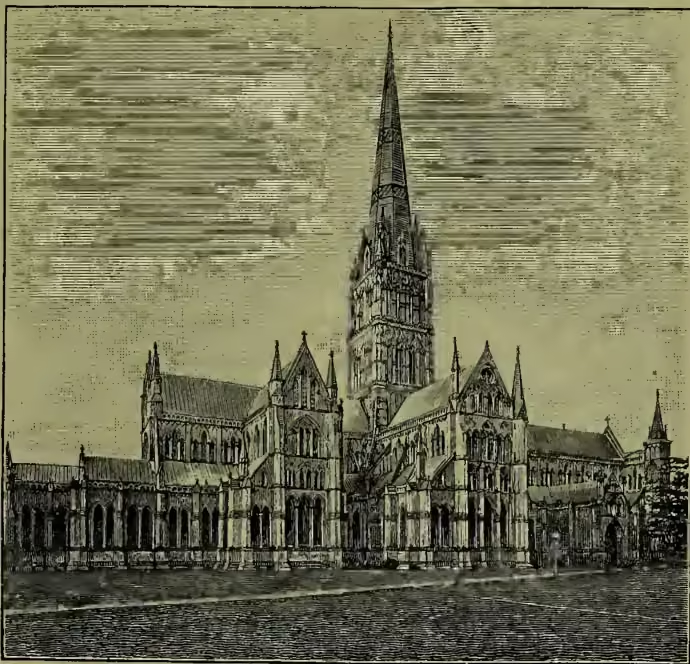
The market-place is spacious and planted with trees, and contains statues of the late Lord Herbert of Lea (Sidney Herbert) and Professor Fawcett, who was a native of the city. Here the Duke of Buckingham was beheaded in 1483 when Salisbury was the headquarters of Richard III. There are many charities and almshouses, and an endowed school for the choristers of the cathedral. The city chiefly depends upon its agricultural trade, the former manufactures of cutlery and woollens being extinct. Salisbury returns one member to parliament. Pop. (1851) 11,657; (1881) 14,792; (1891) 17,362.
John of Salisbury was the confidential adviser of Becket, and, sharing his exile, became (1176) bishop of Chartres. He wrote a Life of Becket, and a work, Polycraticus, in which he lashes the vices of the court. He died 1180.—Margaret, Countess of Salisbury, was the mother of Cardinal Pole (q.v.).—The most notable bishops of Old Sarum were St Osmund and Bishop Roger; of New Sarum, Hallam (whose death at the Council of Constance, 1417, is regarded by Dean Milman as fatal to many really effective reforms in the church), Cardinal Campeggio, Jewell, Seth Ward (a founder of the Royal Society), Burnet, Hoadley, Sherlock, Douglas, Burgess, Denison, Hamilton, and Moberly. Fox the martyrologist, Hooker, Fuller, Pearson, Isaac Barrow, Joseph Butler, and Liddon have been canons of the cathedral, where George Herbert was a frequent worshipper. Among distinguished natives and residents have been Massinger, William and Henry Lawes, Cliffinch (the chief agent in the intrigues of Charles II.), Harris the philologist, Chubb 'the Deist,' and Henry Fawcett. Fielding resided at one time in the Close, and Joseph Addison was educated at the grammar-school.
See Hatcher's History of Old and New Sarum, Britton's Salisbury Cathedral, Price's Salisbury Cathedral, Dodsworth's Salisbury Cathedral, Jones's Fasti Ecclesie Sarisburiensis, Gleeson White's Cathedral Church of Salisbury (1897). For plan of Cathedral, see Vol. V. p. 318.
SALISBURY PLAIN is an undulating tract of chalky down affording splendid pasture for sheep, with rich and well-timbered valleys. The high-lying land is too poor to repay cultivation. Of its many ancient mounds and barrows, the most notable is Stonehenge (q.v.). Salisbury Plain is one of the few places in England where the ancient sport of hawking is still pursued.