Stonehenge (Saxon Stanhengist, 'the hanging stones'), a circular group of gigantic standing stones on Salisbury Plain, about 2 miles from Amesbury in Wiltshire, situated in the midst of an extensive group of prehistoric barrows of the bronze age. The circle of stones, which is about 100 feet in diameter, occupies the central portion of an area of about 360 feet in diameter, enclosed within an earthen rampart and ditch. It consists of two concentric circles enclosing two ellipses, both open at the north-east end. The exterior circle, which is composed of pillar-stones of Tertiary sandstone, locally called 'sarsens,' set up at pretty regular intervals of about 4 feet apart, has been surmounted by a continuous line of imposts closely fitted to each other at the extremities, and having mortise-holes in their under sides, which receive tenons on the tops of the pillar-stones. The pillar-stones show generally about 13 feet of height above the ground, and the imposts are about 10 feet long, feet wide, and 2 feet 8 inches deep. Of this circle seventeen pillar-stones and six imposts retain their original position. About 9 feet within the exterior circle are the remains of a second circle of smaller undressed blocks or boulders of primitive rock, locally known as 'blue stones.' They are irregular in shape and height, and do not seem to have supported imposts, but few now remain standing, and their number and respective positions cannot be accurately determined. Within this inner circle, and separated from it by about the same distance, is an incomplete ellipse, nearly of horse-shoe form, with the open end facing the north-east, formed of five trilithons or groups of two immense pillar-stones supporting an impost. The central trilithon facing the open end of the ellipse is the largest, the pillar-stones being about 23 feet in height above ground, and the added height of the impost making the whole height of the trilithon nearly 28 feet. The dimensions of this trilithon given by Sir Henry James are: height of uprights out of ground, 22 feet 5 inches; breadth, 7 feet 6 inches; thickness, 4 feet; length of impost, 15 feet; breadth, 4 feet 6 inches; thickness, 3 feet 6 inches. The other four, which stood facing each other, two and two on opposite sides of the ellipse, are somewhat smaller. Only two are now perfect; the central one wants the impost, which fell in 1620, one of the pillars lies broken on the great stone, popularly called 'the altar stone,' and the other leans over, supported by one of the smaller stones in front of it. Of the two trilitrons on the west side of the ellipse, the one next the open end has only one pillar-stone standing, the other has fallen inwards with the impost, and both are broken; the other trilitron fell outwards in 1797, but the three stones, though prostrate, are still entire.
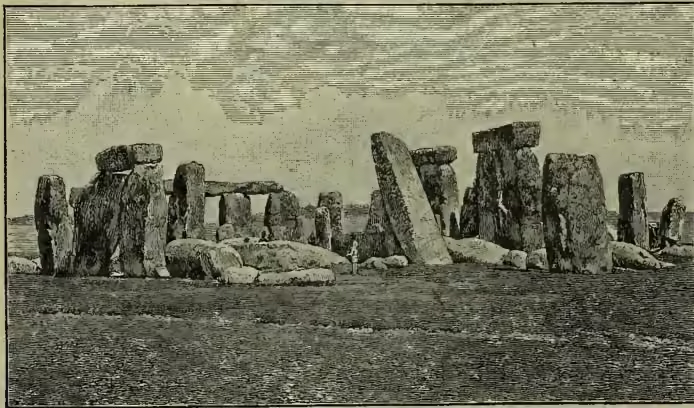
The trilitrons of the ellipse are of the same Tertiary sandstone as the pillar-stones and imposts of the exterior circle, and like them are partially tool-dressed. Within this ellipse is a smaller ellipse of the same form, but composed, like the second circle, of irregularly-shaped 'blue stones' without imposts, varying from 6 to 8 feet in height, and set at intervals of about 5 to 6 feet.
Though not mentioned by any Roman writer, or noticed by Gildas, Nennius, or Bede, Stonehenge comes into the cycle of British history in the 12th century, when it is chronicled by Henry of Huntingdon as one of the four wonders of England, the other three being merely natural phenomena. In the same century Geoffrey of Monmouth, in his Historia Britonum, attributes its erection to Aurelius Ambrosius, in commemoration of the British nobles treacherously slain by Hengist, and mentions that Aurelius himself was buried in it. Again, in recording the death of Constantine about the middle of the 6th century, he states that he was buried 'close by Uther Pendragon, within the structure of stones which was set up with wonderful art not far from Salisbury, and called in the English tongue Stonehenge.' Though Geoffrey's narrative is in the main mythical, it may be accepted as the earliest record of what was believed to be the purpose of Stonehenge. His story is repeated with little variation by all the mediæval writers to the time of Camden. He copied a drawing of it, signed 'R F 1575,' which (making every allowance for bad drawing) shows its outer circle much more complete than at present. Inigo Jones, in 1620, laments the disappearance of stones that were standing when he measured it. Stukely deplores the loss of the fallen stones carried away to make bridges, mill-dams, and the like. Aubrey mentions a large stone carried away within his remembrance to make a bridge. Though the area within the circle has never been systematically explored, flint flakes, fragments of rude pottery similar to the urns found in the neighbouring barrows, bones of oxen, and portions of stags' horns, have been found at various times in desultory excavations made in the hope of discovering some clue to the unknown purpose or uses of the structure. The theories propounded in modern times on these points have been many and various. It has been attributed to the Phoenicians, the Belgæ, the Druids, the Saxons, and the Danes. It has been called a temple of the sun, and of serpent-worship, a shrine of Buddha, a planetarium, a gigantic gallows on which defeated British leaders were solemnly hung in honour of Woden, a Gilgal where the national army met and leaders were buried, and a calendar in stone for measurement of the solar year. The opinion of Lord Avebury, expressed in his Prehistoric Times, is that there are satisfactory reasons for assigning it to the bronze age, though apparently it was not all erected at one time, the inner circle of small unwrought 'blue stones' being probably older than the rest. By most archaeologists it seems to be accepted as an exceptional development from the ordinary type of Stone Circles (q.v.), used as burial-places by the bronze-age people of Britain, though some regard its exceptional development as due rather to a religious influence than to the mere idea of the common commemoration of simple burial. Whatever its origin, it is the grandest megalithic monument in Britain. See books by Long (1876), Gidley (1877), and E. Barclay (1895).