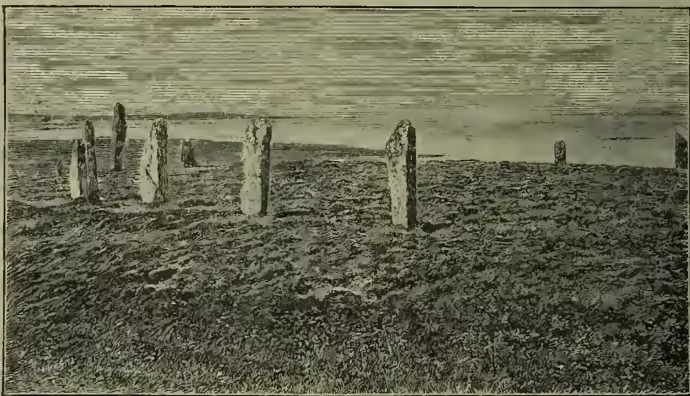
Stone Circles, or Circles of Standing Stones (q.v.), popularly, but erroneously, called Druidical Circles in Britain, Dom-rings or Thing-steads in Scandinavia, and known as Cromlechs in France, consist of unhewn stones set up at intervals round the circumference of a circular area usually of level ground, though they are sometimes found on the slightly sloping side of a hill. The area thus marked off from the surrounding ground varies in size from less than 20 to more than 100 feet in diameter. The number of stones composing the circle also varies greatly, but as most stone circles exist now in a condition of greater or less dilapidation it is often impossible to ascertain with certainty what the original number may have been. Sometimes they are mere boulders rolled into position, at other times they are pillar-stones, evidently chosen for their length, and wedged upright by smaller stones inserted round their bases in the cavity in the subsoil prepared for their reception. Sometimes there is a single circle only, at other times one or two smaller circles are contained con- centrically within the interior circle. Occasionally the area on which the circle stands is further marked off from the surrounding ground by a trench, or by a trench and rampart of earth surrounding the whole, except where a narrow pathway gives access to the interior on the original level. In the district of Scotland between the Dee and the Spey there are numerous examples of a special variety of stone circle distinguished by the presence of a great flat block placed on edge so as to fill one of the intervals between two of the upright pillars, usually on the south-west side of the circle. Circles of small boulder stones placed close together and scarcely showing above the turf are also found in many parts of Europe, indicating that the space thus enclosed has been reserved for burial deposits in prehistoric times. But the circles composed of large stones set at considerable intervals apart are linked with the burial customs of the builders of the chambered cairns of the stone age. A great circle of standing stones encircled the gigantic chambered cairn of New Grange in Ireland, and the smaller cairns of Clava in Strathnairn near Inverness are similarly encircled by pillar-stones. As a rule the cairns which covered the cremation interments of the bronze age are smaller than those of the preceding period, and the custom of placing the burnt bones in a cavity in the soil, covered only by an inverted urn of clay, dispensed with the cairn altogether, while it retained the circle of standing stones as a visible mark or fence of the grave-ground. In about twenty instances in which there has been systematic excavation of stone circles in Scotland the examination of the interior space has disclosed burials of the bronze age, mostly after cremation, but occasionally unburnt. The cremated remains were deposited with cinerary urns placed either in an inverted position over the burnt bones or upright and containing the burnt bones, at the bottom of a shallow pit excavated in the subsoil. These cinerary urns exhibit the forms and ornamentation characteristic of the age of bronze. Sometimes the burials have been placed in cists of unhewn slabs of stone, covered by small cairns of loose stones, underneath the surface level; at other times the burnt bones of many burials have been found placed in shallow cavities excavated in the soil of the interior area of the circle, near the bases of the upright stones. From these circumstances it is conclusively demonstrated that the common varieties of stone circles in Scotland are circular cemeteries of bronze-age burials. It may be that the greater circles, like those of Stennis, Avebury, and Stonehenge, may have had a different origin and purpose, but there is no evidence more conclu- sive than mere conjecture for the assumption of a different purpose for the larger circles, and the great size of the circle surrounding the immense chambered cairn of New Grange shows that a great circle was associated with sepulture.
The largest of the Scottish stone circles is that of Stennis in Orkney, standing on the slope of the hill overlooking the loch of that name about 4 miles NE. of Stromness. It is surrounded by a trench 30 feet wide and about 6 feet in depth, enclosing a total area of about acres. The trench is crossed by two accesses to the enclosed area on opposite sides of the circle, each 17 feet wide. The circle of pillar-stones stands 13 feet within the trench on a circumference of 340 feet in diameter. The original number of pillar-stones was probably sixty, of which only thirteen are now standing; ten are prostrate, and the stumps or fragments of thirteen more are still recognisable. The highest stone standing is 14 feet in height, and several of those now prostrate exceed 12 feet in length. The average distance between the stones is about 17 feet. A smaller circle, which seems, however, to have been composed of larger stones, stood about a mile to the south. Its whole interior area is raised about 3 feet above the surrounding level, and has had a circumcribing ditch, with a rampart on the inner side. Only two stones remain standing, and a somewhat larger one, now prostrate, is 19 feet long and 5 feet broad. It was near this circle that the perforated stone stood, through the aperture of which it was the custom in the 18th century for young men and women of the district to plight their troth by joining hands, a promise of marriage thus made being regarded with superstitious reverence as specially binding. The largest stone circle in England is that of Avebury (q.v.) in Wiltshire. This monument is apparently alluded to in a charter of King Athelstan, dated 939 A.D., where one of the boundaries is said to run 'from the road to Hackpen northward, up along the Stone Row, thence to the burying-places. Stonehenge (q.v.), the most famous of British stone circles, stands within a ditch and embankment enclosing an area of about 360 feet in diameter. It differs from other stone circles not only in its ground-plan, but in the pillar-stones of the exterior circle and the larger ellipse surmounted by imposts, mortised on tenons in the tops of the uprights, and also by the larger stones being thus at least partially tool-dressed. In Norway and Sweden the few stone circles systematically explored have been found to be burial-places of the iron age. They are usually simple circles composed of eight to thirteen stones; occasionally there are two concentric circles, one within the other, the inner circle being sometimes composed of small stones set close together in a ring. Sometimes there is a single pillar-stone in the centre of the circle. As a rule they are not remarkable either for the size of the circles themselves or for the massiveness of the stones of which they are composed. Circles of standing stones are rare to the south of the Baltic. In France they are comparatively few in number, and scarcely anything is yet known of their contents. In Algeria megalithic circular burial-places are not uncommon, but they do not correspond in general with those of northern Europe, being rarely composed of pillar-stones. Circles of pillar-stones, apparently of comparatively recent origin, have been found in northern India, and megalithic circles are stated to have been occasionally met with east of the Jordan, and in northern Arabia.
See Ferguson's Rude Stone Monuments (Lond. 1872); Anderson's Scotland in Pagan Times (Edin. 1886); Plans and Photographs of Stonehenge, by Sir Henry James (Southampton, 1867).